比熊犬 · the bilingual guide
比熊犬: the Bichon Frise for Chinese-Speaking Families
比熊犬 is simply the Chinese name for the Bichon Frise, the cheerful white cloud of a dog. Here is the bilingual guide for Chinese-speaking Singapore families: what the name means, why the breed suits 组屋 life, an English and 中文 glossary, and how to buy one honestly.
Nelson and Kim, Curious Tails · AVS licence AS24J00046
What is a 比熊犬, and is it the same as a Bichon Frise?
The Bichon Frise, or 比熊犬 in Chinese, is one of the most beloved small companions in Singapore. This is the bilingual guide for Chinese-speaking families: what the name 比熊 means, why the dog suits 组屋 (HDB) life, a full English and 中文 glossary, and how to buy one here honestly.
比熊犬 · the cheerful cloud, in two languages
比熊 or 比熊犬? What the name actually means
If you have arrived here after typing 比熊犬 into Google, welcome: you are looking for the same cheerful white dog that English speakers call the Bichon Frise. The two names are one breed. It is worth pausing on the Chinese name, though, because the characters carry a small and charming logic. 比熊 (bǐ xióng) is a phonetic rendering of the French word Bichon: say 比熊 aloud and you can hear ‘Bichon’ hiding inside it. The final character, 犬 (quǎn), simply means dog. So 比熊犬 reads, quite literally, as ‘Bichon dog’.
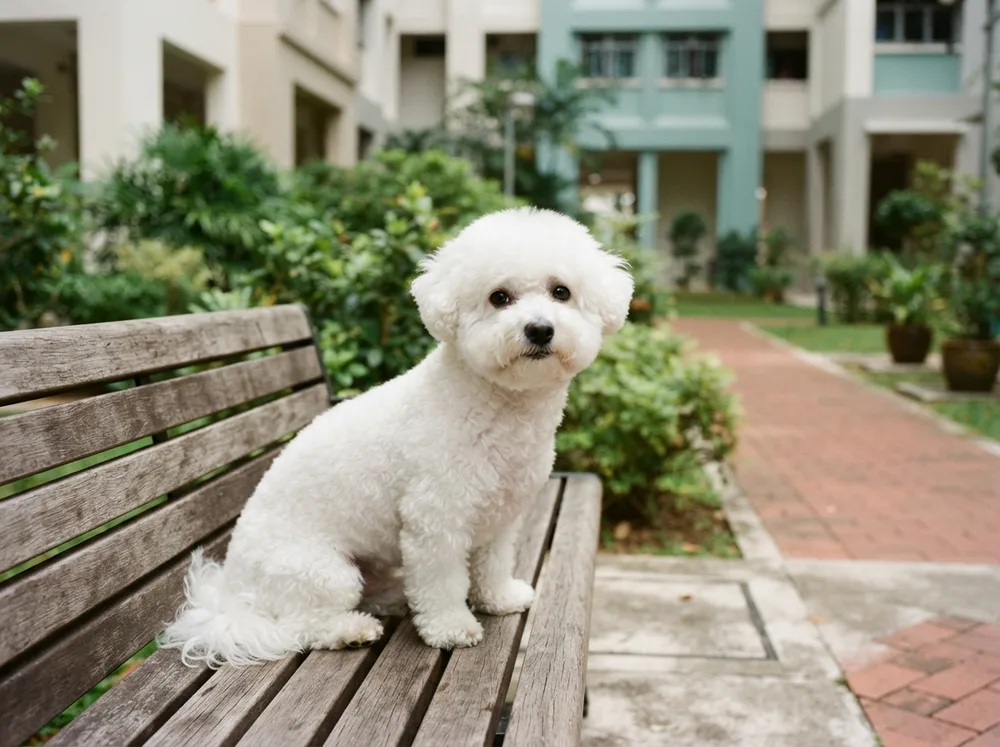
There is a happy accident in the middle. The character 熊 on its own means bear, and anyone who has watched a white 比熊 bounce across a void deck in its rounded teddy-bear cut will agree the name suits it perfectly: a small, soft, cloud-shaped little bear of a dog. Many Chinese-speaking families in Singapore meet the dog as a 比熊 first and only later go looking for its English name, which is exactly why 比熊犬英文 (the English for 比熊犬) is one of the most searched Bichon questions in the country. The short answer, so you can stop searching: 比熊 is Bichon, 犬 is dog, and it is all the same happy breed.
比熊 renders the French ‘Bichon’; 犬 simply means dog. The middle character 熊 means bear, and a 比熊犬 in a teddy-bear cut looks exactly like a small white one.
Where the 比熊犬 comes from, and why it is not a 泰迪
So where does the 比熊犬 actually come from? The breed’s story is European and old. Long before the dog ever reached a Singapore flat, small white companion dogs of the bichon family were kept around the Mediterranean and on Tenerife in the Canary Islands, then shaped into the modern Bichon Frise we know through generations of careful breeding in France and Belgium. That heritage is why the full name is French: Bichon à poil frisé, which means roughly ‘bichon with the curly coat’. What matters for a family choosing one today is simple: this is a companion breed to its curly bones, developed over centuries to be close to people rather than to work or to guard.
One mix-up deserves a plain answer, because Chinese-speaking buyers ask it constantly: a 比熊犬 is not a 泰迪 (the popular nickname for a small Poodle) and not a 贵宾 (Poodle). In a fresh teddy-bear cut the two can look like cousins, but they are separate breeds with separate breed lines. A purebred Bichon, a 纯种比熊犬, is white, carries a soft curly double coat, and has the round black eyes and black nose the breed standard asks for. If a seller shows you a brown, grey or ‘rare-coloured’ 比熊, or a ‘teacup’ size, you are almost certainly looking at a cross or a mislabel. Our English price guide explains what is genuinely normal and what should send you walking.
Why the 比熊犬 suits Chinese-speaking Singapore families
For families in Singapore, and especially for multi-generation homes where grandparents, parents and children share one flat, the 比熊犬 is a genuinely sensible choice rather than only a pretty one. Start with where most of us live. The Bichon is HDB-approved, item 4 on the official list of 62 breeds, so a family in a 组屋 can keep one without any special appeal. At roughly 5 to 8kg it reads a flat as a generous home rather than a cage, walks well in a lift, and tucks happily under a hawker-centre table.
Then there is the coat, which is the quiet clincher for shared flat air. The Bichon is a genuinely low-shedding breed: its curly coat traps loose hair instead of dropping it around the living room, so a home where everyone breathes the same air stays cleaner than a shedding breed would allow. We say low-shedding and 不太掉毛, never ‘no shedding’, because the hair is caught, not eliminated. Finally, the temperament: the Bichon is one of the sunniest, gentlest, most people-focused dogs on the whole approved list, patient with an elderly parent’s slow morning and forgiving of a child’s clumsy cuddle. It asks for company more than it asks for space, which is precisely what a close Singapore household has to give.
Why a 组屋 suits the 比熊
- HDB-approved: item 4 of 62 breeds (组屋批准)
- Small and flat-sized: about 5 to 8kg
- Low-shedding coat for shared air (不太掉毛)
- Gentle temperament, good with 老人 and 小孩
- People-focused: wants company, not a garden
- One dog per flat, licensed with AVS
A bilingual 比熊犬 glossary for the shop visit
Here is the part to screenshot before you visit a shop or a vet. Most of the pet trade in Singapore runs in English, so a family that thinks about the dog in Chinese sometimes hits a small wall of vocabulary at exactly the wrong moment. This table lines up the words you will actually need, the breed, the coat, grooming, the 组屋 rules, health and price, in English and 中文, so nobody has to fumble for a term while standing at the counter with a 幼犬 in their arms.
| English | 中文 (pinyin) | What to know |
|---|---|---|
| Bichon Frise | 比熊犬 (bǐ xióng quǎn) | 比熊 is ‘Bichon’, 犬 is ‘dog’. |
| Purebred | 纯种 (chún zhǒng) | A real Bichon is white and curly-coated. |
| Puppy | 幼犬 / 宝宝 (yòu quǎn) | Goes home around week 9 with us. |
| Coat / low-shedding | 被毛 / 不太掉毛 (diào máo) | 掉毛 means shedding; the Bichon does little of it. |
| Grooming | 美容 (měi róng) | A full groom every 4 to 6 weeks, for life. |
| Teddy-bear cut | 泰迪造型 (tài dí zào xíng) | The rounded pet trim most SG Bichons wear. |
| HDB flat | 组屋 (zǔ wū) | The Bichon is HDB-approved, item 4 of 62. |
| Vaccination | 疫苗 (yì miáo) | Core jabs at weeks 6, 8 and 12. |
| Sterilised | 绝育 (jué yù) | Lowers the dog licence fee sharply. |
| Microchip | 芯片 (xīn piàn) | Required, and tied to the AVS licence. |
| AVS licence | 准证 / 狗证 (zhǔn zhèng) | Every Singapore dog must be licensed with AVS. |
| Price | 价格 (jià gé) | Our all-in band is published, not hidden. |
The honest truth on shedding, allergies and 美容 (grooming)
Two honest notes matter more than any sales line, and we would rather you hear them from us. First, allergies. You may see the Bichon Frise described online, even in Google’s own breed panel, as ‘hypoallergenic’. We will not use that word, because no dog truly is. What is genuinely true is that the Bichon is low-shedding: its coat traps dander and loose hair rather than scattering them, which many allergy-prone families tolerate far better. The only honest test is your own nose, so an allergy household should sit with a 比熊 for a good while before deciding. Our English shedding and allergy guide tells that whole story straight.
Second, grooming, or 美容. That same curly, low-shedding coat is a commitment, not a free gift. Because the dead hair stays in the coat instead of falling out, it will mat if it is neglected, so a 比熊犬 needs brushing at home most days and a professional groom every 4 to 6 weeks for its whole life. In Singapore that is real money, usually 70 to 120 dollars a session, and over a 12 to 15 year life it adds up to more than the puppy itself. We would rather say so now than have you discover it later. Our grooming guide names local salons and price ranges.
‘Hypoallergenic’ is a myth, even in Google’s panel
No dog is truly hypoallergenic, whatever a breed panel says. The 比熊犬 is honestly low-shedding (不太掉毛), which is a real benefit for shared 组屋 air, but the curly coat traps dander rather than removing it. If anyone at home has allergies, sit with a 比熊 before you commit; a reaction usually shows within the visit.
Buying a 比熊犬 in Singapore: our all-in price
When you are ready to bring a 比熊犬 home, here is how it works with us, in plain terms. Curious Tails is an AVS-licensed pet shop at 2 Balestier Road #01-701, and our Bichon puppies are $3,500–$6,000 all-in. That band is published on purpose, because the Singapore (新加坡) market is full of teaser prices, a tiny headline figure with the real cost hidden behind a ‘WhatsApp for price’ button. All-in means the price you see already includes the vet health check, 疫苗 (vaccinations), 芯片 (microchip), the 30-item starter kit, free delivery, a first training lesson and the AVS licence filed for you. Nothing is added at the door. The full breakdown lives on our price guide, and today’s available puppies are refreshed weekly by Nelson and Kim.
You are warmly welcome to message us in English or in Chinese, whichever is easier. WhatsApp us at +65 8220 6408, tell us your housing type and whether anyone at home has allergies, and we will reply honestly, in the language you wrote in, with photos of the 比熊 puppies here this week. There is no pressure and no deposit for a dog you have not met. Come to the shop, sit on the floor with a 幼犬, and see whether the match is right before any money changes hands.
$3,500–$6,000
all-in, published (价格)
30+
Bichons placed in Singapore
HDB ✓
item 4 on the 组屋 list
Week 9
homing, fully health-checked
The 组屋 (HDB) rules in brief
Because it is the first question nearly every Singapore family asks, here is the 组屋 answer in one breath: yes, the 比熊犬 is HDB-approved. It sits at item 4 on the official list of 62 approved breeds, so there is no appeal to file and no size waiver to beg for. The rules that ride along are short and sensible: one dog per flat, counted per household; the dog licensed with AVS; and a breach of the one-dog rule can draw a fine of up to 4,000 dollars. One properly licensed 比熊 is always comfortably inside the lines.
That is the whole bilingual picture: a beloved Bichon Frise, a 比熊犬 by any name, that is built for Singapore flat life and welcome in a 组屋. If you would like the HDB rules in full, including the 2024 update that now allows cats alongside one approved dog, our HDB guide lays it all out. And whenever you are ready, in English or in Chinese, we are here to help you meet one.
Keep exploring
Frequently asked questions
What does 比熊犬 mean, and what is it in English?
比熊犬 is the Chinese name for the Bichon Frise, the small white companion dog. 比熊 (bǐ xióng) is a phonetic rendering of the French word ‘Bichon’, and 犬 means ‘dog’, so 比熊犬 reads literally as ‘Bichon dog’. The middle character 熊 means bear, which suits a fluffy white dog in a teddy-bear cut. The Chinese and English names refer to exactly the same breed.
比熊犬和泰迪、贵宾有什么区别? (How is a Bichon different from a Poodle or teddy?)
A 比熊犬 (Bichon Frise) is a separate breed from the 贵宾 (Poodle), even though a 泰迪 (the nickname for a small Poodle in a teddy cut) can look similar. They have different breed lines. A purebred Bichon, a 纯种比熊犬, is white with a soft curly double coat and round black eyes; if a ‘比熊’ is brown, grey or sold as a ‘teacup’, it is very likely a cross or a mislabel.
Are Bichon Frises (比熊犬) HDB-approved in Singapore?
Yes. The Bichon Frise is HDB-approved, item 4 on the official list of 62 breeds, so a family in a 组屋 can keep one with no special appeal. The rules are simple: one dog per flat, licensed with AVS, with a fine of up to 4,000 dollars for a breach. Our HDB guide covers the full rules, including the 2024 cat update.
比熊犬多少钱一只? (How much is a Bichon Frise puppy in Singapore?)
Our Bichon Frise puppies are $3,500–$6,000 all-in, a band we publish rather than hide behind a ‘WhatsApp for price’ button. All-in means the vet health check, vaccinations (疫苗), microchip, a 30-item starter kit, free delivery, a first training lesson and the AVS licence are already included. The full itemised breakdown is on our price guide.
比熊犬掉毛吗?会引起过敏吗? (Do Bichons shed, and are they hypoallergenic?)
A 比熊犬 is low-shedding (不太掉毛): its curly coat traps loose hair instead of dropping it. But no dog is truly hypoallergenic, whatever an online breed panel says, so we never promise that. The coat traps dander rather than removing it. If anyone at home has allergies, sit with a 比熊 for a while first, because a reaction usually shows within the visit.
比熊犬需要多久美容一次? (How often does a Bichon need grooming?)
A Bichon needs a professional groom (美容) every 4 to 6 weeks for its whole life, plus brushing at home most days, because the low-shedding coat mats if it is neglected. In Singapore a full groom is usually 70 to 120 dollars a session. It is the single biggest ongoing cost of owning a 比熊犬, which is why we mention it before a sale, not after. Our grooming guide names local salons.
Meet your Bichon
Come say hello at Balestier
2 Balestier Road #01-701, Singapore 320002 · Weekdays 12pm–6pm · Weekends 10am–6pm. Or message us first: tell us about your home and routine, and we'll tell you honestly if a Bichon fits.
Ready to meet a 比熊犬?
Tell us your flat type and household on WhatsApp, in English or Chinese, and we will send this week’s photos of the 比熊 puppies at our Balestier shop, honestly and with no pressure.
See available puppies