The signature commitment
Bichon Frise Grooming: the Real Commitment
The cloud coat is a contract: brushing most days, a salon groom every 4 to 6 weeks for life, and a coat-change window nobody warns you about. Here is the whole deal, priced in Singapore dollars, told before you buy.
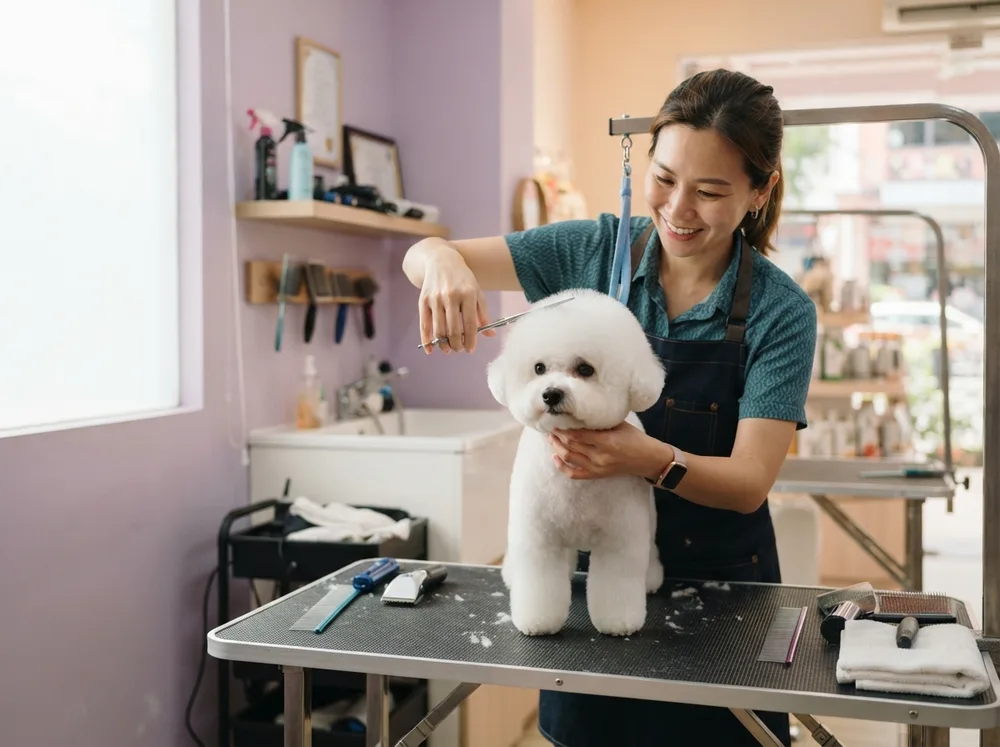
Bichon Frise puppies
From $3,500, all-in
Groomed every 4 to 6 weeks · for life
How much grooming does a Bichon Frise really need?
A professional full groom every 4 to 6 weeks for life, plus line brushing at home daily or every other day. The curly double coat sheds hair inward instead of onto your floor, and trapped hair mats unless a brush removes it. In Singapore a small-breed full groom commonly costs $60–$90, so budget roughly $700–$1,200 a year.
Why this coat mats: the shed hair never leaves
Every breed page on the internet tells you the Bichon Frise is low-shedding. Almost none of them finishes the sentence. The Bichon sheds like any other dog, hair loosens and releases from the skin on a normal cycle, but the breed’s curly double coat catches that hair before it ever reaches your floor. A plush, soft undercoat sits beneath an outer layer of coarser, springy curls, and the curls act like a net. Shed hair does not fall out of a Bichon. It sheds into the coat, and it stays there.
That is the whole trade, stated plainly. The hair your sofa never sees is hair your brush must remove instead, and if the brush does not come, the trapped hair tangles with the living coat and felts into mats. Matting is not a cosmetic issue. A mat starts loose and shrinks as it collects more hair, tightening toward the skin until it pinches with every step, hides moisture and grit against the body, and eventually can only be clipped out. The famous white cloud and the grooming commitment are the same fact wearing two outfits, which is also the honest version of the allergy story: the coat that traps hair also traps dander, which is why the breed suits many allergy households, though no dog is hypoallergenic and we never claim otherwise. The full science is in our shedding and allergy guide.
We are a pet shop, not a grooming salon, and this page exists because the Bichons we see fail in Singapore homes almost never fail on temperament. They fail on coat care that nobody priced in. So we price it in, out loud, before you buy.
The cadence: 4 to 6 weeks, forever, and how to brush between
Here is the commitment in one line: a professional full groom every 4 to 6 weeks, for life, and brushing at home daily or every other day, forever. Not until the puppy grows up, not until the coat settles. A Bichon lives 14 to 15 years, and the cadence never retires.
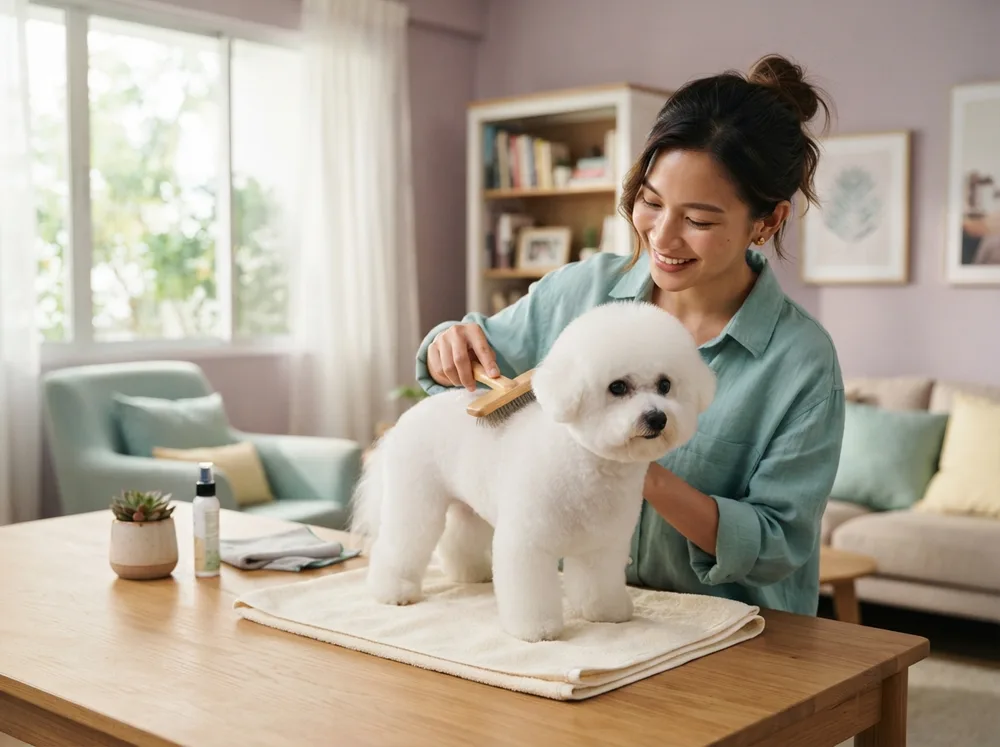
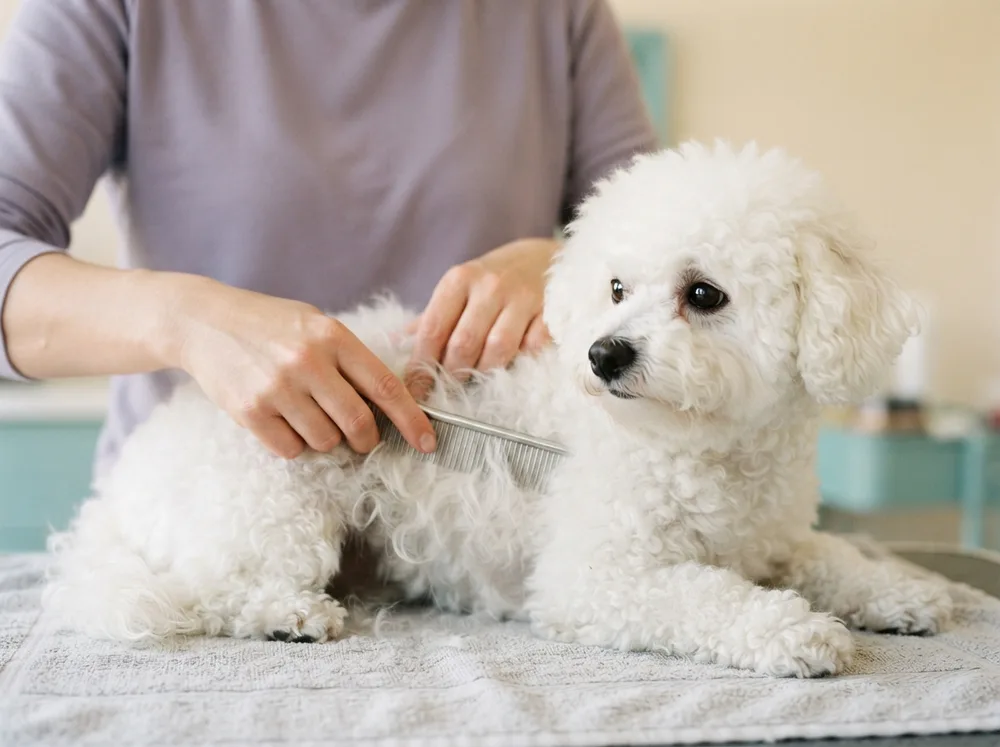
The home brushing has a technique, and the technique matters more than the tool. It is called line brushing: part the coat with your fingers or a metal comb down to visible skin, brush the exposed line outward from the skin with a slicker brush, then move the parting a centimetre and repeat, working across the body in rows. Surface brushing, the quick once-over most new owners do, fluffs the top curls and leaves the trapped shed hair exactly where it was, felting quietly at the roots. A coat can look immaculate on top and be one week from a shave-down underneath. The comb is your audit: if it glides to the skin everywhere, you are winning; where it snags, you have found tomorrow’s mat while it is still five minutes of work instead of a surcharge.
Ten to fifteen minutes a day is the honest budget, a little longer on the day you do the full body in rows. Owners who start in puppyhood, brush on a table, and end every session with a treat get a dog that treats the slicker like affection. Our matting SOS guide covers what to do when the comb finds trouble anyway.
What the salon costs in Singapore, with names
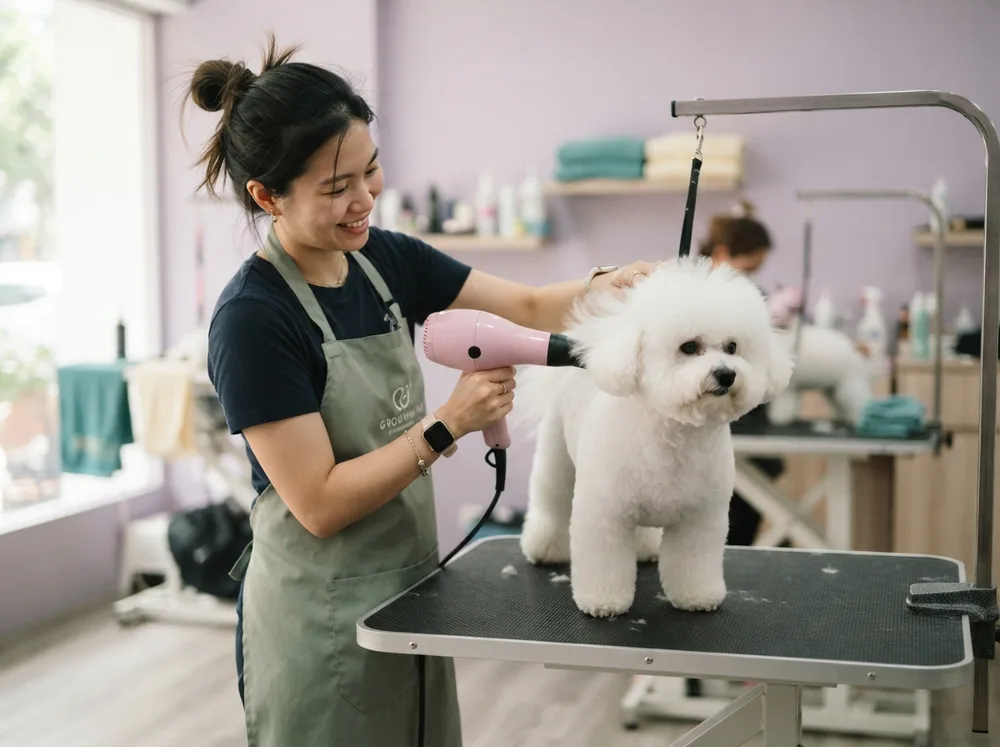
The salon visit is not outsourced laziness, it is skilled work you cannot fully replicate at home: a proper bath, a thorough blow dry that straightens the curl so scissors can cut it evenly, the trim itself, nails, ear care and a sanitary tidy. A full groom for a small breed takes one to two hours. In Singapore, the going full groom price for a Bichon-sized dog commonly lands between $60 and $90 per session, with large budget chains starting around $50 and premium or mobile services quoting above the band. Dematting, if the coat needs it, is almost always charged on top and by the hour, which is the financial argument for line brushing in one sentence.
Names, because a vague "find a good groomer" helps nobody. Fluffy Furries (fluffyfurries.sg, 5.0 stars across 89 Google reviews) grooms Bichons regularly and shows the work publicly. Pawpy Kisses (pawpykisses.com, 4.9 stars across 679 reviews) is one of the most-reviewed salons in the country. Likeable Pets (likeablepets.com.sg, 5.0 stars across 506 reviews) is a mobile dog groomer Singapore owners use when travel stresses the dog; a full groom runs one to two hours at your home, with quotes given by phone. We have no commercial arrangement with any of them, and prices move, so confirm the current rate when you book. The full market survey lives in our grooming price guide.
One habit separates the owners who cruise from the owners who struggle: book the next appointment before you leave the salon. A standing 5-week slot removes the drift that turns 4 to 6 weeks into 9, and 9 weeks is where dematting bills and shave-downs live.
The coat-change window: months 9 to 16, and the panic shave
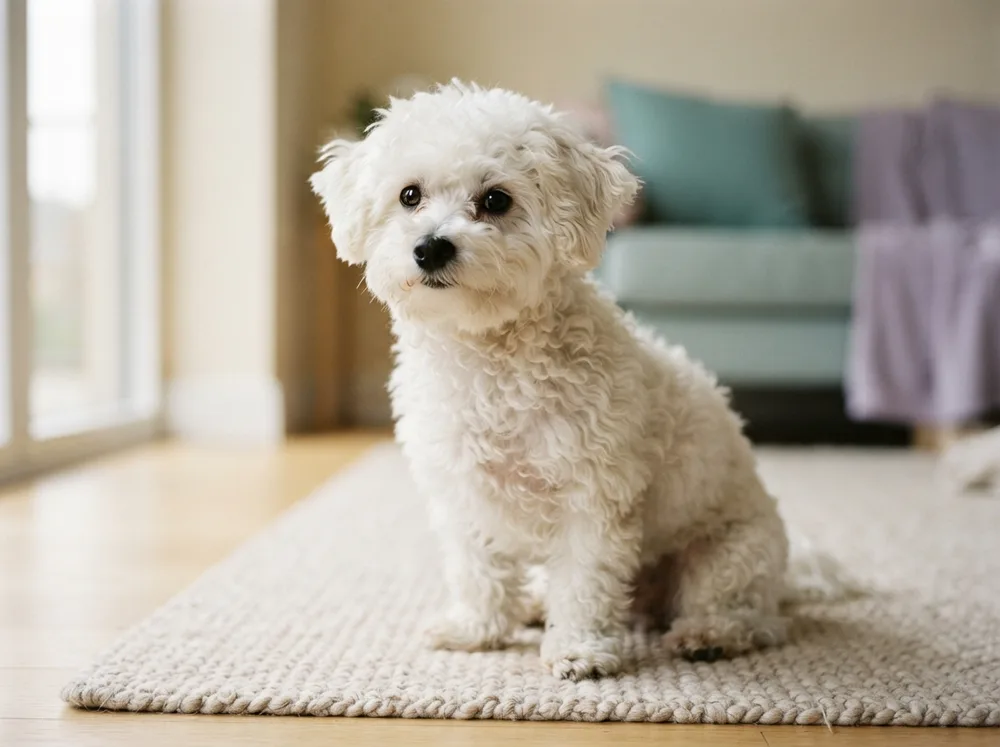
Somewhere around 9 to 16 months, the soft single-texture puppy fluff gives way to the adult double coat, and for several months both coats occupy the same dog. The incoming adult curl tangles with the outgoing puppy hair, and matting accelerates beyond anything the first year prepared you for. Owners who brushed twice a week and got away with it suddenly find felt behind the ears, under the collar, in the armpits, seemingly overnight. This is the puppy coat change, it is normal, and it is the single most common moment for a first-time Bichon owner to panic.
The panic has a name in grooming circles: the panic shave. An overwhelmed owner, a matted adolescent, and a clipper set to the skin. Here is our honest position, because both extremes online are wrong. A shave down is not animal cruelty, and when a coat has felted close to the skin it is genuinely the kind choice: hours of dematting on a squirming adolescent is more distressing and more painful than starting the coat again, and any ethical groomer will tell you the same before they pick up the clipper. The coat regrows in a few months, usually without drama. What a shave-down is, is a signal: the routine that led there will lead there again unless something changes.
The better plan is to see the window coming. From month 8 or so, tighten the salon cadence toward every 4 weeks, upgrade brushing to daily line brushing without exceptions, and let your groomer take the coat shorter through the transition so there is simply less length to felt. Every buyer of ours hears about this window before they reserve a puppy, and our coat change survival guide walks through it month by month.
Teddy bear cut or show coat: the honest choice
Photographs of show Bichons sell a lot of puppies, so let us be honest about the powder puff. The show coat, that immaculate rounded sphere of scissored white, is a competition artefact. It demands coat length a pet owner has no reason to carry, daily maintenance measured in hours, and scissoring skill measured in years. Outside the ring, almost nobody keeps one, and nobody should feel they failed the breed for choosing otherwise.
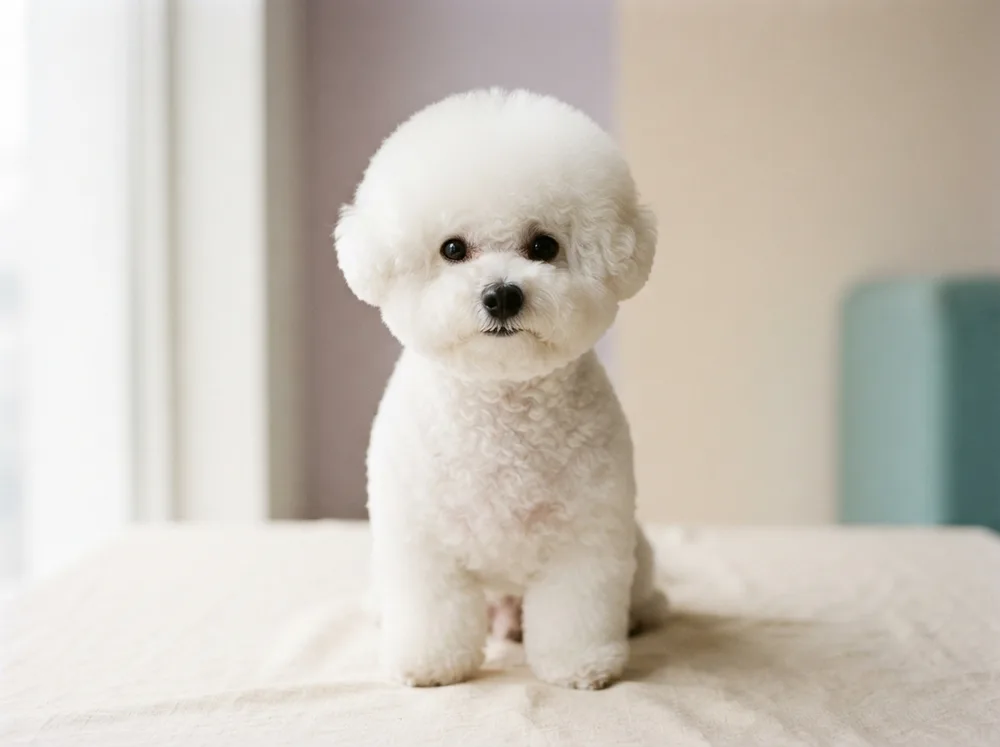
What your Bichon will actually wear is the teddy bear cut: a plush, even length over the body with a rounded head and face, the look that made the breed famous on this side of the internet. It keeps the cloud, keeps the dark eyes and black nose framed in white, and cuts the daily workload to something a working household can sustain. Shorter still is a puppy cut for the humid months. What none of them change is the cadence: a short coat mats more slowly, but the undercoat is still there, the curls still trap shed hair, and the 4 to 6 week rhythm still applies. The cut sets the difficulty level; it does not switch off the game.
The Singapore variable: humidity, damp coats and hotspots
Grooming advice written for temperate countries misses the variable that dominates coat care here: humidity. A damp curly coat mats dramatically faster than a dry one, because moisture tightens the curl and shrinks forming tangles toward the skin. Singapore keeps a Bichon damp constantly, rain-season walks, wet grass at the park, the sweaty microclimate under a harness, the condensation swing between 32-degree afternoons and air-conditioned rooms.
Dampness also opens the door to hotspots, patches of moist, inflamed, rapidly worsening skin that flourish in exactly the conditions a mat creates: trapped moisture, no airflow, warmth. A mat over damp skin in this climate is a hotspot waiting for a weekend. So the tropical rules, the ones temperate websites never print: after any wet walk, towel firmly and then dry fully to the skin, a cool-setting dryer beats air-drying every time; never crate or bed a damp Bichon; check the classic damp zones, armpits, groin, under the ears, behind the harness straps, during every brushing session; and keep walks in the early and late windows so the dog sweats the harness less in the first place. Ten extra minutes with a towel and dryer after a rainy walk saves more coat than any product on the shelf.

The kit, and the yearly bill, added up before you buy
The counter at a pet shop groans with grooming products, most of them optional. The grooming kit that actually earns its place in a Bichon home is short: a quality slicker brush, the everyday tool; a metal comb with fine and coarse ends, the auditor that finds what the slicker missed; a detangling spray, because brushing a bone-dry curly coat breaks hair; blunt-tip scissors for the corner-of-eye tidy between salon visits; a proper absorbent towel and, honestly, a pet dryer, which in this climate pays for itself; plus tear-stain wipes and ear powder for the small routines. Budget roughly $80 to $150 once, then replacements every couple of years. Skip the cheap slicker with pinless heads and the "self-cleaning" gimmicks; buy one good brush instead of three poor ones.
Now the arithmetic nobody prints before the sale. At every 4 to 6 weeks you will book 9 to 13 grooms a year. At the common Singapore band of $60 to $90 a session, that is roughly $700 to $1,200 a year, before the odd dematting surcharge, the kit, and the extra grooms the coat-change year demands. Across a 14 to 15 year life, grooming alone approaches or passes what you paid for the puppy. We publish that number in the same breath as the price band because a Bichon surrendered at month ten with a felted coat is the exact failure this site exists to prevent. If the grooming line fits your budget, this breed will repay it with fourteen years of comedy. If it does not, we would rather tell you now, warmly, than meet the dog again in a rehoming post. Still in? Come and meet the puppies currently in the shop, and we will talk cadence before we talk reservation.
Frequently asked questions
How often does a Bichon Frise need grooming?
A professional full groom every 4 to 6 weeks, for the whole of the dog’s life, plus brushing at home daily or every other day. This is not a premium option, it is the baseline the coat demands. Stretch the cadence and matting starts, and mats hurt.
How much does bichon grooming cost in Singapore?
For a small breed like the Bichon, a full groom in Singapore commonly runs $60 to $90 per session, with budget chains starting around $50 and mobile or premium services quoting higher. Dematting is usually charged on top. Over a year at the 4 to 6 week cadence, budget roughly $700 to $1,200.
Why does a Bichon coat mat so easily?
Because the Bichon barely sheds outward. Loose hair releases from the skin like any dog’s, but the curly outer coat catches it before it falls, so shed hair stays trapped against the soft undercoat. Left unbrushed, that trapped hair felts into mats that tighten against the skin.
What is the puppy coat change?
Between roughly 9 and 16 months the soft puppy coat is replaced by the adult double coat, and for those months both coat types are present at once. Mats form faster than at any other point in the dog’s life. Plan tighter salon intervals and more diligent line brushing through the window.
Is shaving a Bichon Frise cruel?
A planned shave-down by a groomer is not cruel, and when a coat is felted to the skin it is the kind choice, because hours of dematting hurt more than starting again. What fails the dog is the neglect that made shaving the only option. The coat regrows in a few months; keep the cadence and you will not face the choice twice.
What is a teddy bear cut?
A pet trim that keeps the coat at a plush, even length with a rounded head and face. It is shorter and vastly easier to maintain than the powder-puff show coat, and it is what nearly every pet Bichon in Singapore wears. It reduces the workload; it does not remove the 4 to 6 week cadence.
Can I skip the salon and groom at home?
You can and should do the brushing at home, but the full groom is genuinely skilled work: bath, thorough blow dry, scissor finishing, nails, ears, sanitary trim. Most owners who try to replace the salon entirely end up at the salon anyway, with a matted coat and a dematting surcharge.
Does Singapore humidity make grooming harder?
Yes. A damp coat mats faster than a dry one, and our rain season keeps coats damp. Humidity also raises the risk of hotspots, moist irritated patches that flourish under mats. The rule is simple: after wet walks, towel then dry fully to the skin, never leave a Bichon damp.
Are Bichons high maintenance?
On the coat, yes. Because the curly double coat traps shed hair instead of dropping it, that hair mats unless it is managed, so plan a full groom every 4 to 6 weeks plus brushing most days, for life, at roughly $700 to $1,200 a year. On exercise, diet and space they are easy.
Meet your Bichon
Come say hello at Balestier
2 Balestier Road #01-701, Singapore 320002 · Weekdays 12pm–6pm · Weekends 10am–6pm. Or message us first: tell us about your home and routine, and we'll tell you honestly if a Bichon fits.
Doing the maths on the allergy side too?
The same coat that needs all this grooming is the one that traps dander instead of scattering it. Read the honest shedding and allergy guide next.
Read the allergy guide