Coat matting SOS
What to Do When Your Bichon Coat Mats
A matted Bichon is not an emergency and not a verdict on your grooming. Here is the calm version: how to work a small mat out safely, the one rule you must never break, and the moment to hand it to a groomer.
Nelson and Kim, Curious Tails · AVS licence AS24J00046
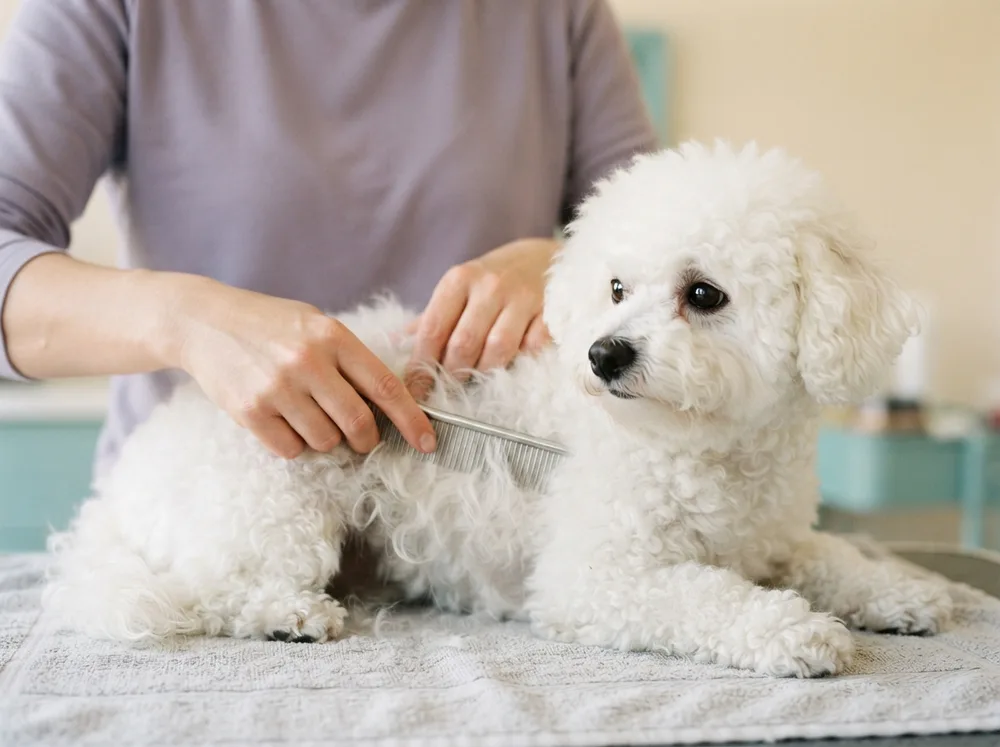
What should I do when my Bichon coat mats?
Work a small mat gently: mist it with detangling spray, tease it apart with your fingers, then a metal comb from the tip inward, never yanking. Stop and let a groomer clip out anything felted to the skin. The one hard rule: never bathe a matted coat, because water and heat only tighten the mat against the skin.
Mat rescue, without hurting the dog
Why a Bichon coat mats, and why a mat is never just cosmetic
The reason a Bichon mats so readily is the same reason the breed barely sheds onto your floor. Loose hair releases from the skin on the normal cycle, but the curly double coat catches it before it can fall: springy outer curls sit over a soft undercoat, and together they work like a net. The shed hair has nowhere to go, so it stays woven into the living coat. Leave it a few days without a brush and that trapped hair twists together and felts into a mat. Understanding bichon matting starts right there, with a coat that is doing exactly what it was bred to do, which is also the honest trade behind the famous white cloud we spell out in full on the grooming commitment guide.
A mat is not a cosmetic problem, and this is the part first-time owners underestimate. A mat starts loose and shrinks as it gathers more hair, tightening toward the body until it begins to pinch the skin with every step. It traps moisture and grit against the skin, seals off airflow, and can hide a scratch, a tick or a patch of sore skin until it is badly inflamed. Vets are blunt about it: matted fur pulls constantly on the skin, restricts movement and is genuinely painful. A field of tight mats is a welfare issue wearing a fluffy disguise, which is why matted dog hair is worth taking seriously the day you feel the first one, not the week it becomes a shave.
Mats do not appear evenly. On a Bichon they form first exactly where coat rubs coat and damp lingers: behind the ears and under the beard, in the armpits and groin, along the collar line and behind the harness straps. Those are the spots your fingers should check first, every single time you brush.
Where Bichon mats form first
- Behind the ears and under the beard
- Armpits and groin, where legs rub the body
- Along the collar and behind harness straps
- Curly double coat traps shed hair in the undercoat
- A tight mat pinches the skin and traps moisture
- Left alone, a mat can only be clipped out
The one rule that saves coats and skin: never wet a mat
Before any technique, learn the rule that ruins more Bichon coats than laziness ever does: never bathe a matted coat. Water is not a shortcut through a tangle, it is the opposite. A wet mat shrinks and tightens, and a curly coat kinks harder as it dries, so a bath drives every existing mat closer to the skin and locks it there. Heat finishes the job, which is why you also never point a hot dryer straight at a mat. The order is always the same: get the mats out while the coat is bone dry, and only then bathe and dry the clean coat properly.
This matters twice over in Singapore. A mat sitting over damp skin in our humidity is a hotspot waiting for the weekend: trapped moisture, no airflow, warmth, and within a day or two an angry, weeping patch of skin underneath. So if your Bichon comes home wet and you find a mat, dry the rest of the coat to the skin and work the mat dry. Do not soak the dog to soften it, and do not leave a damp mat sitting against the skin overnight.
Never bathe, wet or blow-dry a matted coat
Water and heat both shrink a mat tighter against the skin, and a mat over damp skin in Singapore humidity can become a hotspot within a day or two. Always remove mats from a dry coat first, then bathe. If the skin under a mat is already red, warm or weeping, skip the DIY and see a groomer or vet.
Triage first: a tangle, a tight mat, or felted to the skin?
Not every knot is an emergency, and not every mat is a home job. Before you reach for a comb, spend thirty seconds deciding which of three things you are actually looking at, because the honest answer decides whether you help or hurt. Slide a metal comb gently toward the skin: where it glides through, you are fine; where it stops, you have found the problem, and how it stops tells you what to do next.
The rule of thumb is kind to both of you. If a mat lifts clear of the skin and eases with patient work, it is usually yours to solve. If it lies flat against the body, or the skin beneath looks angry, it belongs to a professional. There is no bravery prize for combing out a mat that should be clipped, and every minute you spend fighting a felted pad is a minute your dog spends learning to dread the brush.
| What you are looking at | How it feels | What to do |
|---|---|---|
| Loose tangle | The comb snags but still passes; the knot lifts away from the skin. | A DIY job. Detangling spray, fingers, then comb from the tip inward. |
| Tight mat | A firm lump you can lift slightly; the skin moves with it when you tug. | Try once, gently, dry. If it does not ease in a few minutes, book the groomer. |
| Felted to the skin | A flat pad against the body; you cannot slide anything underneath it. | Stop. This is a groomer job for a spot shave. Do not cut it out yourself. |
| Red or damp under the mat | Warm, pink, weeping or smelly skin beneath the coat. | A vet or groomer, not a comb. A hotspot is likely already forming. |
How to work a small mat out safely, step by step
Once triage says a mat is yours to solve, slow right down, because dematting rewards patience and punishes force. Start by misting the mat with a detangling spray, never a dry coat, because brushing bone-dry curls snaps the healthy hair and teaches your dog that the brush means pain. Give it a moment to soak in. Then use your fingers first, teasing the edge of the mat apart into smaller sections, the way you would ease a knot out of a necklace rather than pulling on both ends and hoping.
Now the technique that protects the skin. Hold the base of the mat firmly against the body with one hand, so any pull lands on your fingers and not on your dog, and work the metal comb or a slicker brush from the tip of the mat inward, picking at the outer edge in tiny strokes and moving closer to the skin only as it loosens. Never dig the comb in at the root, and never yank. Do a little, then stop; if your Bichon flinches, twists away, or the mat has not budged in a few minutes, that is the coat telling you this one is a groomer’s job, not a fight to win tonight.
Two things to skip, whatever a video tells you. Do not take scissors to a mat: the skin tents up into the tangle where you cannot see it, and it is the fastest route to a vet visit and stitches. And do not reach for a softening bath first, for every reason in the rule above. Detangling spray, fingers, comb, patience. That is the whole safe method.
Your at-home demat kit
- Detangling spray (mist first, never brush dry)
- A metal comb, fine and coarse ends
- A quality slicker brush
- Your fingers, the gentlest tool you own
- Treats, to keep the session positive
- No scissors, ever, into a mat
The red lines: when to stop and let a groomer clip it out
Here is the permission a lot of anxious owners are quietly waiting for: handing a matted Bichon to a groomer for a shave down is not a failure, and it is not cruelty. When a coat has felted to the skin, a professional will do a spot shave on the affected zones, or clip the whole coat short and start it again, and any ethical groomer will tell you the same thing before they pick up the clipper: hours of dematting on a squirming dog hurt far more than a few quiet minutes with clippers. The coat is white and fast-growing; it comes back in a couple of months, usually without drama.
You do not need to feel embarrassed at the salon either. Groomers see matted Bichons every week, and a good one will thank you for coming in before the skin underneath was damaged rather than after. The honest cost note, because we would rather you hear it from us: in Singapore, dematting is charged by the hour on top of the normal groom, so a coat left too long becomes a bill as well as a welfare problem. That arithmetic is the entire argument for prevention, and it is why we build the 4 to 6 week grooming cadence into every conversation before a puppy ever goes home.
A planned shave by a groomer is the kind choice when a coat is felted to the skin. Hours of dematting a squirming dog is not.
Why Singapore makes matting harder than the guides admit
Almost every mat-removal guide online is written for a temperate country, and it quietly omits the variable that dominates coat care here: humidity. Moisture makes curls contract, and a contracting curl pulls any forming tangle tighter and closer to the skin, so the same coat mats in a fraction of the time once it stays damp. And in Singapore a Bichon stays damp almost constantly: wet-season walks, dew on the morning grass, the sweaty microclimate under a harness, and the condensation swing every time the dog crosses from a 32-degree afternoon into an air-conditioned room. A coat that would need brushing twice a week in a cooler climate needs it far more often here.
That same dampness is what turns a neglected mat into a skin problem. Trapped moisture, warmth and zero airflow under a felted pad are the exact recipe for a hotspot, and our climate hands over all three for free; damp mats breed hotspots faster than anything else you will meet. The practical answer is not a product, it is a habit: after any wet walk, towel firmly and dry the coat fully to the skin, never crate or bed a damp Bichon, and run your fingers through the damp friction zones, behind the ears, the armpits, the groin and under the harness, while the coat dries. Ten minutes with a towel and your fingers after a rainy walk prevents more matted dog hair than anything on the shelf.
Prevention: the routine that means you rarely meet a mat
The owners who almost never face a mat are not lucky, they run a boring little routine built around line brushing. Instead of skimming the top, you open the coat in narrow partings until bare skin shows, clear each parting with the slicker brush from the root outward, and keep opening new partings until the whole dog has been worked through. A quick surface fluff leaves the shed hair felting at the roots, so a coat can look perfect on top and be a week from a shave-down underneath. Ten to fifteen minutes most days, on a table, ending with a treat, is the whole discipline. Finish with a metal comb pass as your audit: anywhere it catches, you have caught tomorrow’s mat a day early, while it is still a five-minute job.
Two calendar facts finish the job. First, keep the salon to a standing 4 to 6 week slot; booking the next groom before you leave the current one is the single habit that separates the owners who cruise from the owners who struggle. Second, brace for the coat change: somewhere around nine to sixteen months the puppy coat gives way to the adult double coat, both grow at once, and matting spikes seemingly overnight, so tighten the brushing and the cadence hard through that window. Our line brushing routine and coat change survival guide walk through both in detail. Do this, and a mat becomes a rare five-minute fix instead of a Saturday at the salon.
10–15 min
line brushing most days
4–6 wks
standing salon groom
9–16 mo
coat-change matting spike
0 baths
on a coat with mats in it
Keep exploring
Frequently asked questions
Are Bichon Frises prone to matting?
Yes, more than almost any breed. The curly double coat traps shed hair against the undercoat instead of dropping it, and that trapped hair felts into mats within days if it is not brushed out. Mats form first behind the ears, under the beard, in the armpits and groin, and behind the harness straps. It is not a flaw in your dog or your care, it is simply how the coat works, which is why brushing most days is non-negotiable for the breed.
Should I ever bathe or wet a matted Bichon coat?
No. This is the one hard rule. Water shrinks a mat and a curly coat kinks tighter as it dries, so bathing a matted coat drives every tangle closer to the skin and locks it there, and a hot dryer does the same. Always remove the mats from a dry coat first, then bathe the clean coat. In Singapore humidity, a mat left over damp skin can also turn into a hotspot within a day or two.
How do I get a small mat out of my Bichon at home?
Mist it with a detangling spray, never work a dry coat, and let it soak in. Tease the edge apart with your fingers first, then work a metal comb or slicker brush from the tip of the mat inward while your other hand holds the base against the skin so the pull lands on you, not the dog. Go in small strokes, never yank, and stop the moment your Bichon flinches or the mat will not budge.
Is it cruel to shave a matted Bichon?
No. When a coat has felted to the skin, a planned shave down or spot shave by a groomer is the kind choice, because hours of dematting hurt far more than a few minutes with clippers, and any ethical groomer will say so. The white coat regrows in a couple of months. What is unkind is leaving the mats in place, not clipping them out, and you never need to feel embarrassed taking a matted dog to the salon.
How do I know when to stop and see a groomer?
Run a comb toward the skin. If a mat lifts clear of the body and eases with gentle work, it is a home job. If it lies flat and felted against the skin, if you cannot slide anything underneath it, or if the skin below looks red, warm or damp, stop and book a groomer, or a vet if the skin is inflamed. There is no prize for combing out a mat that should be clipped.
Does Singapore humidity make matting worse?
Yes, noticeably. A damp curly coat mats far faster than a dry one because moisture tightens the curl, and our wet-season walks, morning dew and aircon-to-outdoors swings keep a Bichon damp. Damp mats also breed hotspots. After any wet walk, towel and dry the coat fully to the skin, never leave the dog damp, and check the friction zones behind the ears, in the armpits and groin, and under the harness while it dries.
Meet your Bichon
Come say hello at Balestier
2 Balestier Road #01-701, Singapore 320002 · Weekdays 12pm–6pm · Weekends 10am–6pm. Or message us first: tell us about your home and routine, and we'll tell you honestly if a Bichon fits.
Want a Bichon whose coat starts off right?
Every puppy leaves our Balestier shop groomed, with the brushing routine and the 4 to 6 week cadence talked through before you go. Come and meet the ones in the shop now.
See available puppies