Grooming at home
How to Brush a Bichon Frise at Home
The low-shedding coat is the whole reason a Bichon mats: the hair it does not drop stays trapped in the curls until a brush removes it. Here is line brushing, the at-home method that actually keeps the coat open between salon visits.
Nelson and Kim, Curious Tails · AVS licence AS24J00046
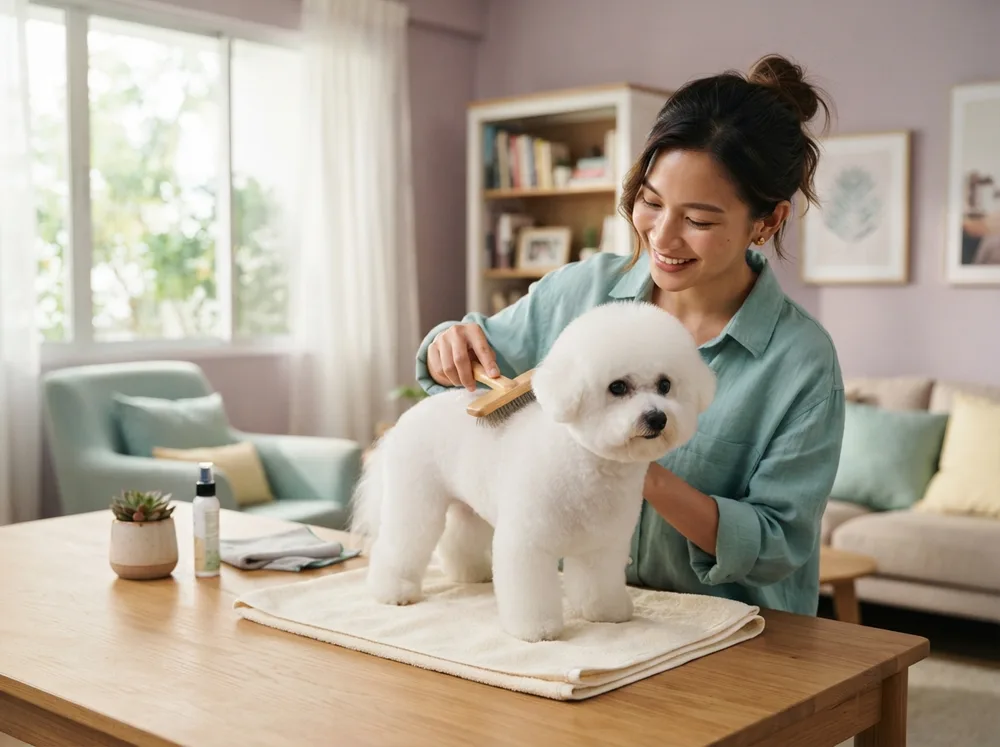
How do you brush a Bichon Frise at home?
Line brush it. Mist a section with detangling spray, part the coat down to the skin, and brush that exposed line outward with a slicker brush. Then run a metal comb through the same line to check your work. Repeat in rows, daily or every other day, ten to fifteen minutes, and never on a dry coat.
Line brushing, the honest way
Why brushing a Bichon is not optional
Here is the part almost every breed page leaves out. The Bichon Frise is genuinely low-shedding, but low-shedding does not mean low-maintenance, it often means the opposite. Your Bichon sheds hair like any dog does; the difference is where that hair goes. In most breeds the dead hair falls onto your floor. In a Bichon, the springy curly double coat catches it on the way out, so the shed hair stays trapped against the soft undercoat instead of landing on the sofa.
That trapped hair is the whole reason you brush. Left in the coat, it tangles with the living hair and felts into mats, and a mat is not a cosmetic nuisance. It starts loose, shrinks as it gathers more hair, and tightens toward the skin until it pinches with every step and holds damp against the body. The brush is simply how you take out the hair the coat refuses to drop. Skip it for a week or two and matting begins quietly, down at the roots, where a glance will never catch it. This is also the honest version of the coat that suits many allergy homes: the curls that trap hair trap dander too, though no dog is truly non-allergenic, and our shedding and allergy guide tells that story straight.
Why the coat needs the brush
- Low-shedding means hair stays IN the coat, not on your floor
- Curly double coat: soft undercoat under springy outer curls
- Trapped shed hair felts into mats that pinch the skin
- Mats hold damp against the body and invite skin trouble
- Brushing removes the hair the coat will not drop
- Miss a week and matting starts at the roots, unseen
The kit you actually need (and one hard rule)
You do not need the wall of products at the pet shop counter. Four things do almost all the work, and one good version of each beats three cheap ones. The tools that matter are a slicker brush, a metal comb, a detangling spray and a little patience. A pin brush is a pleasant extra for fluffing the coat up at the end, but the slicker and the comb are the pair that keep a Bichon mat-free between salon visits.
One rule sits above the whole tool list: never brush a dry coat. A bone-dry curly coat is brittle, and a slicker dragged through it snaps healthy hair and scratches the skin, which quietly teaches your dog that the brush hurts. Always mist the section you are about to work on first, lightly, so it is faintly damp rather than wet. This single habit protects more coat than any brush on the shelf.
| Tool | What it does |
|---|---|
| Slicker brush | The everyday tool. Fine bent wires lift the coat and free the shed hair caught in the curls. This is what you brush with, line by line. |
| Metal comb | The auditor. A fine-and-coarse comb you run through after the slicker to prove the coat is clear to the skin. Where it snags, a mat is forming. |
| Detangling spray | The lubricant. A light mist so the wires glide instead of snapping dry hair. A leave-in spray conditioner does the same job. |
| Pin brush | The finisher. Optional, handy for fluffing the coat up and out once the slicker and comb have done the real work. |
What line brushing actually is
Almost everyone who says their Bichon hates brushing, or mats no matter what, is doing the same thing: brushing the surface. They run the slicker over the top of the coat, the curls look fluffy and clean, and the job feels finished. It is not. Surface brushing touches only the outer layer and never reaches the trapped hair underneath, which carries on felting at the roots while the dog looks immaculate on top. A coat can pass every casual glance and still be a week away from a shave-down at the skin.
Line brushing is the fix, and it is the one technique that genuinely works on this coat. The idea is simple. Instead of brushing the coat as a single surface, you brush it in thin horizontal lines, each one parted down to the skin, so every hair from root to tip passes under the brush. You part a line, brush it clear, drop the parting a centimetre lower, and repeat, working up the body in rows like tiling a wall. It is slower than a surface once-over by a few minutes, and it is the entire difference between a coat that stays open and one that felts.
Surface brushing fluffs the top and leaves the mat forming underneath. Line brushing parts the coat to the skin so no hair is missed. Same brush, completely different result.
How often, and how long it really takes
The honest cadence is daily, and every one to two days is the realistic floor for a working household. A Bichon coat does not hand you a week off. Loose hair keeps shedding into the curls every single day, so every day or two you clear it before it has time to knit. Miss three or four days in Singapore’s humidity, especially after a damp walk, and you will feel the change under the comb before you see it in the mirror.
The time is less than people fear. A full line brushing of the whole dog takes ten to fifteen minutes once you have the rhythm, a touch longer on the day you do every section thoroughly, and less on a quick maintenance pass over the mat-prone spots. Set up on a grooming table or any waist-high surface with a towel so you are not hunched over the floor, and the session stays calm for both of you. Start in puppyhood, keep it short, and end every time with a treat, and the slicker becomes something your dog leans into rather than dodges.
Daily
the ideal cadence
Every 1–2 days
the realistic floor
10–15 min
a full line brush
4–6 weeks
salon groom, for life
Your brushing routine, step by step
Here is the whole thing in order. The first few times, do it on a quiet evening with the tools and a treat pouch within reach, and do not chase a perfect finish, chase a consistent habit.
- Settle the dog. Lift your Bichon onto a grooming table or a towel-covered counter at waist height. A non-slip surface and a calm voice do half the work before you touch the coat.
- Mist, do not soak. Spray a little detangling spray or leave-in spray conditioner over the section you are about to brush so it is faintly damp. Remember the golden rule: never brush a dry coat.
- Part a line to the skin. With your free hand or the teeth of the metal comb, push the coat up and part a thin horizontal line so you can actually see bare skin along it.
- Brush that line outward. Lay the slicker brush flat at the parting and brush the exposed hair down and out, from the skin to the tips, a few light passes until it lifts cleanly.
- Audit with the comb. Run the metal comb back through the same line. If it glides to the skin, move on. If it snags, you have found a mat starting, so tease it with the comb and re-brush the spot.
- Drop, repeat, then the tricky bits. Lower the parting a centimetre and go again, working up each leg, the chest, the back and the tail in rows. Finish with the face, ears, armpits and under the collar, the places that mat first.
That is line brushing, start to finish. Follow this order every time and it turns into muscle memory inside a fortnight. Our matting SOS guide covers what to do on the day the comb finds a mat too tight to tease out by hand.
The mistakes that undo good intentions
Most Bichon coats that fail do so despite a caring owner, not because of a careless one. The errors are honest, and they are almost always the same handful. Surface brushing is the big one: brushing the top and trusting that the underneath is fine. Close behind is brushing too rarely, letting three or four humid days stack up until the coat is already knitting. Then there is brushing a bone-dry coat, which breaks hair and stings, and teaches the dog to dread the slicker.
The subtler mistakes hide in the map of the dog. Owners brush the broad, easy back and skip the friction zones, the armpits, the groin, behind the ears and under the harness and collar, which is exactly where mats form first. And a fair few quietly give up on the metal comb, when the comb is the single tool that tells the truth about what the slicker brush left behind. Fix these five and you have fixed almost every home-grooming problem a Bichon owner has ever written to us about.
The number one mistake: surface brushing
- Brushing only the surface: the top looks clean while shed hair felts at the roots
- Brushing too rarely: three or four humid days is enough to start a mat
- Brushing a dry coat: it snaps hair and stings the skin, so mist first
- Skipping the friction zones: armpits, groin, ears, collar and harness lines mat first
- Trusting the slicker alone: only the metal comb proves the coat is clear to the skin
Where home brushing ends and the groomer begins
Brushing at home is the maintenance that keeps a coat open between grooms. It does not replace the salon, and it is not meant to. A full groom, the bath, the proper blow dry that straightens the curl, the scissor finish, the nails, the ears and the sanitary trim, is skilled work most owners cannot fully do at home. The two jobs work as a team: your daily brushing keeps the coat mat-free so the groomer can cut a clean shape every 4 to 6 weeks, for the whole of the dog’s life. The full commitment, cadence and real Singapore cost, is laid out in our Bichon grooming guide.
Some days the comb finds a mat you cannot tease out, and that is a signal, not a failure. If a mat is tight to the skin, do not attack it with scissors, because you can nick the skin far more easily than you would ever believe. Book the groomer and let them choose between careful dematting and, if the coat has truly felted, a kind shave-down. In our climate the trigger is usually damp: after a rain-season walk, check and dry the armpits, groin and ear folds all the way to the skin, because a wet coat felts overnight. If you would like to see the method in person, come and meet the puppies at our shop on 2 Balestier Road #01-701, and we will run a line brushing on a real Bichon before you ever take one home.
When to call the groomer
- Home brushing keeps the coat open; the salon does the full groom
- Book a professional groom every 4 to 6 weeks, for life
- A mat tight to the skin is a groomer job, not a scissors job
- Never cut at a mat yourself, you can nick the skin
- After rain walks, dry the damp zones or they felt overnight
- We will demo a line brushing at the shop before you buy
Keep exploring
Frequently asked questions
How often should I brush a Bichon Frise?
Daily is ideal, and every one to two days is the realistic floor. The curly coat traps shed hair every day, so you clear it before it knits into a mat. In Singapore’s humidity you cannot safely stretch it: three or four missed days, especially after damp walks, is usually enough for matting to start at the roots where you cannot see it yet.
How long does brushing a Bichon take?
A full line brushing of the whole dog takes about ten to fifteen minutes once you have the rhythm, and less on a quick maintenance pass over the mat-prone spots. Working on a grooming table or any waist-high surface makes it faster and calmer. Start short in puppyhood and finish with a treat, and most Bichons come to enjoy it.
What is the best brush for a Bichon Frise?
A slicker brush paired with a metal comb. The slicker lifts the coat and pulls out the trapped shed hair; the metal comb is the auditor that proves the coat is clear to the skin. Add a detangling spray so you never brush a dry coat, and a pin brush if you like a fluffed finish. That short kit does almost everything.
Why does my Bichon still mat even though I brush it every day?
Almost always because of surface brushing. Running the slicker over the top fluffs the curls but never reaches the shed hair trapped underneath, which keeps felting at the roots while the coat looks clean. The fix is line brushing: part the coat to the skin in thin rows so every hair passes under the brush, then check each row with the metal comb.
Can I brush my Bichon’s coat when it is dry?
No. A bone-dry curly coat is brittle, and a slicker dragged through it snaps healthy hair and irritates the skin, which also teaches your dog that brushing hurts. Always mist the section first with a detangling spray or leave-in spray conditioner so it is faintly damp, then brush. Never brush a dry coat is the one rule above all the others.
Do Bichon Frises shed?
Yes, every dog sheds, but a Bichon sheds very little onto your home. The dropped hair is caught by the curly double coat and held against the undercoat rather than falling on the floor, which is what makes the breed low-shedding and friendlier for many allergy households, though no dog is truly hypoallergenic. That trapped hair is exactly what your brushing removes.
Does brushing at home replace professional grooming?
No. Home brushing keeps the coat open and mat-free between visits, but the full groom, the bath, blow dry, scissor finish, nails and ears, is skilled work best left to a salon every 4 to 6 weeks for life. The two work together: good brushing lets the groomer cut a clean shape, and a standing appointment keeps the whole routine on track.
Meet your Bichon
Come say hello at Balestier
2 Balestier Road #01-701, Singapore 320002 · Weekdays 12pm–6pm · Weekends 10am–6pm. Or message us first: tell us about your home and routine, and we'll tell you honestly if a Bichon fits.
Want the whole grooming picture?
Brushing is the daily half. See the salon cadence, the real Singapore prices and the honest yearly cost, all priced in before you buy a puppy.
Read the grooming guide