The honesty pillar
Do Bichon Frises shed? The honest allergy answer
Where the hair really goes, where the allergens really live, and the 30-minute test that beats every claim online. Told straight by the shop that repeats it before every sale.
Bichon Frise puppies
From $3,500, all-in
The honest low-shedding answer
Do Bichon Frises shed, and are they hypoallergenic?
Bichons shed, but the hair catches in the curly double coat instead of falling onto floors, that is what low shedding honestly means. No dog is truly hypoallergenic: allergens are proteins in dander, saliva and urine, not hair, and homes show similar allergen levels across breeds. The Bichon still genuinely helps many allergy households by spreading less dander, removed at the salon every 4 to 6 weeks. The honest test is a 30-minute trial visit at our Balestier shop, not a claim on a website.
What low shedding really means: into the coat, not onto your floor
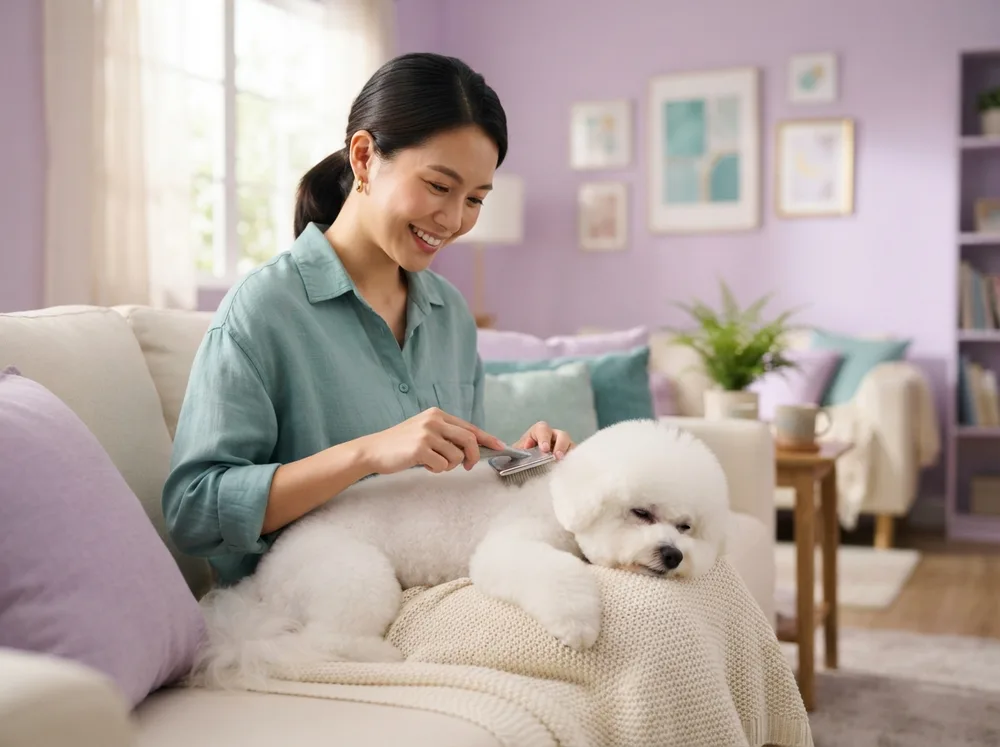
Start with the claim on every listing: the Bichon Frise does not shed. It is almost true and completely misleading. Every dog with hair sheds, because hair grows, dies and detaches on a cycle no breed escapes. What makes the Bichon different is where the dead hair goes. On a Labrador it falls straight out, onto your floor, your sofa, your office trousers. On a Bichon, the shed hair catches in the curly double coat, held by the curl the way a leaf is held by a hedge, and it stays there until a brush or a groomer takes it out.
So the honest sentence is this: a Bichon sheds into its coat, not into your home. Run a hand over a healthy powder puff coat and it comes away clean. Wear black, hug the dog, stand up, and there is nothing to roll off. For floor-fur purposes the breed genuinely earns its low shedding reputation, and in an HDB flat where the sofa, the bed and the laundry rack share sixty square metres, that matters more than it does in a landed house.
The catch is that trapped hair does not politely wait forever. Left in the coat, the dead hair and the live curls felt together into mats, tight against the skin, and mats pinch. The no-fur-on-the-floor deal is paid for with a brush most days and a professional groom every 4 to 6 weeks, for the dog’s whole life. Our grooming guide lays out that commitment with real Singapore salons and real prices, because the coat is a contract, not a feature.
We put this page in the core of the site, above prettier topics, because the gap between “does not shed” and the truth is exactly where disappointed owners come from. Every buyer of ours hears this version before money moves.
The allergen science, told straight
Now the bigger claim, the word every listing uses: hypoallergenic. Here is the science, told straight. A dog allergy is not a reaction to hair. It is a reaction to allergen proteins, produced in the dog’s skin, saliva and urine. The famous one is carried in dander, the microscopic flakes of dead skin every warm-blooded animal releases constantly, and in dried saliva, which coats the fur of any dog that grooms itself, which is all of them.
Every dog makes these proteins. There is no coat type, no breed, no cross that produces none. That is why the vet-dermatology consensus is blunt: studies measuring allergen levels in real homes find broadly similar levels whether the resident dog is a so-called hypoallergenic breed or not. The protein is made by the dog, not the hairstyle.
So when a listing promises hypoallergenic dogs, it is promising something no dog can deliver, and it is usually promising it to the exact families who most need the truth: households where a child’s allergic reaction or a parent’s asthma is the whole reason they are researching breeds at 11pm.
We would rather rank for the honest answer than repeat the myth. No dog is non-allergenic. Not our Bichons, not anyone’s. What a breed can honestly differ in is how much allergen it spreads around your home, and that is where the Bichon’s case actually stands up.
Why the Bichon still genuinely helps many allergy households
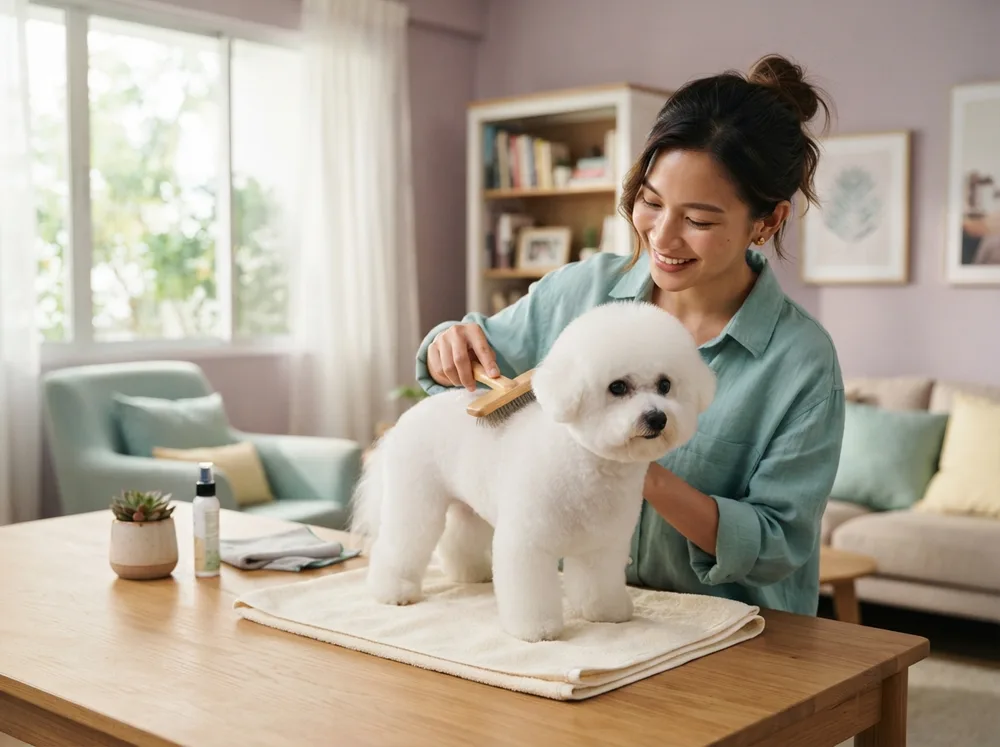
Because here is the part the debunkers skip: many allergy sufferers genuinely do live more comfortably with a Bichon than with a shedding breed, and the mechanism is the same coat physics from the top of this page. Dander rides on hair. A breed that drops loose hair everywhere is running a delivery service for allergen, seeding every cushion, carpet and aircon current in the flat. A Bichon’s coat holds that payload in place until it is brushed or bathed out.
Then the grooming cadence finishes the job. Every 4 to 6 weeks, the accumulated dead hair, dander and dried saliva is washed and stripped out of the coat at the salon, outside your home, instead of working loose across your furniture over months. Less spread, removed regularly, off-site. That is the honest, mechanical reason the breed keeps earning recommendations from allergy households, and none of it requires the magic word.
What it does not mean is a guarantee. Allergen is still produced, still present on the dog, still transferred by licking and petting. A severely allergic person can react to the world’s best-groomed Bichon in minutes. The breed shifts the odds, sometimes dramatically. It does not repeal them.
Which is why we will not sell you a Bichon on this page’s say-so, or any page’s. We will ask you to come and run the only test that means anything.
The trial visit: the only allergy test worth trusting
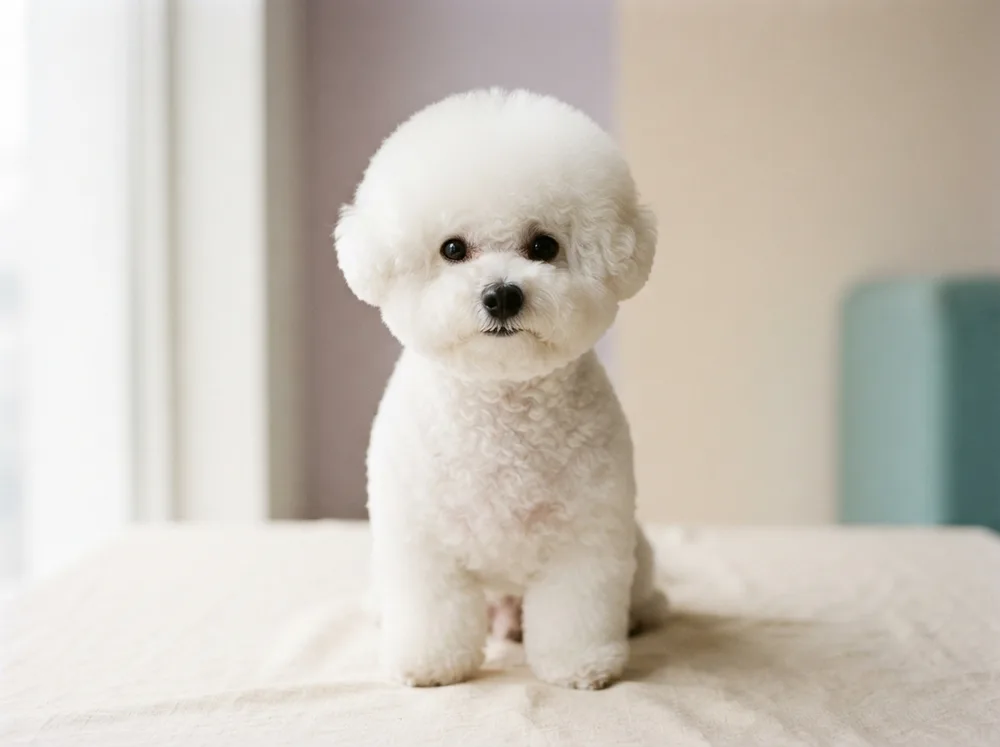
The trial visit is our standing offer and the most honest thing on this site. Come to the shop at 2 Balestier Road #01-701, weekdays 12 to 6, weekends 10 to 6, and sit with a Bichon for at least 30 minutes. Not a doorway hello: a proper sit, on the floor, in the room where the dogs live. Hold the puppy against your shirt. Let it lick your hand. Breathe the air.
Reactions that are going to shape your life with this dog usually show inside that window: itchy eyes, a tightening chest, the sneezing run that will not stop. If they show, we will say the hard thing warmly and suggest a different path, sometimes a different breed, sometimes no dog yet. If nothing shows, you have better evidence than any listing could print, though we will still say it plainly: a calm first visit is a good sign, not a certificate.
Bring the actual allergy sufferer. It sounds obvious, and yet we regularly meet buyers scouting alone for an allergic partner or child at home. Their immune system is the one voting. If the allergy is diagnosed and serious, layer in an allergist’s advice before committing; a proper test panel plus a long trial visit is the strongest evidence a family can assemble.
And if you fall for a specific puppy, ask us about a second, longer visit before reserving. We have held puppies for exactly this reason. A week of patience beats a rehoming ad in month three, every time, and we say so as the shop that would make the sale. Browse who is currently in the shop on our available puppies page before you come.

The allergy-household playbook for Singapore flats
Say the visit goes well and the Bichon comes home. Here is the playbook that keeps an allergy household comfortable in a Singapore flat, learned across 30+ placements. Rule one, and it outranks everything else: the bedroom is off-limits, from night one, no exceptions for sad eyes. You spend eight hours with your face on the bedding; keep it allergen-clean and you give the allergic person a nightly reset no purifier can match.
Rule two: filter the air. An air purifier with a true HEPA filter in the living room, and one in the allergy sufferer’s bedroom, catches the dander that does go airborne. HDB rooms are small, which for once is an advantage: one decent unit turns the room’s air over fast. Service the aircon filters monthly too, because they hoard dander and redistribute it every time the compressor kicks in.
Rule three: a washing routine. Soft furnishings are allergen warehouses, so wash sofa covers, cushion covers and the dog’s own bedding weekly on a hot cycle, and choose washable over plush wherever you can. Wipe the dog’s coat and paws with a damp cloth after walks, and keep baths to the groomer’s schedule rather than over-bathing at home, which dries the skin and can increase dander.
A Singapore-specific note: our humidity is mostly your friend here, damp air keeps dander from floating as freely as it does in dry climates, but the same humidity feeds dust mites, which are a far bigger allergy trigger in local homes than any dog. If symptoms persist after the playbook, test for mites before blaming the Bichon. More than one dog here has been rehomed for a mattress’s crimes.
Choosing among the low-shedding breeds, honestly
If you searched hypoallergenic dogs Singapore and landed here, the honest version of your question is: which low-shedding breeds suit my family, and which of them can legally live in my flat? The Bichon is our breed and our bias, so here is the even-handed answer. The Toy Poodle brings the same coat physics with more trainability and more energy. The Maltese is silkier, lighter, and higher-maintenance on tear staining. The Shih Tzu is calmer with a heavier coat commitment. The Havanese splits the difference.
Every one of them sheds into the coat rather than onto the floor, every one needs the salon cadence, and not one of them is hypoallergenic, whatever the listing said. Our breed comparison hub matches the Bichon against each, honestly enough that we sometimes talk ourselves out of a sale.
The crosses deserve their own honest paragraph. The poochon and the maltichon inherit low-shedding coats from both parents, and both qualify for HDB flats as crosses of two approved breeds. They are real options, and for some families the better ones.
We keep purebred Bichon Frises only, white coats only, so if a cross fits your family better we will say so and point you to a sibling specialist rather than bend the truth to fit our stock. Our Bichon mixes guide covers the poochon and maltichon question properly.

Low-shedding and HDB-approved: the intersection that decides it
And the intersection nobody ranks for, even though Singapore keeps searching it: low-shedding AND HDB-legal. The Bichon Frise is HDB-approved, item 4 on the official 62-breed list, verified against hdb.gov.sg this month. One dog per flat, licensed with AVS, breach fines up to $4,000. The same list carries the other low-shedding names above, and item 62 approves crosses of any two approved breeds.
That combination, a coat that keeps the flat clean and a breed the flat is allowed to keep, is the real reason the Bichon is one of Singapore’s quiet default dogs. The full rules, the licence fees and the verification dates live on our Bichon and HDB guide. The allergy truth lives here. Between the two pages, you can make this decision on facts, which is the whole point of this site.

Frequently asked questions
Do Bichon Frises shed?
Yes, but the shed hair catches in the curly double coat instead of falling onto your floors and sofa. That is what low shedding honestly means: the hair still dies and detaches, it just stays trapped in the coat until a brush or the groomer removes it. The trade is that the coat must be brushed most days and professionally groomed every 4 to 6 weeks, or the trapped hair mats.
Are Bichon Frises hypoallergenic?
No dog is, and we will not use the word as a promise. Allergens are proteins carried in dander, saliva and urine, not in the hair itself, and vet-dermatology studies find similar allergen levels across homes regardless of breed. What the Bichon genuinely offers is less spread: the coat traps loose hair and dander instead of scattering it. For many allergy sufferers that difference is meaningful. The only honest test is meeting the dog.
How do I test if I am allergic to a Bichon before buying?
Come to our shop at 2 Balestier Road and sit with a Bichon for at least 30 minutes. Handle the puppy, let it lick your hand, sit in the room where the dogs live. Most reactions that are going to matter show within the visit. If you have a diagnosed dog allergy, an allergist consult before committing is also money well spent.
Which hypoallergenic dogs are HDB-approved in Singapore?
The honest reframe: there are no hypoallergenic dogs, but several low-shedding breeds are on HDB’s approved list, and the Bichon Frise is item 4, alongside the Toy Poodle, Maltese, Shih Tzu and Havanese. Crosses of two approved breeds qualify under item 62, so a poochon or maltichon is also HDB-legal. Our comparison guide matches them honestly.
Do air purifiers help with dog allergies in an HDB flat?
They help as one layer, not a cure. A HEPA filter unit in the living room and bedroom removes airborne dander, and the smaller volume of an HDB room actually works in your favour, one unit turns the air over quickly. Pair it with a bedroom-off-limits rule, weekly washing of soft furnishings, and cleaning the aircon filters monthly, since they collect dander and blow it back out.
Should the dog be allowed in the bedroom if someone has allergies?
No, and this is the single highest-value rule in the playbook. You spend a third of your life with your face against the bedding. Keep the Bichon out of the bedroom from day one and the allergy sufferer gets eight clean hours a night, which for many households is the difference between manageable and miserable.
Does grooming every 4 to 6 weeks reduce allergens at home?
Yes, meaningfully, because the salon removes the trapped dead hair and dander from the coat before it works loose at home, and the bath washes out the dried saliva coating the coat. The Bichon needs this grooming cadence anyway for coat health, so an allergy household is simply getting a second benefit from a bill it was always going to pay.
Can a dog allergy develop after the puppy comes home?
It can, sensitivities shift over time in either direction, which is one more reason we prefer a long trial visit and honest talk before purchase. If it happens, the playbook (bedroom rule, HEPA filtration, washing routine, grooming cadence) controls most mild cases, an allergist can help beyond that, and our 5-day bring-back promise exists for the hard early cases.
Meet your Bichon
Come say hello at Balestier
2 Balestier Road #01-701, Singapore 320002 · Weekdays 12pm–6pm · Weekends 10am–6pm. Or message us first: tell us about your home and routine, and we'll tell you honestly if a Bichon fits.
Allergies in the household?
Tell us on WhatsApp before you visit. We will plan a longer, quieter trial sit, and if the honest answer turns out to be a different breed, we will say so.
Compare low-shedding breeds