The coat-change survival guide
Surviving the Bichon Puppy Coat Change
Around 9 to 16 months your Bichon grows two coats at once, and the matting gets worse than anything the first year prepared you for. Here is what is happening, month by month, and how to get both of you through it with the coat intact.
Nelson and Kim, Curious Tails · AVS licence AS24J00046
What is the Bichon puppy coat change, and how do I survive it?
Between roughly 9 and 16 months your Bichon trades its soft puppy coat for the adult double coat, and for a few months both grow at once, so matting peaks. You survive it by tightening the salon toward every 4 weeks, brushing to the skin every day, and letting your groomer take the coat shorter until it settles.
Months 9 to 16, month by month
What the Bichon puppy coat change actually is
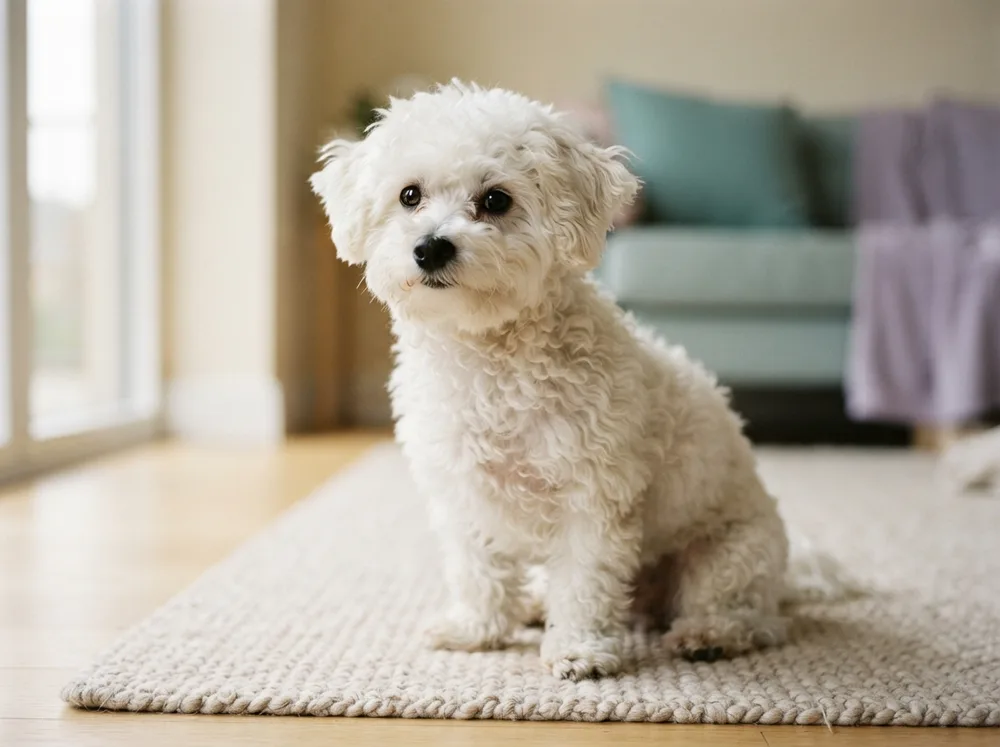
The fluffy little cloud you brought home is wearing a temporary coat. A Bichon puppy is born in soft, single-texture fluff, easy to brush and quick to forgive a missed day, and almost every new owner quietly assumes that is simply what the breed feels like. It is not. Somewhere around 9 to 16 months, that puppy coat is pushed out and replaced by the grown-up double coat, and the dog you groom at eighteen months is a noticeably different animal to brush than the one you groomed at six.
Here is the first thing to say plainly, because the internet fills up with worried owners at exactly this point: the bichon puppy coat change is normal. It is not illness, it is not a bad diet, and it is not a sign your dog is secretly a mix. A purebred Bichon sheds its baby coat on schedule like every double-coated breed does, and the well-known Quora and Reddit threads asking some version of “why is my purebred Bichon suddenly shedding at eight months” are all describing this same ordinary milestone. Most owners first notice it around month 8 or 9, and the whole transition is usually settled by fifteen to eighteen months.
The coat change at a glance
- Starts roughly month 8 to 9, runs to about 16
- Soft puppy coat gives way to the adult double coat
- Both coats grow at once for several months
- Matting is at its lifetime peak in this window
- It is normal, not illness and not a mixed breed
- Settles into one even adult coat by 15 to 18 months
Why matting suddenly accelerates
To understand why this window is so brutal, remember what makes a Bichon low-shedding in the first place. The coat barely sheds outward: loose hair releases from the skin like any dog’s, but the springy outer curls trap it against the soft undercoat before it can fall, which is why your floor stays clean and your brush does the work instead. During the coat change, that trap runs at double capacity. The soft puppy coat is loosening and shedding out all at once, while the coarser adult coat is growing in beneath it, so for several months the dog is carrying two coats that are actively tangling with each other.
That is the mechanism behind the horror stories. Trapped, shed puppy hair wraps around the incoming adult curls and felts into mats faster than at any other time in the dog’s life. A twice-a-week routine that survived all of puppyhood stops being enough almost overnight, and the first felt shows up in the classic hiding spots: behind the ears, under the collar, in the armpits, around the sanitary area. Nothing has gone wrong with your dog or your effort. The coat has simply changed the rules, and your brushing routine has to change with it.
Matting is at its lifetime peak now
From roughly month 9, your Bichon mats faster than it ever will again. A coat that looked fine on Sunday can be felt to the skin by the following weekend, so this is the one window where a single skipped brushing session genuinely costs you.
Your month-by-month survival plan
The good news is that the coat change is completely survivable, and the owners who sail through it are simply the ones who saw it coming and tightened their routine a month early. The plan has three moving parts: shorten the gap between professional grooms, upgrade home brushing to daily, and give your groomer permission to take the coat shorter than usual while the overlap lasts. Here is how that looks across the window.
Screenshot this onto your phone, because the single biggest predictor of a smooth coat change is starting the tighter routine before the matting begins, rather than reacting after the first felt appears.
| Age | What is happening | What to do |
|---|---|---|
| Months 6 to 8 | Puppy coat still soft, but the change is coming | Get onto a standing salon cycle and start daily line brushing now, before the mats do. |
| Months 9 to 11 | Adult curls push in; matting begins in earnest | Tighten the salon toward every 4 weeks; brush to the skin every single day. |
| Months 12 to 14 | Peak overlap, both coats at full tangle | Let the groomer take the coat shorter; audit the damp zones at every brushing. |
| Months 15 to 16 | Adult double coat wins; the shedding-out slows | Hold the routine; only ease back toward 5 to 6 weeks once the mats stop forming. |
The panic shave question, answered honestly
Sooner or later an overwhelmed owner with a matted adolescent stands in a salon and hears the word “shave”. This is the most emotional decision of the whole window, and both extremes online are wrong, so here is our honest position. A shave down is not cruelty. When a coat has felted close to the skin, clipping it off and starting again is genuinely the kinder choice, because hours of dematting on a squirming young dog hurt far more than a fresh start, and any ethical groomer will tell you the same before they reach for the blade.
What a shave is, is a signal. The coat regrows in a few months, usually with no drama at all, but the routine that let a coat felt to the skin will felt the next one too unless something changes. So we tell every buyer the same thing: do not fear the clipper, and do not treat it as a moral failure, but do treat a full shave as the loud alarm it is. If you kept up the tighter cadence and the daily brushing and a mat still beat you, a planned shave-down is a reset, not a defeat. If you are reaching for it because the routine slipped, fix the routine first. Our matting SOS guide covers the middle ground between a perfect coat and the clippers.
A planned shave-down is not cruelty; when a coat has felted to the skin it is the kind choice. The neglect that made it necessary is the failure, never the clipper.
Tools and technique for the window
The tools that get you through the window are the same ones you should already own, used more often and more thoroughly. What changes is how deep every session has to reach. During the coat change the new adult coat binds to the loosening puppy coat right at the skin, so line brushing becomes non-negotiable: lift a narrow section with the metal comb, stroke the slicker brush through it from skin to tip, then lift the next section until the whole body is done. The quick once-over most people do only fluffs the top and leaves the two coats quietly welding together exactly where you cannot see it.
Two habits make the difference. First, treat the metal comb as your auditor: if it slides to the skin everywhere, you are winning; wherever it snags, you have found tomorrow’s mat while it is still thirty seconds of work. Second, never brush a bone-dry coat, because dry curls snap; a light mist of detangling spray lets the slicker brush glide. Ten to fifteen minutes a day, on a table, ending every time with a treat, keeps an adolescent Bichon tolerant of the whole business. The full step-by-step is in our daily brushing routine.
The coat-change kit
- Quality slicker brush, the daily workhorse
- Metal comb, fine and coarse, your auditor
- Detangling spray, never brush a dry coat
- A pet dryer, to dry fully to the skin
- Daily line brushing, to the skin, in rows
- Book the next groom before you leave the salon
The Singapore multiplier: humidity through the change
Every grooming guide written for Britain or the American Midwest misses the one variable that dominates coat care here, and it happens to peak at the worst possible moment. Humidity makes a curly coat mat dramatically faster, because moisture tightens the curl and shrinks a forming tangle toward the skin, and Singapore keeps a Bichon damp almost constantly: rain-season walks, wet grass at the park, the sweaty microclimate under a harness, the swing between a 32-degree afternoon and an air-conditioned living room. Layer that onto the coat change and you have the fastest-matting conditions your dog will ever meet.
So the tropical rule is simple and non-negotiable during this window: never let your Bichon stay damp. After any wet walk, towel firmly and then dry all the way to the skin with a cool-setting dryer, because a damp mat over warm skin is how a hotspot starts. Check the classic damp zones, the armpits, the groin and behind the ears, at every brushing session. Ten extra minutes with a towel and dryer after a rainy walk protects more coat than any product on the shelf, and it matters twice as much while both coats are still in play. The full tropical routine sits in our grooming commitment guide.
When it ends, and the coat you are left with
The coat change ends, and it ends completely. By somewhere around fifteen to eighteen months the last of the puppy coat has shed out, the adult coat has fully grown in, and your Bichon is left with one even, slightly coarser double coat that actually holds a teddy bear cut better than the baby fluff ever did. The relief is real: the coat still mats, because the trap that makes a Bichon low-shedding never switches off, but it mats at the normal lifelong pace rather than the runaway pace of the change.
From there the routine relaxes back to its lifelong shape, a professional groom every 4 to 6 weeks and line brushing every day or two, the same commitment we walk every buyer through before they reserve a puppy. If you get your Bichon through months nine to sixteen with the coat intact, you have learned the hardest grooming lesson the breed will ever teach you, and everything after it is easier. If you are still weighing up the breed and want the whole grooming picture first, honestly and in Singapore dollars, come and meet the puppies in the shop and we will talk you through it.
Keep exploring
Frequently asked questions
At what age does the Bichon puppy coat change happen?
It runs roughly from 9 to 16 months, though most owners first notice it around month 8 or 9 when the soft puppy coat starts shedding out and matting picks up. The coarse adult double coat grows in underneath over the same period, and the whole transition is usually settled by about fifteen to eighteen months.
Why is my Bichon suddenly shedding and matting at around eight months?
Because it has reached the coat change, and this is completely normal. The soft puppy coat is being shed out while the adult coat grows in, so the dog carries two coats at once for a few months. Sudden shedding and fast matting at this age is the ordinary milestone every double-coated Bichon goes through, not illness and not a sign of a mixed breed.
Should I shave my Bichon during the coat change?
Only if the coat has genuinely felted close to the skin. A planned shave-down by a groomer is not cruel; when a coat is matted to the skin it is the kinder choice, because hours of dematting hurt more than starting again. But a shave is a signal that the routine needs to change. If you tighten the brushing and grooming instead, most owners never reach that point.
How often should I brush my Bichon through the coat change?
Daily. Surface brushing is not enough during this window: you need proper line brushing, parting the coat to the skin with a metal comb and brushing each line out with a slicker brush, working across the body in rows. Ten to fifteen minutes a day, plus a slightly longer full-body session once or twice a week, is the honest budget while both coats are present.
How often should my Bichon be professionally groomed during the coat change?
Tighten the cadence toward every 4 weeks for the duration of the window, rather than the usual 4 to 6. It also helps to let your groomer take the coat shorter than normal through the overlap, so there is simply less length to felt. Once the change settles, you can ease back toward the lifelong 4 to 6 week rhythm.
Does the coat change mean my Bichon is no longer low-shedding?
No. The heavy shedding is temporary, just the baby coat clearing out. Once the adult double coat has grown in, the Bichon returns to being a genuinely low-shedding breed, catching loose hair in its curls instead of dropping it on your floor. That same trap is why the coat still needs regular brushing, and why no Bichon is ever truly hypoallergenic, but the coat-change shedding itself passes.
Meet your Bichon
Come say hello at Balestier
2 Balestier Road #01-701, Singapore 320002 · Weekdays 12pm–6pm · Weekends 10am–6pm. Or message us first: tell us about your home and routine, and we'll tell you honestly if a Bichon fits.
Want the whole grooming picture?
The coat change is one hard chapter. See the full Bichon grooming commitment, the cadence and the yearly cost, all priced in Singapore dollars before you buy.
Read the grooming guide