Breed comparison
Bichon Frise vs Maltese
Two small white companions, easy to mix up and genuinely different underneath. Here is the fair, Singapore-specific side-by-side on coat, grooming, temperament, tear staining, price and HDB status, from a shop that raises only the Bichon.
Nelson and Kim, Curious Tails · AVS licence AS24J00046
Bichon Frise or Maltese: which should I choose?
Both the Bichon Frise and the Maltese are small, white, low-shedding companions that are HDB-approved in Singapore, so neither is a wrong choice. The honest split: the Bichon is sturdier, merrier and curly-coated; the Maltese is tinier, more devoted and silky-coated, with more tear staining to manage.
Bichon Frise vs Maltese
Bichon Frise vs Maltese: the honest short version
Put a Bichon Frise and a Maltese side by side on a Singapore sofa and most people see the same dog: a small white cloud with dark round eyes, the kind of lap dog that belongs in a photo. Look closer and they are built differently, and the differences are exactly the ones that decide which one fits your flat and your family. This is the honest bichon frise vs maltese comparison, written by a shop that raises only one of them and is trying to be fair rather than to win.
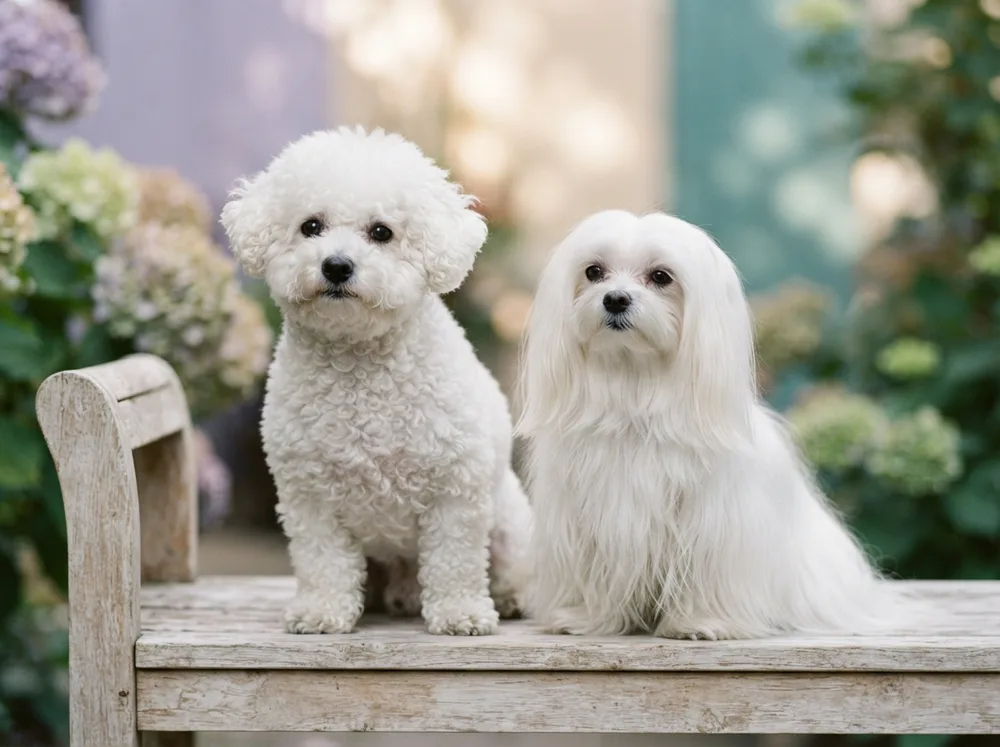
Here is the shape of it before the detail. The Bichon is the sturdier, bouncier of the two, wrapped in a curly powder puff coat. The Maltese is the tinier, more devoted one, draped in a long silky coat that falls straight to the floor. Both are small breed companions, both are gentle, both sit on Singapore’s approved list, and neither is the obvious winner. The winner is simply the one that matches how you actually live.
Two white clouds, built differently: the Bichon is the sturdy, merry all-rounder; the Maltese is the delicate, devoted shadow.
The at-a-glance comparison, made for Singapore
If you want the whole comparison in one screen, here it is. Every row is written for Singapore, with real coat, temperament, price and HDB-approved notes rather than the American pound-and-inch tables that fill most search results. Read down the two columns and you will already be leaning one way before the honest paragraphs that follow.
| Trait | Bichon Frise | Maltese |
|---|---|---|
| Coat type | Curly double coat, the plush powder puff look | Silky single coat, long, straight, floor-length if grown out |
| Shedding | Low-shedding: dead hair catches in the curls | Also low-shedding: little undercoat, but still tangles |
| Grooming | Salon every 4 to 6 weeks, plus regular brushing | Salon every 4 to 6 weeks, plus near-daily combing |
| Size | Sturdier: roughly 5 to 8kg | Tinier and finer: roughly 3 to 4kg |
| Temperament | Merry, outgoing, playful; loves a crowd | Gentle, devoted; a true one-person lap dog |
| Tear staining | Can stain, usually milder | More prone: the classic Maltese eye stain |
| Barking | Alert, will announce visitors; settles fast | Alert and watchful; often the yappier one |
| Trainability | Bright and eager; a natural at tricks | Clever but can be stubborn on house-training |
| Health & lifespan | Long-lived, commonly 12 to 15 years | Long-lived, 12 to 15 years; more delicate build |
| Price band (SG) | $3,500–$6,000, our all-in band | Often quoted from around $2,000 to $5,000 |
| HDB status | Approved, item 4 of 62 | Approved, item 33 of 62 |
Coat and shedding: curly double coat vs silky single coat
Start with the coats, because that is where the two breeds genuinely diverge. The Bichon wears a curly double coat: a soft undercoat beneath a coarser curly outer layer, the combination that gives the breed its rounded powder puff silhouette. The Maltese wears a silky single coat: no undercoat at all, just one layer of fine, straight hair that keeps growing until it reaches the floor. Same colour, completely different engineering.
Both are honestly low-shedding, and for the same underlying reason: loose hair tends to stay in the coat rather than drop onto your floor. On the Bichon the dead hair is trapped by the curl; on the Maltese there is simply very little undercoat to shed in the first place. In a Singapore flat, where the sofa, the bed and the laundry rack share the same sixty square metres of air, that is a real advantage for both breeds over a heavier-shedding dog.
Now the honest caveat that most listings skip. Neither breed is truly hypoallergenic, because no dog is. Allergies are triggered by proteins in dander and saliva, not by hair itself, so a low-shedding coat spreads less allergen around your home but never removes it. If someone in your household reacts to dogs, the coat type is a help, not a cure, and the only real test is time in the same room. Our shedding and allergy guide tells that story straight for the Bichon.
Coat and shedding, side by side
- Bichon: curly double coat, the powder-puff look
- Maltese: silky single coat, long and straight
- Both low-shedding: hair stays in the coat
- Both need the salon every 4 to 6 weeks
- Neither is truly hypoallergenic, no dog is
- Trapped hair still mats without brushing
Grooming and tear staining: where the daily work differs
Do not mistake low-shedding for low-maintenance. Both of these coats are a lifelong commitment to professional grooming every 4 to 6 weeks, and both demand regular home brushing in between. The difference is in the daily job. The Bichon’s curls need line-brushing so the trapped hair does not felt into mats against the skin. The Maltese’s long single coat tangles even faster and, kept full-length, needs combing most days, which is why so many Singapore owners keep their Maltese in a short puppy cut.
Singapore’s humidity leans on both coats. Damp air and rainy-season walks mean a white dog picks up grass, drain water and the start of a mat far quicker here than in a dry climate, so the brush and the towel by the door are not optional for either breed. On grooming cost and cadence the two are close enough that it will not decide your choice; the coat you are honestly willing to maintain at home should.
The one clear split is tear staining. Both breeds have the white coat and the facial structure that can show a reddish-brown stain below the eyes, but the Maltese is notably more prone to it, and on that silky white face it shows more plainly. It is manageable with a daily wipe and a clean routine, but it is real, ongoing work, and it is worth walking in with your eyes open rather than discovering it in month two.
Leaning Maltese? Our sister site covers it
We raise Bichon Frises only, so we keep this page fair rather than pretending the Maltese comes second. If the Maltese is winning you over, our sister site maltese.sg carries the Maltese-first version of this comparison and the full tear staining routine we deliberately do not duplicate here.
Size, temperament, barking and trainability
On size, the answer to the question everyone asks is yes: the Bichon is the bigger of the two, though both are firmly small breed dogs. A Bichon carries a little more substance at roughly 5 to 8kg, where a Maltese is finer and lighter at around 3 to 4kg. Neither needs a garden, but the Bichon’s sturdier frame makes it the more robust choice around boisterous children, while the delicate Maltese asks for gentler handling.
Temperament is where the personalities part. The Bichon is the merry extrovert of the pair, bouncy, sociable and happy in a busy household, the dog that does a joyful lap of the living room for no reason at all. The Maltese is gentler and more devoted, often bonding hard to one person and content to be a quiet lap dog, though that closeness can tip into separation anxiety if it is left alone too long. Both are deeply affectionate; they just express it at different volumes.
On barking, both will announce the lift arriving and the food delivery at the door, because alertness comes bundled with being small and watchful. The Maltese tends to be the more reactive of the two, quicker to sound off at strangers, while the sociable Bichon usually settles faster once it has said hello. On trainability the Bichon has the edge: bright, eager and food-motivated, it was a performing dog for a reason, whereas the clever Maltese can bring a stubborn streak, especially to house-training. Neither is hard work with kind, consistent training from day one.
Personality and size, at a glance
- Bichon roughly 5 to 8kg; Maltese around 3 to 4kg
- Bichon: merry, outgoing, robust with children
- Maltese: gentle, devoted, a one-person lap dog
- Both bark to alert; the Maltese is often yappier
- Bichon edges trainability; Maltese can be stubborn
- Maltese more prone to separation anxiety
Health, lifespan and price in Singapore
Both breeds are wonderfully long-lived: a healthy Bichon or Maltese commonly reaches 12 to 15 years, so this is a decade-and-a-half decision, not a passing one. Both share the small-dog watch-list of dental care and patellar (kneecap) issues, and both do best with a breeder who takes health screening and the parent breed lines seriously. The Bichon is prone to bladder stones and skin sensitivities; the tiny Maltese, with its finer frame, needs careful handling and close dental attention. Ask any seller of either breed how they screen, and expect a straight answer.
On price, the two overlap more than they differ in Singapore. Our own Bichon Frise band is $3,500 to $6,000, all-in, and a well-raised Maltese is often quoted a little lower, commonly from around $2,000, though the better Maltese lines climb into the same range. Whichever way you go, budget beyond the puppy: both coats commit you to the salon every 4 to 6 weeks for life, and both dogs need an AVS licence and the usual first-year setup. The sticker price is the smallest number you will spend.
12-15 yrs
Lifespan, both breeds
Items 4 & 33
Both HDB-approved
$3,500+
Our Bichon band, all-in
4-6 wks
Salon cadence, both
Who each breed suits
So who is each dog for? Choose the Bichon Frise if you want the merry all-rounder: a sturdy, sociable dog that suits a lively family, copes well with children, and greets your HDB block like a returning celebrity. It is the easier pick for first-time owners who want personality and resilience in one small, low-shedding package, and it is the dog we have placed with more than thirty Singapore families for exactly those reasons.
Choose the Maltese if you want the devoted little shadow: a tiny, elegant lap dog for a calmer home, a couple or a single owner, someone who is around often and does not mind the daily coat combing and the tear staining upkeep. In a quiet, gentle household the Maltese is a jewel. Around toddlers and rough-and-tumble play, its delicate frame simply asks for more care than the robust Bichon does.
Pick the Bichon for a busy, playful home; pick the Maltese for a quiet one built around a single devoted shadow.
The honest verdict
The honest verdict is that there is no loser here. Both the Bichon Frise and the Maltese are small, white, low-shedding companions, both are HDB-approved (the Bichon at item 4, the Maltese at item 33 of the official 62-breed list), both are held to the same one dog per flat rule, and both will love you for the better part of fifteen years. The decision is about fit, not quality.
As the shop that raises only Bichons, our bias is honest and stated out loud: we think the sturdy, cheerful, family-proof Bichon is the easier first dog for most Singapore homes, and it is the one we can put in your arms this week. But if this page has nudged you toward the Maltese, follow that instinct and read the Maltese-first view and the full tear-stain routine on our sister site maltese.sg, which we keep so we never have to talk down the other breed here. Better still, come and meet a Bichon at Balestier and let the dog cast the deciding vote. It usually does.
Keep exploring
Frequently asked questions
Is a Bichon Frise or a Maltese better for Singapore?
Neither is a wrong choice: both are small, low-shedding and HDB-approved. The Bichon suits busy family homes and first-time owners who want a sturdy, cheerful all-rounder. The Maltese suits quieter households and single owners who want a tiny, devoted lap dog and do not mind more tear-staining upkeep. Your lifestyle decides it, not the breed’s quality.
What is the main difference between a Bichon Frise and a Maltese?
The coat and the build. The Bichon has a curly double coat and the rounded powder-puff look, at roughly 5 to 8kg. The Maltese has a silky single coat that grows long and straight, on a finer 3 to 4kg frame. In character the Bichon is the merry extrovert; the Maltese is the gentler, more devoted shadow.
Are Bichons bigger than Maltese?
Yes, though both are firmly small breeds. A Bichon Frise is the sturdier of the two at around 5 to 8kg, while a Maltese is finer and lighter at roughly 3 to 4kg. That extra substance makes the Bichon the more robust choice around young children, while the delicate Maltese asks for gentler handling.
Do Maltese get more tear stains than Bichon Frises?
Yes. Both white breeds can show a reddish-brown stain below the eyes, but the Maltese is notably more prone to it, and it shows more plainly on that silky white face. It is manageable with a daily wipe and a clean routine, but it is real ongoing work. We keep the full tear-stain routine on our sister site maltese.sg.
Are Bichon Frises and Maltese hypoallergenic?
No, because no dog is truly hypoallergenic. Both are low-shedding, which spreads less dander around your home, but allergies are triggered by proteins in dander and saliva, not by hair, so a low-shedding coat helps without ever curing an allergy. The only honest test is spending real time in the same room before you commit.
Which is easier to train, a Bichon or a Maltese?
The Bichon usually has the edge. It is bright, eager and food-motivated, a natural at tricks and historically a performing dog. The Maltese is clever too but can bring a stubborn streak, especially to house-training. Neither is hard work with kind, consistent training from the first week home, and both are sensitive to harsh handling.
Are both breeds HDB-approved, and can I keep both?
Both are HDB-approved: the Bichon Frise is item 4 and the Maltese is item 33 on the official 62-breed list. But HDB allows only one dog per flat, counted per household, so you cannot keep a Bichon and a Maltese together in the same flat. Each dog also needs its own AVS licence.
How much do a Bichon Frise and a Maltese cost in Singapore?
They overlap. Our all-in Bichon Frise band is $3,500 to $6,000. A well-raised Maltese is often quoted a little lower, commonly from around $2,000, though better lines reach the same range. Either way, budget past the puppy: both coats need the salon every 4 to 6 weeks for life, plus the AVS licence and first-year setup.
Which is better, Maltese or Bichon?
Neither is better, they suit different homes. The Bichon is sturdier at 5 to 8kg, merrier, and the easier first dog for a busy family. The Maltese is tinier at 3 to 4kg, more devoted and quieter, with more tear-staining upkeep. Both are HDB-approved and both need the salon every 4 to 6 weeks.
Meet your Bichon
Come say hello at Balestier
2 Balestier Road #01-701, Singapore 320002 · Weekdays 12pm–6pm · Weekends 10am–6pm. Or message us first: tell us about your home and routine, and we'll tell you honestly if a Bichon fits.
Ready to meet a Bichon?
See the Bichon Frise puppies currently in our Balestier shop, each one HDB-approved and ready for flat life.
See available puppies