The honest head-to-head
Bichon Frise vs Poodle
Two small, curly, low-shedding companions that Singapore families constantly cross-shop. Here is the honest, Bichon-first comparison with the Toy Poodle: coat, colours, size, temperament, health and HDB status, and exactly where to go if a Poodle is truly your dog.
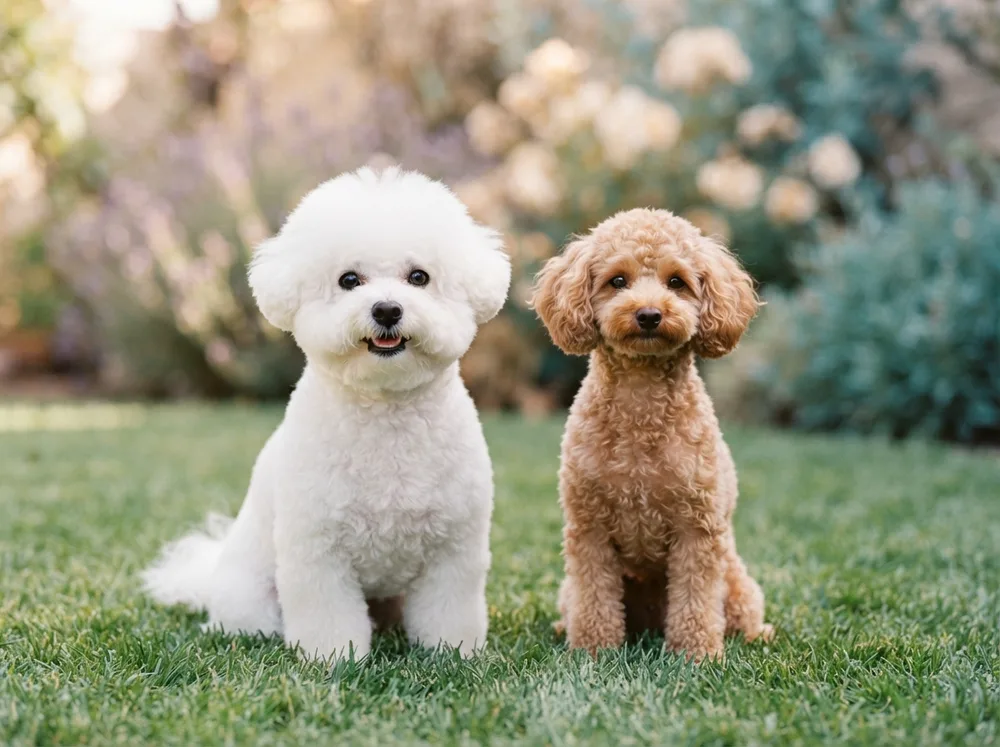
Which is better, a Bichon Frise or a Toy Poodle?
The Bichon Frise and Toy Poodle are close cousins: both small, curly, genuinely low-shedding and HDB-approved. The real split is temperament: the Toy Poodle is more energetic and endlessly trainable, the Bichon merrier and steadier, a born lap companion. Neither is hypoallergenic. If you truly want a Poodle, our sister site poodle.sg will serve you better.
Bichon Frise vs Toy Poodle
Bichon Frise vs Toy Poodle: the honest short answer
Line up a white Bichon Frise beside a Toy Poodle and it is easy to see why Singapore families cross-shop the two. Both are small, curly-coated, genuinely low-shedding companion dogs bred for one job: sitting on your lap and adoring your household. Both are HDB-approved, both need the same serious grooming, and both will have charmed your mother-in-law by Tuesday. If you have typed bichon frise vs poodle into Google at 11pm, you are really asking a narrower question than it looks, and this page answers it the honest way, from a shop that keeps only one of the two breeds.
Here is the short version before the detail. The real differences are not in the coat, where the two are near twins, but in temperament, energy and colour. The Toy Poodle is one of the most intelligent, trainable and energetic dogs on earth, a joy for an owner who loves training and a handful for one who does not. The Bichon is merrier and steadier, a born lap companion that asks a little less of you. One note on scope: this whole comparison means the Toy Poodle, the pocket-sized cousin, not the large Standard Poodle that towers over a Bichon and never sees the inside of an HDB flat.
Both
HDB-approved small breeds
4–6 wks
pro grooming, both breeds
White
Bichon only vs many Poodle colours
12–16 yrs
lifespan, both breeds
Bichon Frise vs Toy Poodle at a glance
If you want the whole comparison on one screen, here it is. Every row is written Bichon-first but scored fairly, because the point of this page is the right dog for your home, not an easy sale for ours. Read across each trait, then drop into the honest prose below for the why behind every line.
| Trait | Bichon Frise | Toy Poodle |
|---|---|---|
| Coat | Curly double coat, soft and dense, genuinely low-shedding | Curly single coat, no undercoat, also genuinely low-shedding |
| Colours | White only (a little buff or apricot shading allowed) | Many coat colours: black, white, apricot, red, cream, silver, brown, parti |
| Grooming | Brush most days, professional groom every 4 to 6 weeks | Same commitment: brush most days, groom every 4 to 6 weeks |
| Size | Sturdier, about 5 to 8kg, round head, short muzzle | Similar or smaller, often 2 to 4kg, finer, longer muzzle |
| Temperament | Merry, steady, uniformly outgoing, a touch clownish | Brilliant and sensitive, very trainable, can be reserved with strangers |
| Energy & exercise | Moderate: a good daily walk and play satisfy most | Higher: needs more exercise plus real mental work |
| Barking | Alert barking at the door, manageable with training | Quick and clever, can bark from boredom if under-stimulated |
| Trainability | Bright, willing and food-motivated, a keen student | Exceptional, among the most intelligent of all breeds |
| Health & lifespan | Bladder stones, dental, skin; lifespan about 12 to 15 years | Patellar luxation, eye conditions, dental; often 14 to 16 years |
| Price in Singapore | $3,500–$6,000 all-in, our own band | Varies widely by colour and size; ask poodle.sg |
| HDB status | HDB-approved, item 4 of 62 | Toy Poodle approved at item 42; large Standard Poodle does not qualify |
Coat, colours and grooming: near twins with one clear split
Start where the two breeds look identical, because that is where most of the confusion lives. Both wear a curly coat that is genuinely low-shedding, and the mechanism is the same on each: the dead hair catches in the curl instead of drifting onto your sofa. The difference under the fluff is quiet. A Bichon carries a soft double coat, a dense undercoat beneath the curly outer layer; a Toy Poodle has a single curly coat with no undercoat at all. Both feel like a warm cloud, and neither leaves fur on your black work trousers, which is the whole reason flat-dwellers fall for them.
The honest split is colour, and the myth. A Bichon Frise comes in white, full stop, with at most a little buff or apricot shading that a puppy grows out of. A Toy Poodle arrives in a paintbox of coat colours: black, white, apricot, red, cream, silver, brown and parti, which is a genuine reason some buyers lean Poodle. What neither breed is, whatever the listing promised, is hypoallergenic. No dog is. Allergens live in dander and saliva rather than in hair, so low shedding spreads less allergen around a home without ever removing it. Both breeds also share one non-negotiable bill: a professional groom every four to six weeks for life, or the curl mats down to the skin. Our shedding and allergy guide tells that whole story straight.
Size and build: the sturdy cloud and the dainty athlete
Size is where the two part company on the scales. A grown Bichon Frise is a sturdy little dog of roughly 5 to 8kg, stocky and round, with a broad head, a short muzzle and dark eyes set in that famous powder-puff face. Pick one up and it feels solid, which is part of why the breed copes so cheerfully with children and busy family floors.
A Toy Poodle is usually similar or a touch smaller and finer, frequently in the 2 to 4kg range, with longer legs, a longer muzzle and a lighter, more athletic frame. If that feels too dainty, the Miniature Poodle, its bigger sibling, lands much closer to the Bichon in weight. Both breeds are true small dogs that suit an HDB flat, so this is about feel and sturdiness, not one being a giant. If you want a robust, low-slung cuddle, the Bichon has the edge; if you like a springy little athlete, the Toy Poodle wins the point.
Size and build at a glance
- Bichon Frise: about 5 to 8kg, stocky and sturdy
- Toy Poodle: often 2 to 4kg, finer and lighter
- Bichon: round head, short muzzle, powder-puff face
- Poodle: longer legs and muzzle, athletic frame
- Miniature Poodle sits closer to Bichon weight
- Both are true small breeds for HDB flats
Temperament: merry and steady versus clever and busy
This is the heart of the bichon frise vs poodle decision, and it is where honest advice earns its keep. The Bichon Frise is the merrier, steadier of the two: relentlessly cheerful, uniformly sociable with strangers, children and other dogs, and content to clown around the flat without demanding a job. It is an easygoing extrovert that treats every visitor as a friend it simply has not met yet. That even temperament is exactly why the breed makes such a forgiving first dog.
The Toy Poodle is a different, dazzling animal. It is one of the most intelligent and trainable breeds in the world, quick to pick up tricks, obedience and household routines that leave a Bichon owner blinking. That brilliance carries a flip side. A Poodle is more sensitive, often bonds intensely with one person, can be a little reserved or aloof with strangers, and grows bored and mischievous without regular mental work. Give a Toy Poodle a job and it shines; leave it under-stimulated and it will invent its own, usually a noisy one.
The Toy Poodle is the class genius who needs homework; the Bichon is the sunny classmate everyone likes. Choose the one whose daily demands match your life, not the one who photographs best.
Energy, exercise and barking in a Singapore flat
Match the energy to your home and you will be happy with either breed. A Bichon Frise has moderate needs: a solid daily walk, a play session and a stretch of lap time cover it, which fits the rhythm of HDB life and a working household. A Toy Poodle runs hotter. It wants more exercise and, just as importantly, more mental stimulation, the puzzle toys, the training games, the new places, or that clever brain turns restless on you.
Barking follows the same logic, and it deserves a straight answer, since noise is the top worry for close HDB neighbours. Neither breed is silent. Both are alert little watchdogs that will announce the lift, the delivery man and the cat two floors down. The Bichon tends to bark from excitement, or, if it is over-attached, from separation; the Toy Poodle more often barks from boredom when its mind is left idle. Both are very manageable with early training and enough to do, and both fare far better when they are not left alone for long, unbroken days.
The flat-living verdict on energy and noise
For a quieter, moderate companion that slots into a working HDB household, the Bichon is the gentler default. For an active owner who enjoys training and can burn off a busy brain daily, the Toy Poodle is superb. Under-exercise either one and you get barking; that is on the routine, not the breed.
Health and lifespan: two long-lived small breeds
Both breeds are built to last, and both come with a short list of conditions worth knowing before you commit. The Bichon Frise is generally hardy, with a lifespan around 12 to 15 years. Its watch-items are bladder stones and urinary trouble, dental disease in that small mouth, itchy skin and allergies, plus the patellar luxation, or slipping kneecap, common to many small breeds. Cataracts and other eye conditions turn up in the breed lines too.
The Toy Poodle is famously long-lived, often reaching 14 to 16 years and sometimes beyond. Its own list leans orthopedic and ocular: patellar luxation, progressive eye conditions, dental disease and, in some lines, a delicate windpipe. The honest headline for both is identical. Most of these risks are managed by buying from someone who does real health screening on the parents, keeps the puppy lean, and books routine dental care. Ask to see those health checks and meet the parents where you can, because a cross such as the poochon inherits from both sides and the same questions apply.
Health and lifespan at a glance
- Bichon lifespan about 12 to 15 years
- Toy Poodle often 14 to 16 years or more
- Bichon: bladder stones, dental, skin, luxating patella
- Toy Poodle: patellar luxation, eye conditions, dental
- Both: buy from real health screening of the parents
- Keep either lean and book routine dental care
Who each dog suits, and the honest route out
So which cloud is yours? Choose the Toy Poodle if you are an active, hands-on owner who genuinely enjoys training, wants a dog that can learn almost anything, and is happy to meet a busy brain halfway every single day. Choose the Bichon Frise if you want a merrier, lower-key lap companion, a uniformly friendly dog that forgives a first-timer and is content with a good walk and a warm knee. Families with young children often find the Bichon’s sturdier build and easygoing temperament the gentler fit; owners who dream of a clever training partner lean Poodle. Both, remember, are HDB-approved small breeds, the Bichon at item 4 and the Toy Poodle at item 42.
Now the part most comparison pages will not say out loud, because we breed only one of these dogs. If everything above has you set on a Toy Poodle, or on a poodle cross like a poochon or a maltipoo, you should buy from a specialist who lives and breathes that breed, not from a Bichon shop selling it as a sideline. Our sister brands exist for exactly this: poodle.sg for Poodles, and maltipoo.sg for the Maltese-and-Poodle cross. Tell them Curious Tails sent you. And if the honest verdict is a Bichon, the merrier, steadier, white curly companion every one of these clouds is measured against, then you are already in the right place. Compare it against the rest in our breed comparison hub, or come and meet ours at 2 Balestier Road #01-701.
Neither breed is better; they are different dogs for different homes. The Toy Poodle is the brilliant athlete, the Bichon the sunny companion, and the wrong reason to choose either is a colour chart or a hypoallergenic promise.
Keep exploring
Frequently asked questions
Is a Bichon Frise or a Toy Poodle better for me?
Neither is better in the abstract; they are different dogs for different homes. Choose the Toy Poodle if you are an active owner who loves training and wants a brilliant, highly trainable dog, and can give it real exercise and mental work every day. Choose the Bichon Frise if you want a merrier, steadier lap companion that is uniformly friendly, forgiving of a first-timer and happy with a good walk and plenty of cuddles. Both are small, low-shedding and HDB-approved, so the decision is really about temperament and energy, not coat.
What is the main difference between a Bichon Frise and a Toy Poodle?
Temperament and colour, not coat. Both breeds are small, curly and genuinely low-shedding, and both need grooming every four to six weeks. The Toy Poodle is more energetic and one of the most intelligent, trainable dogs alive, but also more sensitive and prone to boredom. The Bichon is merrier, steadier and more uniformly sociable, a natural lap dog. On looks, the Bichon is white only while the Toy Poodle comes in a wide range of coat colours.
Which is more hypoallergenic, a Bichon or a Toy Poodle?
Neither, because no dog is truly hypoallergenic, whatever the listings and even Google’s summary claim. Allergens are proteins in dander, saliva and urine, not in the hair itself, so a low-shedding coat spreads less allergen around a home without ever removing it. Both the Bichon and the Toy Poodle are honestly low-shedding, which helps many allergy households, but the only real test is spending 30 minutes with the actual dog before you commit. Our shedding and allergy guide walks through how to do that properly.
Are Bichon Frises and Toy Poodles the same size?
Close, with the Bichon usually the sturdier of the two. A grown Bichon Frise is a stocky 5 to 8kg with a broad head and short muzzle. A Toy Poodle is often smaller and finer, frequently 2 to 4kg, with longer legs and a longer muzzle. If you want a little more dog than a Toy Poodle, the Miniature Poodle sits closer to the Bichon in weight. Both are true small breeds that fit an HDB flat comfortably.
Do Bichon Frises bark more than Toy Poodles?
Neither breed is silent, and both are alert little watchdogs, so the real driver of nuisance barking is the routine, not the breed. A Bichon tends to bark from excitement or, if over-attached, from separation. A Toy Poodle more often barks from boredom when its clever mind is under-worked. Both settle well with early training, enough daily stimulation and not being left alone for long, unbroken days, which matters especially in a flat with close neighbours.
Which lives longer, and what health issues should I know about?
Both are long-lived small breeds. The Bichon Frise typically lives about 12 to 15 years and can be prone to bladder stones, dental disease, itchy skin and a luxating patella. The Toy Poodle often reaches 14 to 16 years or more, with patellar luxation, eye conditions and dental disease among its watch-items. For either breed, most risk is managed by buying from real health screening of the parents, keeping the dog lean, and staying on top of dental care.
Do you sell Toy Poodles, or only Bichon Frises?
Only purebred white Bichon Frises. We are a single-breed specialist, so if this comparison has convinced you that a Toy Poodle, or a poodle cross like a poochon or maltipoo, is the dog for you, we will send you to a specialist who lives and breathes that breed rather than sell it as a sideline. Our sister brands poodle.sg and maltipoo.sg cover exactly that ground. If a purebred Bichon is your match, come and meet ours.
Meet your Bichon
Come say hello at Balestier
2 Balestier Road #01-701, Singapore 320002 · Weekdays 12pm–6pm · Weekends 10am–6pm. Or message us first: tell us about your home and routine, and we'll tell you honestly if a Bichon fits.
Set on a Bichon, or pointed the honest way
If the merry white Bichon is your match, meet the puppies looking for a home right now. If the honest answer is a Toy Poodle or a poodle cross, tell us and we will point you to the right sister specialist.
See available puppies