Daily dental care
A Daily Dental Routine for Small White Breeds
Small white breeds like the Bichon pack a full set of teeth into a tiny mouth, so plaque and tartar build fast and dental disease starts young. Here is the daily routine that prevents it, the toothpaste that is safe, and the honest truth about chews, additives and the cost of a vet scaling in Singapore.
Nelson and Kim, Curious Tails · AVS licence AS24J00046
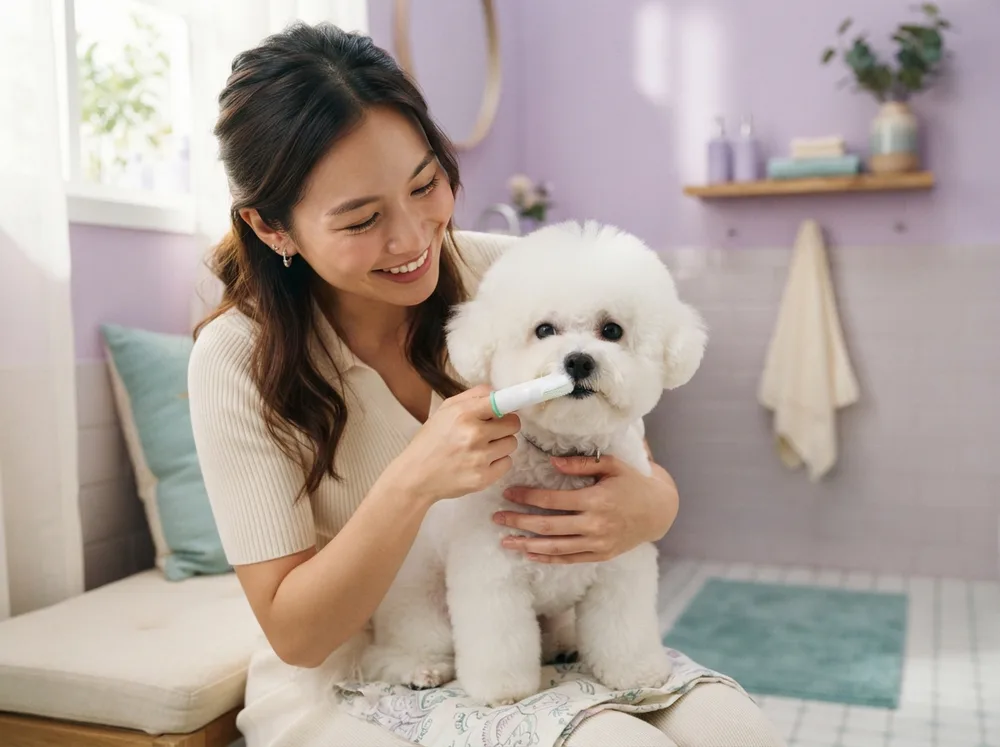
How do I keep my Bichon Frise’s teeth healthy?
Brush daily with dog toothpaste, never human toothpaste. Small white breeds crowd a full set of teeth into a little mouth, so plaque and tartar build fast and dental disease starts young. A daily minute with a soft finger brush is the cheap prevention that keeps you out of a costly scaling under anaesthetic.
Small mouths, big dental stakes
Why small white breeds are prone to dental disease
Here is the uncomfortable truth about the prettiest little dogs. A Bichon Frise, like the Maltese and the Toy Poodle it is so often confused with, carries the same forty-two teeth a Labrador does, but packs them into a jaw a fraction of the size. Those crowded teeth sit shoulder to shoulder with barely a gap between them, and every tight junction is a trap for food and plaque. Plaque is the soft, sticky film of bacteria that forms on teeth within hours of a meal, and in a roomy big-dog mouth a fair amount of it simply wears away with chewing. In a small breed mouth it has nowhere to go.
Left on the tooth for a day or two, that soft plaque hardens into tartar, the yellow-brown crust that no brush can shift once it has set. Tartar creeps under the gum, the body reacts, and the gums redden and swell into gum disease. Carry on ignoring it and it becomes periodontal disease, where the infection works down to the roots, loosens the teeth, and quietly seeds bacteria into the bloodstream, which is why dental care is really whole-body care and not vanity. This is why vets call dental disease the most common health problem they see in adult dogs, and why small breeds like the Bichon carry more than their share of it. It is not bad luck or bad ownership. It is the small-breed tax, and it starts far younger than most owners expect, often well before a dog’s third birthday. Our Bichon health guide sets dental disease alongside the breed’s other watch-points.
Why the small mouth loses
- Forty-two teeth crammed into a tiny jaw
- <strong>Crowded teeth</strong> trap food and <strong>plaque</strong> at every junction
- Plaque hardens to <strong>tartar</strong> within a day or two
- Tartar under the gum drives <strong>gum disease</strong>
- Untreated, it becomes <strong>periodontal disease</strong> and tooth loss
- The small-breed tax often starts before age three
The one rule that matters most: dog toothpaste, never human
Before any technique, one rule sits above the rest, because getting it wrong can genuinely harm your dog. You must use dog toothpaste, and you must never use human toothpaste. The reason is not fussiness. Dogs cannot rinse and spit, so they swallow whatever you brush with, and human paste is designed to be spat out. Most human toothpaste carries fluoride in amounts meant for a rinsing adult, and a worrying number of ‘sugar-free’ brands contain xylitol, an artificial sweetener that is harmless to us and dangerous, even life-threatening, to dogs. Even the foaming agents that make our paste lather can upset a dog’s stomach.
Proper dog toothpaste is built to be swallowed and usually comes in flavours a dog genuinely wants, poultry, beef or malt, which quietly turns the whole job into something your Bichon looks forward to. Many are an enzymatic toothpaste, meaning they keep working against bacteria chemically even in the spots the brush does not quite reach. Then pair it with the right tool. For a small mouth, a soft finger brush that slips over your fingertip gives you the most control and feels the least intrusive to the dog, and a small-headed dog toothbrush works well once your Bichon is used to the idea.
Never use human toothpaste on a dog
Dogs swallow what you brush with, and human paste is not made for that. Skip it entirely, and check the label of any paste for these:
- Xylitol or a ‘sugar-free’ sweetener, which is toxic to dogs even in small amounts
- Fluoride, dosed for a rinsing adult and not for a dog that swallows
- Foaming detergents that upset the stomach
- When in any doubt, use a vet-approved dog toothpaste only
The daily brushing routine, step by step
Here is the whole routine, and the good news is that it takes under two minutes once your dog is on board. The secret is not force, it is building tolerance a little at a time, ideally from puppyhood, so the brush becomes a normal part of the evening rather than a wrestling match. Go at your Bichon’s pace across a week or two, not a single sitting.
- Let the dog taste the paste. Put a little dog toothpaste on your finger and let your Bichon lick it off, for a few days if needed, so the flavour becomes a treat rather than a surprise.
- Introduce the brush. Smear the paste onto a finger brush and let the dog lick it straight from the bristles, so the tool arrives attached to something nice.
- Lift the lip, touch a few teeth. Gently raise the lip and rub the brush over just the big outer teeth for a few seconds, then stop and praise. Build up to more teeth over several sessions.
- Brush at the gumline. Hold the brush at a 45-degree angle to the gumline and work in small circles, because the edge where tooth meets gum is exactly where plaque does its damage.
- Favour the outsides. The outer surfaces facing the cheek collect the most tartar, while the tongue keeps the inner faces cleaner, so a quick pass over the outsides earns most of the benefit.
- Finish on a high note. End every session with a treat, a game or a cuddle, so the routine files itself under good things and tomorrow is easier than today.
Aim to brush daily. If life truly gets in the way, three times a week is the honest minimum that still holds plaque back, but daily is what keeps a small mouth genuinely ahead of the tartar. Consistency beats intensity every time: sixty unhurried seconds tonight does far more than a heroic ten-minute scrub once a fortnight.
What else helps, and what quietly does not
Brushing is the one thing that genuinely works, and everything else is a helper at best. That is worth saying plainly, because the pet-shop shelf is full of products that hint they can replace the brush, and none of them can. Used alongside daily brushing, though, several are worth having, and one or two are worth avoiding.
The pattern is clear once you see it. Chews, additives and dental diets all nibble at the edges of the problem, while the brush is the only tool that actually reaches the gumline where dental disease begins. Use the helpers if you and your dog like them, but never let them talk you out of the daily minute that does the real work.
| What it is | Does it help? | The honest verdict |
|---|---|---|
| Dental chews | Yes, a little | A vet-recommended chew scrapes some plaque as the dog gnaws and freshens the breath. A helper, never a substitute for the brush, and mind the extra calories. |
| Water additives | Modestly | Tasteless liquids added to the water bowl can slow bacteria a little. Effortless to use, but no water additive cleans a tooth the way bristles do. |
| Dental diets | Somewhat | Large, fibrous kibble designed to wipe the tooth as the dog bites. Useful for some dogs, but it only reaches the crown, not the gumline. |
| Ordinary dry food | Barely | The old belief that any kibble cleans teeth is mostly a myth. Most dogs crunch once and swallow, so it does little against tartar. |
| Raw bones and antlers | Risky | Bones and antlers can crack a small dog’s teeth outright, and vets see the fractures. Not a gamble worth taking on a Bichon. |
Professional scaling, and why it needs anaesthetic
Even with faithful brushing, most dogs need a professional clean at some point, because no home routine removes tartar that has already hardened, or cleans below the gum where the real trouble hides. This is a veterinary scaling and polish, the same idea as your own dental visit but done thoroughly on a dog. The catch, and the reason it costs what it does, is that it is carried out under anaesthetic. A dog will not lie still with its mouth open while a vet cleans every surface, probes each gum pocket and takes X-rays, so general anaesthesia is simply what makes a complete, safe, genuinely useful clean possible.
In Singapore a routine scaling under anaesthetic commonly runs to a few hundred dollars, and climbs from there once X-rays, extractions or the treatment of advanced periodontal disease are involved, which is precisely why prevention is the smart money. You will also see clinics and groomers offering anaesthesia-free cleaning for less. Be careful there. Without anaesthetic a groomer can only scrape the visible surfaces, which looks tidy but leaves the plaque under the gumline untouched, the very place that matters, while the scraping itself can stress the dog and scratch the enamel. Most vets regard it as cosmetic rather than treatment. The full picture of what a Bichon costs to keep, vet care included, sits in our Bichon price guide.
A daily minute with a finger brush is the cheapest dental care there is. The alternative is a scaling under anaesthetic that costs a few hundred dollars, and far more once teeth start coming out.
The warning signs that mean book a vet
Because dental disease builds slowly and hides at the back of the mouth, it is easy to miss until it is well advanced. The earliest and most reliable clue is the one owners tend to laugh off: breath. Healthy dog breath is not minty, but it should not be foul either. Persistent bad breath is not simply doggy charm, it is the smell of bacteria multiplying along the gumline, and it is usually the very first sign worth acting on.
Look, too, at the mouth itself now and then. Red gums, especially an angry red line right where the gum meets the tooth, mean inflammation is already underway. A brown or yellow crust of tartar along the teeth, new drooling, a dog that suddenly chews on one side or drops its food, pawing at the mouth, or a loose or missing tooth, are all reasons to book a vet rather than wait and see. Some Bichons begin to lose teeth from around seven when years of plaque were never managed, and loose front teeth in a young dog are never normal. Caught early, most of this is reversible with a clean and a fresh start on brushing. Left late, it costs teeth.
See a vet if you notice
- Persistent <strong>bad breath</strong>, the first and most reliable sign
- <strong>Red gums</strong>, or a red line right at the gumline
- A brown or yellow <strong>tartar</strong> crust on the teeth
- Chewing on one side, dropping food, or new drooling
- Pawing at the mouth or obvious discomfort
- Any loose, wobbly or missing tooth
Start early, and start today
If there is one thing to carry away from this page, it is that dental disease is almost entirely preventable, and the single biggest lever is when you begin. The rule the vets all repeat is to start early. A puppy that learns at nine weeks that a finger brush means a tasty flavour and a cuddle grows into a dog that offers up its mouth without a fuss, and a lifetime of easy daily brushing is what keeps the tartar, the scaling bills and the lost teeth away. Begin at eight years old, with the gums already sore, and everything is harder for both of you.
That is the honest whole of it. It is not glamorous, it is not expensive, and it works: a minute a day with the right dog toothpaste, a few sensible helpers, and a vet clean when your vet judges it is due. Every Bichon that leaves our Balestier shop goes home already vet-checked and set up for the right start, and we are glad to show you how to hold the brush and win over a wriggling puppy before you take one home. Our skin and humidity guide covers another Singapore care habit worth building early.
The reassuring bottom line
Dental disease is common in small white breeds, but it is also one of the most preventable problems your Bichon will ever face. A daily minute now saves teeth, money and discomfort later. Start young, keep it kind, and let your vet handle the deep scaling when it is genuinely due.
Keep exploring
Frequently asked questions
How often should I brush my Bichon Frise’s teeth?
Daily is the goal. A small mouth full of crowded teeth builds plaque and tartar fast, so a sixty-second brush every evening is what keeps dental disease at bay. If daily is genuinely impossible, three times a week is the honest minimum that still helps, but treat it as a floor, not a target. Consistency matters far more than a long, occasional scrub.
Can I use human toothpaste on my Bichon?
No, never. Dogs cannot rinse and spit, so they swallow whatever you brush with, and human toothpaste is not made to be swallowed. Many sugar-free pastes contain xylitol, a sweetener that is toxic and even life-threatening to dogs, and the fluoride and foaming agents are not safe for them either. Use a vet-approved dog toothpaste only, which comes in poultry or beef flavours your Bichon will actually enjoy.
Do dental chews and water additives replace brushing?
No. Dental chews scrape a little plaque as the dog gnaws, and water additives slow bacteria modestly, so both are useful helpers alongside brushing. But none of them reaches the gumline the way bristles do, which is where dental disease actually begins. Think of chews and additives as extras that support the brush, never as a substitute for the daily minute itself.
How much does dog teeth scaling cost in Singapore, and why does it need anaesthesia?
A routine scaling and polish at a Singapore vet commonly runs to a few hundred dollars, and more once X-rays or extractions are needed. It is done under general anaesthetic because no dog will hold still with its mouth open while every surface is cleaned and each gum pocket is checked, so anaesthesia is what makes a thorough, safe clean possible. Anaesthesia-free cleaning only scrapes the visible surfaces and leaves the important part, below the gumline, untouched.
Is it too late to start brushing my adult Bichon’s teeth?
It is never too late, though starting young is far easier. Introduce the brush gradually over a week or two, letting your dog taste the toothpaste first and building up a few teeth at a time with plenty of praise. If there is already heavy tartar or red gums, book a vet clean first, so you are brushing a fresh, comfortable mouth rather than a sore one.
What are the warning signs of dental disease in a Bichon?
The first and most reliable sign is persistent bad breath, which is the smell of bacteria along the gumline. Watch also for red gums, a brown or yellow tartar crust, new drooling, chewing on one side or dropping food, pawing at the mouth, and any loose or missing tooth. Loose front teeth in a young dog are never normal. Caught early, most dental disease is reversible, so book a vet at the first of these signs.
Meet your Bichon
Come say hello at Balestier
2 Balestier Road #01-701, Singapore 320002 · Weekdays 12pm–6pm · Weekends 10am–6pm. Or message us first: tell us about your home and routine, and we'll tell you honestly if a Bichon fits.
Want a puppy that starts right?
Every Bichon from our Balestier shop goes home vet-checked and set up for good habits, dental care included. See who is looking for a home right now.
See available puppies