Family-fit, told honestly
Are Bichon Frises Good Family Dogs?
Yes, and genuinely one of the best small family dogs for the right home. Here is the honest picture: the gentle temperament that suits children and other pets, plus the three caveats every family should plan for before falling for the fluff.
Nelson and Kim, Curious Tails · AVS licence AS24J00046
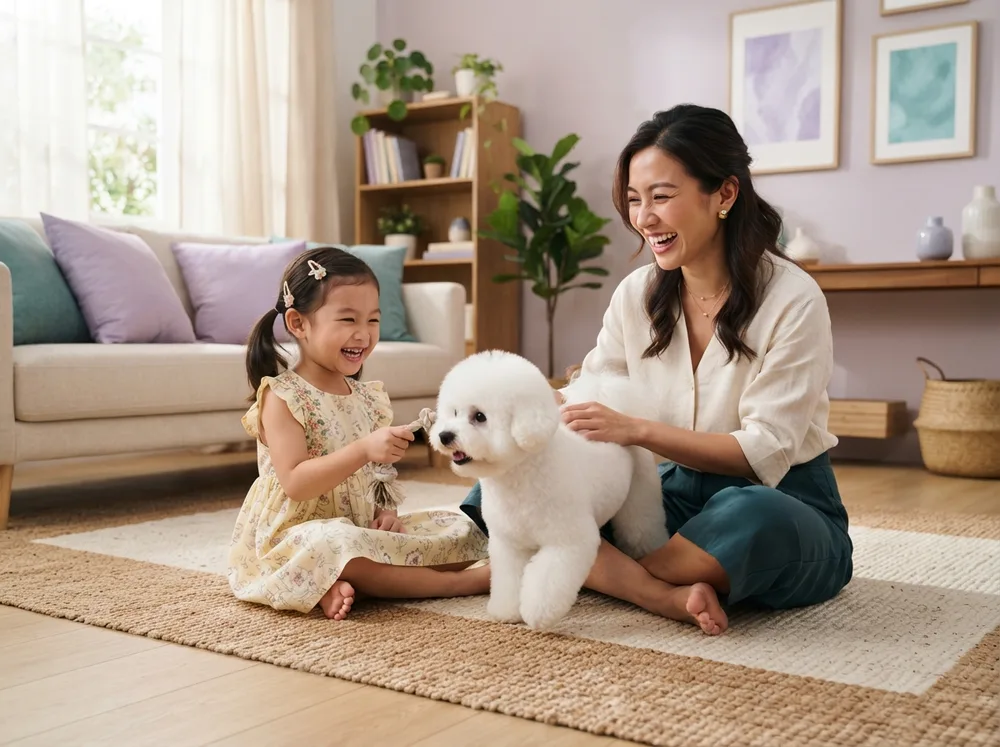
Are Bichon Frises good family dogs?
Yes, and genuinely one of the best small family dogs. The Bichon Frise is gentle, merry and sturdy for a small breed, good with children and good with other pets. The honest caveats: supervise toddlers, plan for separation anxiety if the flat empties all day, and budget the grooming commitment.
Gentle, merry, built for family life
The honest yes: the temperament that makes a family dog
So, the question families actually type into the search bar at midnight: are Bichon Frises good family dogs? Yes, and genuinely one of the best small ones. The whole reason is temperament. The Bichon is merry, gentle and endlessly affectionate, a cheerful little dog that seems delighted by everyone in the household and treats the family as its entire world. It is playful without being highly strung, soft with visitors, and quick to flop belly-up for a rub from whoever is nearest.
That sunny nature is not marketing, it is the breed. Developed over centuries as a companion, the Bichon leads with warmth and asks for company in return, which is exactly what most families want in a first pet. It is good with children of all ages, good with other dogs, and small enough to suit an HDB flat, the reasons it sits so comfortably on the shortlist for Singapore homes. But a good family dog is a match, not a guarantee, so the rest of this guide gives you the honest version: where the Bichon shines, and the caveats to weigh before you decide.
Why the Bichon fits family life
- Merry, gentle and affectionate by nature
- Good with children and patient in a busy home
- Good with other dogs, easy in a multi-pet flat
- Sturdy for a small breed, not a fragile teacup
- Playful in bursts, then a happy lap dog
- Small enough for an HDB flat, no garden needed
Bichons and young children: sturdy, soft, but supervise the toddlers
With kids, the Bichon has a genuine advantage over the tiniest toy breeds: it is sturdy for a small breed. A grown Bichon weighs roughly 5 to 8kg on a solid little frame, not the fragile two kilos of a teacup dog, so it copes with the noise, movement and gentle rough-and-tumble of a busy home far better than its size suggests. It is patient, rarely snappy, and tends to adore the child who feeds it and plays with it. For families with school-age children who have been taught how to behave around a dog, it is close to ideal, and it stays good with kids of all ages once those basics are in place.
The honest caveat is about the youngest ones. A 6kg dog is still a small dog, and a toddler who grabs, squeezes or trips onto it can hurt it, or startle even a sweet-natured dog into a warning snap. This is a matter of toddler supervision, not a breed flaw. Teach little ones to stroke gently and never to disturb the dog while it sleeps or eats, and give the Bichon a retreat it can always reach: a crate, a playpen or a quiet corner where the rule is that nobody follows. Get those two habits right and the friendship between a Bichon and a small child is one of the loveliest things you will ever watch unfold.
The one rule with toddlers: supervise, every time
A Bichon is soft-natured but still a small dog. Never leave a toddler and any dog together unsupervised, teach gentle hands early, and make sure the dog always has a retreat it can escape to. Almost every small-dog nip in a family home traces back to a missed one of these three, not to a bad dog.
Bichons with other dogs and cats: the easy multi-pet fit
Adding a Bichon to a home that already has pets is usually the easy part. The breed carries almost none of the guarding or possessive edge that some toy dogs show, so it is good with other dogs and generally good with cats too, especially when it is raised alongside them from puppyhood. A well-socialised Bichon would far rather make a friend than defend a corner, which is why it settles into a multi-pet home with so little drama. Slow, supervised introductions on neutral ground still matter, as they do for any new pairing, but the raw material here is a sociable, easygoing dog.
There is a Singapore footnote worth knowing. Since 1 September 2024, HDB flats may keep up to two licensed cats alongside one approved dog, so a mixed cat-and-dog household is now firmly within the rules, and the Bichon is a gentle fit for it. If you are weighing a second dog rather than a cat, that is a real decision with real trade-offs, and our guide on one Bichon or two walks through whether a playmate genuinely helps or simply doubles the grooming and the cost.
The caveats every family must plan for
No honest family-dog guide stops at the charm, so here are the pros and cons that matter, starting with the three things to plan for before a Bichon comes home. The first and biggest is separation anxiety. This is a velcro dog that bonds hard and wants its people nearby, and a flat that empties at 7am for work and school and stays empty until evening is the classic trigger. Left alone too long, too regularly, an anxious Bichon barks, howls, scratches at doors and can lose its potty training, and it is the single most common reason the breed is given up, here and everywhere.
The second caveat is the coat. A Bichon is beautiful because someone maintains it, and that grooming commitment is real: brushing most days to prevent mats, plus a professional groom every four to six weeks for the whole of the dog’s life. The third is simply the flip side of that lovely small size, the toddler care already covered above. None of the three is a dealbreaker for the right home. They are the questions a caring family answers before buying, not the surprises it discovers in month two.
A Bichon fits the family that is actually around. If someone is home most days, nearly everything else about the breed is easy; if nobody is, no amount of charm fixes the maths.
The exercise and grooming commitment, in real numbers
Families often over-estimate how much exercise a Bichon needs and under-estimate the grooming. On the exercise side it is refreshingly modest: two short daily walks and a game of fetch down the corridor keep a Bichon happy, which is part of why it suits flat life and busy parents so well. It is playful in bursts, tears off on its daily zoomies, then settles contentedly onto the nearest lap. No garden required, no marathon needed, which makes the energy side of the commitment easy for most homes to meet.
The grooming is the part that catches people out, and it is the honest cost of that cloud-white coat. Budget for a professional groom every four to six weeks, brushing at home in between, and the recurring bill that comes with both. The same coat is the reason the breed is genuinely low-shedding and friendlier for many allergy households, though no dog is ever truly hypoallergenic, and we tell that story straight in our shedding and allergy guide. Price the grooming in before you buy rather than after, and there are no nasty surprises waiting for the family budget.
5–8 kg
Adult weight, sturdy for a toy breed
2 × 20 min
Daily walks most Bichons want
4–6 weeks
Professional groom, for life
12–15 yrs
A companion that grows up with the kids
A good first dog, and a good dog for seniors
Two groups ask us this constantly, and for both the answer is a warm yes with one shared asterisk. For first-time owners, the Bichon makes a strong first dog because it wants to get things right: it responds beautifully to kind, reward-based training, shrugs off beginner mistakes, and rarely tests you the way a headstrong working breed will. For seniors, it is close to a perfect companion, small enough to lift and handle easily, light on exercise demands, and happiest doing exactly what a retiree can offer in abundance, which is company all day long.
The single asterisk is the same one that runs through this whole guide. A Bichon needs a household that is around for a good part of the day, so the hardest fit is the busy family or the working individual whose home sits empty from morning to night. If that is your schedule, the honest move is to fix the day-structure first, with a midday walker, a slow alone-time plan and ideally a second adult on a different shift, or to wait until life allows it. We would genuinely rather say so before a sale than take a dog back after one.
Who a Bichon suits, and who should wait
- Families with school-age children: easy, sturdy, affectionate
- Families with toddlers: lovely, with supervision and a retreat
- Multi-pet homes: sociable with dogs and cats, little guarding
- First-time owners: forgiving, trainable, a strong first dog
- Seniors and retirees: small, gentle, thrives on all-day company
- Empty-all-day homes: plan hard for separation anxiety, or wait
Match the Bichon to your household
Every family is different, so here is the whole thing as a grid: the common Singapore household types and how a Bichon really fits each, honestly rated rather than sold. Find the row that looks most like your home, and you have the short version of whether this cheerful little cloud belongs in it.
| Household type | How a Bichon fits |
|---|---|
| Family with a baby or toddler | A lovely match with active supervision. Teach gentle handling, give the dog a guaranteed retreat, and never leave the two alone together. |
| Family with school-age kids | Close to ideal. Sturdy for a small breed, patient and playful, and the children can help with the brushing and training. |
| Multi-pet home (dogs or cats) | An easy fit. Good with other dogs and cats, with little guarding, and HDB now allows two cats alongside one approved dog. |
| First-time owners | A strong first dog: tolerant of beginner mistakes and quick to learn, as long as someone is home for a good part of the day. |
| Seniors or retirees | Excellent. Small, affectionate and light on exercise, and the all-day company a retiree offers suits the breed perfectly. |
| Home empty all day | The hard case. Plan for separation anxiety first, with a midday break and slow alone-time training, or honestly reconsider the timing. |
Meet one before you decide
Here is how we would end it, as a shop that places these dogs every week. A good family dog is never just a breed, it is a breed in the right home, and the Bichon Frise earns that title in more Singapore homes than almost any dog its size. It is gentle, good with children, easy with other pets and built for flat life, with three honest caveats you now know to plan for. Come and meet the puppies at 2 Balestier Road #01-701, or message us first and tell us about your family and your week, and we will give you the same straight answer we give every buyer: how a Bichon would fit, or whether to wait a little.
Keep exploring
Frequently asked questions
Are Bichon Frises good family dogs?
Yes, and one of the best small breeds for it. The Bichon Frise is merry, gentle and affectionate, good with children and good with other pets, and small enough to suit an HDB flat, so it genuinely earns the family-dog label in most Singapore homes. The honest caveats are three: supervise toddlers, plan for separation anxiety if the flat sits empty all day, and budget the grooming commitment.
Are Bichon Frises good with young children and toddlers?
Yes, with supervision. A Bichon is sturdy for a small breed and patient with the noise of a busy home, which makes it a lovely fit for school-age kids who have learned to handle a dog gently. With toddlers it is the adults’ job to supervise every interaction, teach gentle hands, and give the dog a retreat it can escape to. Get those habits right and it is a wonderful match.
Are Bichon Frises good with other dogs and cats?
Yes on both counts. Bichons are good with other dogs and generally good with cats, with little of the guarding or snappiness some toy breeds show, so they slot into a multi-pet home with minimal fuss, especially when raised alongside other animals. Introduce new pairings slowly and on neutral ground. In Singapore, HDB now allows up to two licensed cats alongside one approved dog, so a mixed household is within the rules.
Can a Bichon Frise be left alone while the family is at work and school?
Only with a real plan. The Bichon is a velcro dog that bonds hard, so a flat left empty for eight or nine hours, with no midday break and no gradual alone-time training, is the classic trigger for separation anxiety: barking, howling and lost potty habits. Some families make it work with a dog walker, a playpen and slow training. If nobody can be home for much of the day, this is the breed’s hardest fit and worth an honest rethink.
Are Bichon Frises good for first-time owners or seniors?
Yes to both, with one shared asterisk. First-time owners get a forgiving breed that wants to cooperate and picks up training quickly. For seniors it is close to ideal: small, gentle, light on exercise and happiest with all-day company. The asterisk is the same for everyone, the dog needs a household that is home for a good part of the day, so an empty-all-day schedule is the one situation to fix first.
What is the downside of a Bichon Frise as a family dog?
There are three honest downsides. Separation anxiety is the big one: this is a velcro breed that struggles with long days alone. The grooming commitment is real, with a professional groom every four to six weeks plus brushing in between for life. And the small size means toddler supervision is non-negotiable. None is a dealbreaker for the right home, but every family should know all three before falling for the fluff.
Do Bichon Frises bark a lot in an HDB flat?
Not by nature, but they announce things: the lift, the delivery rider, footsteps outside the door. With calm training from puppyhood plus enough company and exercise, that announcement stays a single bright woof rather than a session, and neighbours rarely hear the dog at all. A Bichon that barks all day is nearly always a bored or lonely Bichon, which loops back to the separation-anxiety point above.
Meet your Bichon
Come say hello at Balestier
2 Balestier Road #01-701, Singapore 320002 · Weekdays 12pm–6pm · Weekends 10am–6pm. Or message us first: tell us about your home and routine, and we'll tell you honestly if a Bichon fits.
Ready to meet one?
Every Bichon in our shop is HDB-approved, health-checked and raised for family life. Tell us about your household and we will help you find the right fit, or say honestly if the timing is not right yet.
See available puppies