Barking, managed kindly
Managing the Bichon Alert Bark in Close Quarters
The Bichon is a merry little watchdog, not a yappy dog, but in an HDB block even a bright alert bark carries straight to the neighbours you share a wall with. Here is how to read the bark, fix it at the trigger, and stay the quiet unit on the corridor.
Nelson and Kim, Curious Tails · AVS licence AS24J00046
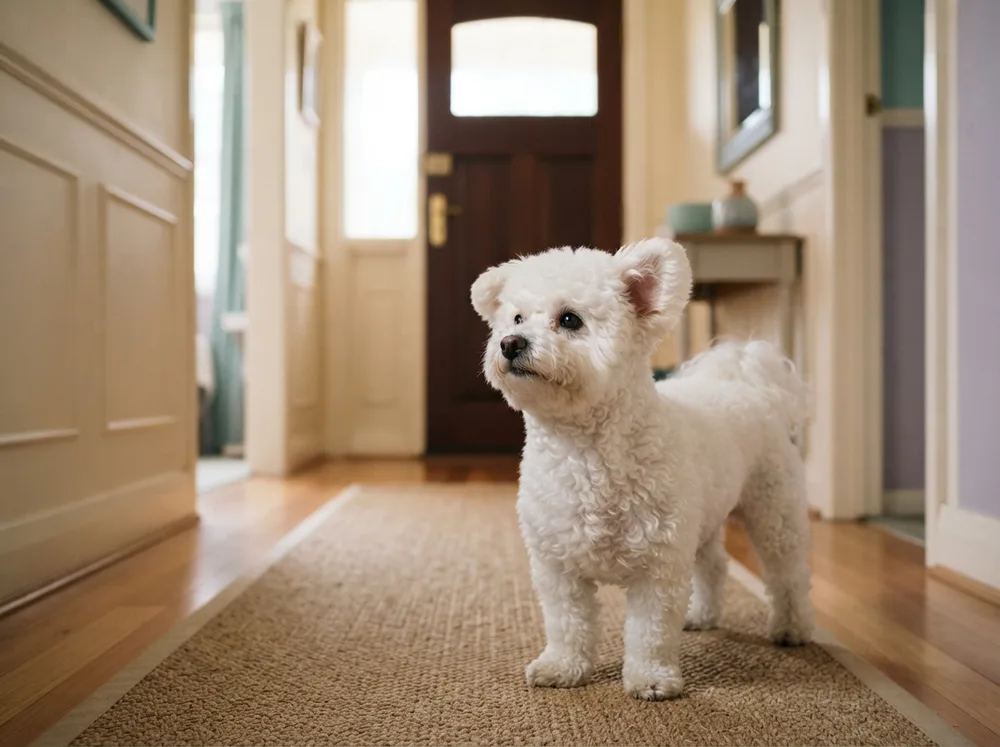
Do Bichon Frises bark a lot, and can it be managed in an HDB flat?
Bichons have a bright alert bark, higher and softer than a terrier’s but never silent. It is very manageable once you name the trigger and teach the quiet cue, and it matters most in an HDB block, where a shared corridor carries every bark to the neighbours on the other side of your wall.
Quiet corridors, happy neighbours
A merry watchdog, not a yappy dog
The honest headline first, because it is the opposite of what most people expect from a small white dog. The Bichon Frise is not a yappy breed. Ask the American Kennel Club and you get the verdict every good breeder repeats: an alert, attentive dog, but one for whom incessant barking simply is not a regular habit. What the Bichon is, instead, is a merry little watchdog. Bred for centuries as a companion and a pint-sized lookout, it takes announcing the world seriously: the doorbell, the lift arriving on your floor, the delivery rider padding down the corridor, next door’s cat on the ledge. That bright alert bark is not misbehaviour, it is the breed doing precisely the job it was made for.
So bichon frise barking is real, but it is not the ceaseless yapping some toy breeds are famous for. A Bichon’s bark sits higher and softer than a terrier’s, and it tends to come in short bursts tied to a trigger rather than as a constant background drone. Learn the handful of reasons a Bichon speaks up and you can manage almost all of it. There are really five: the alert bark at a sound, demand barking for attention or food, barking that comes from plain boredom, barking at night, and the barking that is actually separation anxiety wearing a disguise. Each one has its own fix, and treating them as a single problem is exactly why so many owners feel stuck.
A Bichon does not bark to annoy you. It barks to tell you something, and the whole skill is learning which of the five things it means.
First, name the trigger behind the bark
Before any technique works, you have to know which bark you are facing, because the fix for a doorbell alert is the near-opposite of the fix for a demand bark. Every good trainer starts in the same place: find out why. Spend two or three ordinary days as a quiet detective. Jot down the time, the sound or event in the seconds before the bark, where your Bichon was standing, and what happened next, paying special attention to whether the barking won it something it wanted.
A pattern appears faster than you would think. Barks clustered around 7am and 6pm are almost always the lift and the returning-neighbour rush. Barks the instant you reach for your keys are anxiety warming up. Barks that stop the second you glance over are demand barking, plain and simple. A bout that only happens on the days you skipped the walk is boredom. Once the trigger has a name, the right technique more or less picks itself, which is why this unglamorous step is the one that saves the most grief.
The five Bichon barks
- Alert bark: a sharp burst at the doorbell, the lift or a corridor sound
- Demand barking: aimed at you for food, play or a lap, and it stops the moment it works
- Boredom barking: aimless and repetitive, always worst on an under-exercised day
- Barking at night: a strange noise, a full bladder, or loneliness in a dark flat
- Anxiety barking: it starts as you leave and runs on while the flat is empty
A fix for every trigger
Here is the whole toolkit on a single grid. Match the bark you named above to its technique, and notice that not one of them involves shouting, which a Bichon simply hears as you barking along too. Every fix runs on the same gentle engine: positive reinforcement, rewarding the calm you want rather than punishing the noise you do not. Print this row of the internet, stick it on the fridge, and you have the plan in front of you.
| Trigger | What it is | The fix |
|---|---|---|
| Doorbell or lift | The alert watchdog bark at a corridor sound | Teach the quiet cue, then desensitise the sound by playing it low and rewarding calm |
| Demand barking | A bark aimed at you for food, play or a lap | Never reward it: wait for silence, then give the attention. Any pay-off teaches the bark |
| Boredom | Aimless nuisance barking, worst on an empty day | More enrichment: two real walks, puzzle toys and daily mental stimulation |
| Barking at night | Restlessness, a full bladder or a strange noise | A last toilet trip, a covered pen and steady white noise to mask the corridor |
| Separation anxiety | Barking that begins the moment you leave | A slow, structured alone-time plan; this is a distress problem, not a bark problem |
The quiet cue, and desensitising the door and lift
Two techniques do most of the heavy lifting, and both are the kind of reward-based training a Bichon genuinely enjoys. The first is the quiet cue. Wait for a natural bark, say “quiet” once in a calm, flat voice, and the very instant your dog pauses, even for a single breath, mark it with a bright “yes” and reward the quiet with a treat. Repeat until the word reliably predicts the reward, then begin asking for a beat or two more silence before you pay. Because the breed is so food-motivated, most Bichons have the idea inside a week or two of short, cheerful sessions.
The second technique is desensitising the trigger itself. If the doorbell or the lift chime is the culprit, record it, play it back at a whisper while your Bichon stays calm, reward that calm, then raise the volume by tiny steps across several days. You are patiently teaching the sound to mean “good things are coming” instead of “sound the alarm”. The same slow method tames the whole HDB corridor: a screen across the lower door gap and a blind drawn against the walkway quietly remove half the visual triggers before you train a single thing.
The quiet cue in five steps
- Let one natural bark happen, then say “quiet” once, calmly
- The instant the barking pauses, mark it with a bright “yes” and treat
- Reward the quiet; never shush with a treat mid-bark, which pays the bark
- Slowly ask for a longer silence before the treat arrives
- Keep sessions short and upbeat, and stop while the dog still wants more
The HDB angle: your neighbours share your wall
In a landed house an alert bark is background noise that dies in the garden. In an HDB block it is a shared event. Your front door opens straight onto a common corridor, sound ricochets off concrete and travels between units, and the neighbour on the far side of your bedroom wall hears the 7am lift-bark just as clearly as you do. This is the real reason barking management matters more here than almost anywhere else: a Bichon that is an angel inside your flat can still be the reason a folded note appears under your door.
Being a good corridor neighbour comes down mostly to not letting the barking rehearse itself unheard all day. HDB’s Code of Responsible Behaviour, the short promise every flat-owner signs, asks you to manage nuisance barking, and the estates that stay friendly are the ones where owners act on it long before a complaint is ever filed. A quick, honest word with your immediate neighbours helps enormously: tell them you are actively training, ask them to flag any daytime barking you cannot hear from inside, and you turn a looming complaint into a little goodwill. Our HDB rules guide sets out the wider good-neighbour code in full.
The neighbours never hear how sweet your Bichon is on the sofa. They only ever hear the bark through the wall, so that is the version of your dog you are really training.
What not to do: bark collars and quick fixes
Search for a shortcut and you will quickly meet the bark collar, in its citronella, ultrasonic and shock forms, so let us be plain: we do not recommend one for a Bichon, and most modern trainers are firmly with us. A bark collar punishes the noise without ever teaching the dog what to do instead, so the real cause, the boredom, the anxiety or the unmanaged doorbell, sits there untouched. For a sensitive, deeply people-focused toy breed, an aversive collar often trades barking for something worse: a fearful, shut-down dog, or barking that simply relocates to a moment the collar cannot catch.
The same caution covers shouting, squirt bottles and swooping in to grab the dog quiet. To a Bichon, any large reaction from you reads as attention, and attention is the precise prize a demand barker was fishing for in the first place. The kinder methods are not merely nicer to sit through, they genuinely work better and they last, because they resolve the cause instead of masking the sound for an afternoon.
Skip the bark collar
Citronella, ultrasonic and shock bark collars punish the sound without teaching an alternative, and on a sensitive toy breed they often breed fear or redirected barking. Train the quiet cue and fix the trigger instead: slower for a week, and better forever.
When the barking is really anxiety
One kind of barking deserves a plan of its own, because at heart it is not a barking problem at all. If your Bichon begins barking or howling the moment you leave and keeps going while the flat stands empty, that is separation anxiety, the breed’s single most common behavioural risk. This is a genuinely velcro dog, bred to live at your side, and no quiet cue reaches an animal that is barking from distress rather than habit. Punishing it, and a bark collar most of all, only stacks fear on top of panic.
The answer is to rebuild alone-time slowly and on purpose: short absences first, a safe playpen, food puzzles and enrichment, a midday break on the longest days, then gradually longer stretches solo. It is very manageable, but it is a separate project from everyday alert barking, and it is the reason we screen every buyer whose flat empties out during the day. Our Bichon separation anxiety plan lays out the full week-by-week routine, while the temperament guide explains why this sunny little breed feels an empty flat so keenly to begin with.
Keep exploring
Frequently asked questions
Do Bichon Frises bark a lot?
Not excessively. The Bichon is an alert dog rather than a yappy one: it gives a bright bark at a real trigger like the doorbell or the lift, then settles. It is not built for the constant background yapping some toy breeds are known for. Left bored or alone all day it will bark far more, so most heavy barking traces back to boredom or separation anxiety rather than the breed itself.
Are Bichon Frises yappy dogs?
No, despite the small-dog reputation. Bichons are alert and attentive, and they will announce a visitor, but incessant barking is not a normal Bichon habit. Because they are so social, the exception is being left alone too long, when an under-stimulated Bichon may bark or whine for company. Meet its needs for exercise and enrichment and you have a quiet, cheerful little companion.
How do I stop my Bichon Frise from barking?
Start by naming the trigger, because each bark needs a different fix. Teach the quiet cue and reward silence, desensitise the doorbell and lift by playing the sound low and rewarding calm, never reward a demand bark with attention, and pour more enrichment and mental stimulation into a bored dog. If the barking only happens when you leave, treat it as separation anxiety with a proper alone-time plan.
Should I use a bark collar on a Bichon Frise?
We do not recommend it, and most modern trainers agree. Citronella, ultrasonic and shock bark collars punish the noise without teaching the dog what to do instead, so the real cause is never addressed. On a sensitive, people-focused toy breed like the Bichon, an aversive collar often creates fear or simply shifts the barking elsewhere. The quiet cue and trigger training are slower for a week and far better for life.
Why does my Bichon bark when no one is home?
That is the classic sign of separation anxiety, the Bichon’s most common behavioural issue. This is a velcro breed that bonds hard and struggles with an empty flat, so the barking is distress, not disobedience, and no quiet cue will reach it. The fix is to rebuild alone-time slowly with a playpen, food puzzles and short absences that lengthen over weeks. Our separation anxiety plan walks through the full routine.
Will my Bichon’s barking get me a complaint in my HDB flat?
It can, because an HDB corridor carries sound between units and your neighbours share your wall. HDB’s Code of Responsible Behaviour asks every owner to manage nuisance barking, so a dog left to bark all day is a genuine friction point. The good news is that a trained, well-exercised Bichon is a quiet neighbour; managing the barking early, and telling neighbours you are working on it, heads off almost every complaint.
Why does my Bichon bark at night?
Night barking usually has a simple cause: a new noise in a quiet block, a full bladder, or loneliness in a dark flat. Rule out the physical needs first with a last toilet trip and water managed sensibly, then make the sleeping spot secure with a covered playpen and steady white noise to mask corridor sounds. If the barking is really distress at being apart from you, it loops back to the separation anxiety plan.
Meet your Bichon
Come say hello at Balestier
2 Balestier Road #01-701, Singapore 320002 · Weekdays 12pm–6pm · Weekends 10am–6pm. Or message us first: tell us about your home and routine, and we'll tell you honestly if a Bichon fits.
Barking that is really anxiety?
If the barking starts the moment you leave, it is separation anxiety, not a training gap. Here is the week-by-week plan we hand every household that is out during the day.
Read the separation anxiety plan