A working household’s plan
A Separation Anxiety Plan for Working Households
The Bichon’s devotion is the whole joy of the breed, and also its one real risk when the flat empties at 8am. Here is the from-week-one plan we hand every working household, step by step.
Nelson and Kim, Curious Tails · AVS licence AS24J00046
Can a full-time working household own a Bichon Frise?
The Bichon Frise is a velcro dog, so separation anxiety is the breed’s single biggest behavioural risk in a home left empty all day. It is not a reason to give up work. Built from week one, a plan of gradual departures, a safe playpen, food puzzles and a midday break makes a normal workday genuinely workable.
Alone-time training from week one
Why the Bichon feels it worse than most
Every honest guide to this breed leads with the same caveat, and so do we: the Bichon Frise is a velcro dog. It was bred over centuries for one job, to be a companion, and it takes that job seriously, trailing you room to room and settling only when you are in sight. In a home where someone is usually around, that devotion is the whole joy of the breed. In a home that empties at 8am and refills at 7pm, it is the seed of bichon separation anxiety, the single most common reason this cheerful breed struggles, and the one behaviour problem we screen for before every placement.
Separation anxiety is not disobedience and it is not spite. It is genuine distress in an animal that is, by design, hyper-attached to its people. When a Bichon that has bonded hard is left alone for long stretches with no preparation, the panic comes out as noise, damage and broken toilet habits. The good news, and the reason this page exists, is that alone-time is a skill a Bichon can be taught, as long as you build it deliberately from the first week rather than discovering the problem in month two. Our Bichon temperament guide covers the velcro trait in full; this is the plan that answers it.
A Bichon does not choose to fall apart when you leave. It is a companion breed doing exactly what it was bred to do, which is why the fix is training and structure, never punishment.
Is it separation anxiety, or just boredom?
Not every mess on the floor is anxiety, and telling the difference changes what you do next. True separation anxiety is tied to your absence: the signs begin as you prepare to leave, or within the first fifteen to thirty minutes of you being gone, and they are frantic rather than casual. A pet camera (more on that below) is the quickest way to see which one you are dealing with, because the timing gives it away.
Boredom looks different. A bored or under-exercised Bichon chews and digs at a relaxed pace, spread across the day, and settles happily the moment you provide an outlet. Normal puppy adjustment is different again, a new pup crying its first few nights in a strange home. The excessive barking, howling, destructive behaviour aimed at doors and windows, drooling, pacing and house soiling in a previously clean dog, all triggered specifically by being left alone, are the cluster that points to real anxiety and earns this whole plan.
Signs it is anxiety, not boredom
- Distress starts as you pick up your keys or shoes, before you even leave
- Frantic howling or barking that carries down the HDB corridor
- Destructive behaviour focused on doors, windows and the exit
- Scratching or chewing at the playpen or crate to get out
- House soiling in a dog that is otherwise reliably clean
- Drooling, pacing or refusing a favourite treat once you are gone
- Calm and glued to you again the instant you come home
The from-week-one alone-time protocol
Here is the core of the plan, the one we hand every working household on collection day. The principle is simple and backed by behaviourists: you teach a Bichon that being left alone is safe and boring by practising it in tiny doses and growing the time only as fast as the dog stays relaxed. Two tools do most of the work. First, desensitise the departure cues, the keys, the shoes, the bag, by picking them up at random times and then sitting back down, until they stop predicting anything. Second, use counterconditioning: a stuffed food puzzle that only ever appears when you leave, so alone-time starts to predict something good.
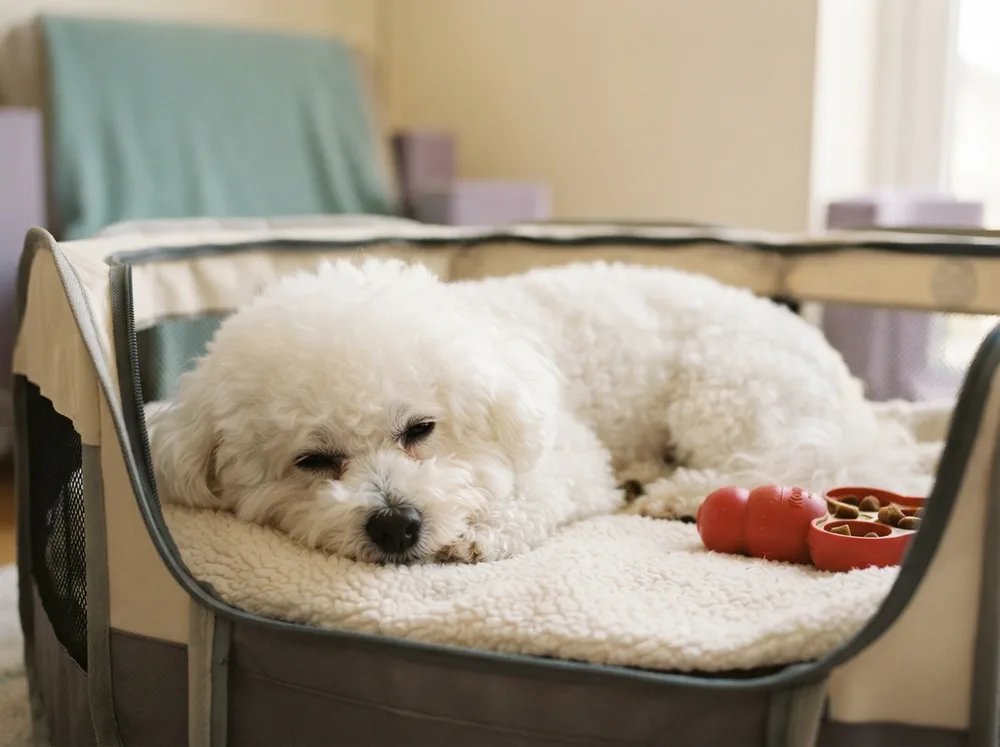
Give the dog one safe space, a comfortable playpen or open crate with water, a bed and that special toy, and never use it for punishment. Then follow the gradual departures below, starting the week your puppy comes home. Move to the next stage only when the current one is genuinely dull for the dog. If a stage triggers distress, you have gone too fast: drop back a level and slow down. Our first week home guide sets up the playpen this schedule needs.
| Stage | What to practise |
|---|---|
| 1. Days 1 to 3 | Reward your puppy for settling in its playpen while you stay in the room. Step out of sight for a few seconds, return calmly, and repeat. |
| 2. Days 4 to 7 | Leave the room for one to five minutes with a food puzzle in the pen. Handle the departure cues at random times without actually leaving. |
| 3. Week 2 | Build to fifteen to thirty minutes out of the flat. Keep every arrival and departure low-key and undramatic. |
| 4. Weeks 3 to 4 | Extend toward one to two hours, only as long as the dog stays relaxed. Add a real midday break for the longest days. |
| 5. Month 2 onward | Reach a normal working stretch in steps, backed by a midday walker or doggy daycare so the dog is never alone the whole day at once. |
A realistic weekday for a full-time-work household
Training builds the skill; your weekday timetable has to give the dog a life around it. Be honest about the number that matters most, the hours your flat sits empty in a row. As a rough welfare guide, many trainers and the RSPCA suggest an adult dog should not be left alone longer than about four hours at a stretch, and a puppy far less. A nine-hour workday does not rule out a Bichon, but it does mean the day cannot be one unbroken block of alone-time.
Break it up. A brisk walk before work takes the edge off, and a tired dog rests better. In the middle of the day, a midday walker or a few days of doggy daycare turns one impossible nine-hour stretch into two manageable halves, and Singapore has plenty of both within an estate. A pet camera lets you check in, confirm the dog is settled rather than screaming, and catch a problem early. And enrichment, rotated food puzzles, a snuffle mat, a frozen treat, gives the mind something to do besides miss you. None of this is exotic; it is just a plan, and it is the difference between a Bichon that copes and one that suffers.
~4 hrs
Rough max alone at a stretch (RSPCA guide)
Midday
Walker or daycare splits the day in two
2 × 20 min
Daily walks most Bichons want
Week 1
When alone-time training should start
What not to do, however tempting
Half of getting this right is not making it worse, and a few common instincts do exactly that. The biggest is punishment. Coming home to a chewed door or a puddle and scolding the dog teaches it nothing about being alone, because it cannot connect your anger to something it did hours ago; all it learns is that your return is frightening, which deepens the anxiety. There is nothing to punish here anyway, only distress to treat.
The second mistake is the dramatic goodbye and the ecstatic hello. Long, emotional farewells and huge reunions make your comings and goings feel enormous, exactly the opposite of the calm, boring non-event you are trying to build. Keep both low-key. And do not flood a brand-new puppy with a full nine-hour day in week one and hope it adapts; that is not training, it is sink-or-swim, and this breed sinks. A note on close quarters: in an HDB flat your neighbours share a wall and a corridor with the fallout, so a barking, anxious dog is a neighbour problem as much as a welfare one. Our Bichon barking guide handles the corridor side.
Four things that make Bichon separation anxiety worse
- Punishing the dog for barking, chewing or accidents that happened while you were out
- Long, emotional goodbyes and over-the-top reunions that inflate every departure
- Throwing a new puppy straight into a full workday alone with no build-up
- Getting a second dog as a quick fix, which often just gives you two anxious dogs
When it is beyond training, and you need help
Most Bichons, given this plan from the start, learn to handle a working day without drama. But separation anxiety runs on a spectrum, and a minority of dogs, especially those who learned to panic before you ever met them, do not improve on alone-time training alone. If weeks of patient work bring no progress, if the dog injures itself trying to escape the crate, or if the panic is so total it refuses even the food puzzle, that is not a failure of effort. It is a sign to bring in help rather than push harder.
Start with your vet, who can rule out a medical cause and, in the harder cases, discuss calming supplements or short-term anti-anxiety medication that lowers the panic enough for training to work. For entrenched cases, an accredited veterinary behaviourist or a qualified positive-reinforcement trainer can build a bespoke desensitisation programme. Medication is not a shortcut or a defeat; used alongside the plan, it is sometimes the thing that makes the plan possible. Every Curious Tails puppy also comes with a free first training lesson with an AVS-certified trainer, timed for week one precisely so good alone-time habits start while they are easy.
Signs it is time to call a professional
- Weeks of consistent training with no improvement at all
- The dog hurts itself trying to escape the crate or playpen
- Panic so severe it will not touch even a high-value treat
- Non-stop howling that continues the entire time you are out
- Your vet as the first call, to rule out a medical cause
- A veterinary behaviourist for entrenched, severe cases
The honest part: some homes should wait
We will finish where our screening starts, with the honest question we ask before any reservation: how many hours will this puppy be alone on a normal weekday, and what is the plan for them? There is no wrong answer, only answers that need a plan and answers that need a rethink. A work-from-home household barely needs this page. A household out ten hours a day with no midday cover, no doggy daycare budget and no appetite for the training simply is not ready for a velcro dog today, and a Bichon placed into that day will suffer, and so will the neighbours through the wall.
That is not a sales pitch, it is the opposite of one. We would rather lose a sale than place a Bichon into a life that makes it miserable, which is why we sometimes ask a buyer to fix the day-structure first, or wait, or occasionally choose a more independent breed. If your household is out all day but willing to build the plan on this page, a Bichon can absolutely thrive, and we will help you set it up. Tell us your real weekday on the puppies page or on WhatsApp, and we will tell you honestly how a Bichon fits before a single deposit changes hands.
The kindest thing an honest shop can do is say when a schedule is not ready for this breed. A plan built from week one is the difference; hoping the dog will just cope is not a plan.
Keep exploring
Frequently asked questions
How long can I leave a Bichon Frise alone during the workday?
As a welfare rule of thumb, many trainers and the RSPCA suggest no more than about four hours alone at a stretch for an adult dog, and much less for a puppy. A Bichon is a velcro dog, so it feels long absences harder than most. A nine-hour workday is still workable, but only if you break it up with a midday walker or doggy daycare and build alone-time slowly from week one, rather than leaving the dog in one unbroken block.
How do I start alone-time training for a new Bichon puppy?
Begin the week it comes home, in tiny doses. Give the puppy a safe playpen with a stuffed food puzzle that only appears when you leave, step out of sight for a few seconds, and return calmly. Grow the time only as fast as the puppy stays relaxed, and desensitise your departure cues, the keys, shoes and bag, by handling them at random without leaving. The full stage-by-stage schedule is in the plan above.
What is the 3-3-3 rule, and does it apply to a Bichon?
The 3-3-3 rule is a rough settling-in timeline for a new or rescue dog: about three days to decompress, three weeks to learn the routine, and three months to feel fully at home. It is useful for setting early expectations, but it is not a cure for separation anxiety. A velcro breed like the Bichon still needs deliberate alone-time training on top of simply settling in.
Will getting a second dog fix my Bichon’s separation anxiety?
Usually not. Separation anxiety in a Bichon is about the bond with its people, not simply about being alone in a room, so a second dog often just means two dogs that fret when you leave rather than one. Occasionally company helps a little, but it is never a reliable fix and it doubles the commitment. Build the training plan first; do not adopt a second dog as a shortcut.
Is it cruel to leave a Bichon with separation anxiety alone all day?
Leaving a genuinely anxious dog to panic alone for nine hours, day after day, with no plan, is hard on the dog and usually on the neighbours too. But owning a Bichon while working full time is not cruel in itself. The honest line is the plan: with a midday break, enrichment and alone-time training built from week one, a working household can do right by a Bichon. Without any of that, the schedule needs to change before the dog arrives.
When should I see a vet or behaviourist about my Bichon?
See your vet if weeks of patient training bring no improvement, if the dog hurts itself trying to escape, or if the panic is so total it refuses even a high-value treat. Your vet can rule out medical causes and, in harder cases, discuss calming supplements or short-term medication that lowers the panic enough for training to work. For entrenched cases, ask for a referral to an accredited veterinary behaviourist.
Meet your Bichon
Come say hello at Balestier
2 Balestier Road #01-701, Singapore 320002 · Weekdays 12pm–6pm · Weekends 10am–6pm. Or message us first: tell us about your home and routine, and we'll tell you honestly if a Bichon fits.
Out all day, but willing to build the plan?
Tell us your real weekday and we will say honestly whether a Bichon fits it, and how to set the plan up. Every puppy is screened for exactly this before any reservation.
See available puppies