House training, told straight
Potty Training the Stubborn Small Dog
The small dog with the big stubborn streak is genuinely slower to house train than the internet admits. Here is the calm, HDB-flat method we hand every new owner: a fixed pee tray, a schedule keyed to the puppy, kind crate work, and not one word of punishment.
Nelson and Kim, Curious Tails · AVS licence AS24J00046
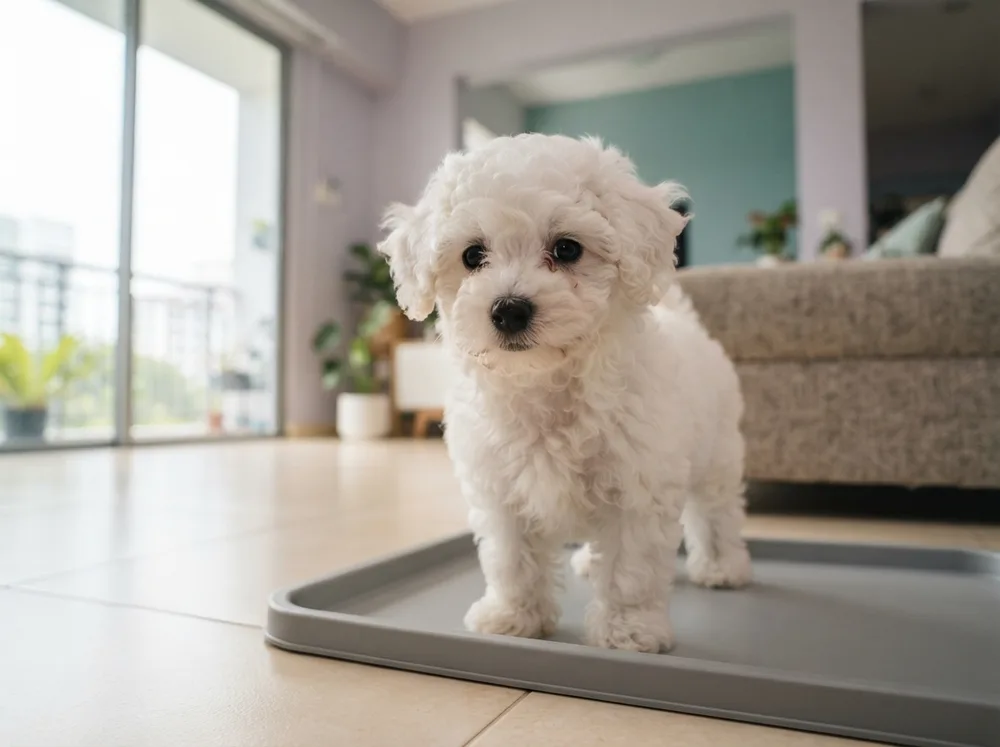
Can you potty train a Bichon Frise, and how long does it take?
Yes, you can fully potty train a Bichon, but plan for months, not weeks: a toy-breed small bladder and a real stubborn streak make the breed slow to house train. The method that works in an HDB flat is a fixed pee tray, a tight potty schedule, kind crate training, and zero punishment.
Pee trays, patience, and a Singapore flat
Why Bichons are slow to housebreak
Let’s start with the reassurance, because you probably arrived here mid-mop and mildly despairing. If your Bichon is still having accidents at four or five months old, you have not failed, and neither has the puppy. The bichon frise potty training curve is genuinely longer than the big-dog curve, for two honest reasons that stack on top of each other, and once you understand both you can stop taking the puddles personally and start working with the biology instead of against it.
The first reason is plumbing. A Bichon is a toy dog with a toy-sized small bladder, and a young puppy simply cannot hold on the way a Labrador can. As a rough guide, an eight-week-old holds for under an hour while it is awake and pottering about, stretching to perhaps ninety minutes by three months, and the tank only grows as the puppy does. Ask for more than the bladder can give and an accident is not disobedience, it is physics. This is why house training a small breed is a game of frequency first and everything else second.
The second reason is temperament, and this is where the Bichon earns its reputation. Under all that cheerful fluff sits a real stubborn streak, and a Bichon that has decided the cool tiled floor is perfectly acceptable, or that a rainy corridor is beneath it, will hold that opinion with quiet conviction. The breed is clever and food-motivated, which is your lever, but it is not biddable in the eager-to-obey way a working dog is. Housebreaking therefore rewards patience and routine over cleverness, and it punishes shortcuts. None of this is a reason to pick a different puppy. It is simply the job description, and it is very doable.
A small bladder plus a stubborn streak means months, not weeks. Read every early accident as information about your schedule, never as defiance from your dog.
The setup for an HDB flat with no garden
Here is the part no overseas guide will tell you, because most of them quietly assume a back door and a garden. In a Singapore HDB flat there is no yard to send the puppy into, so your very first decision is where the toilet actually lives, and then you commit to it hard. You have three sensible options, and the golden rule is to pick one and only one, because a puppy allowed to go in several places learns nothing except that everywhere is fair game.
Option one is a pee tray or dog toilet with a washable pad or a real turf topper, tucked on the service balcony or in the bathroom. It is the most popular flat setup for good reason: it works in a downpour, it survives a nine-hour workday, and it wipes clean in seconds. Option two is a patch of indoor grass, the real or artificial turf trays many Singapore owners swear by, which also eases a later switch to grass outdoors. Option three is fully outdoors at a fixed toilet spot downstairs, which is lovely for exercise but hostage to lifts, weather and your puppy’s pre-vaccination timeline. Most families run the tray first and add outdoor trips as the puppy matures.
Whichever you choose, zone the space with a playpen. A puppy given the run of a whole flat cannot yet tell the living room from the toilet, so you shrink the world down: a pen with the bed and water at one end and the pee tray at the far end teaches the puppy to step away from its sleeping spot to relieve itself, which is the exact instinct the whole method is built on. As the accidents fade, the pen grows, and only then does the flat open up room by room.
Your HDB-flat potty station
- Pick ONE toilet: pee tray, indoor grass, or a fixed spot downstairs
- Playpen-zone it: bed and water at one end, tray at the far end
- A service balcony or bathroom suits a pee tray best
- Keep the tray well away from the food and sleeping area
- Same tray, same place, every single time for weeks
- Widen the pen only as the accidents fade
The schedule: after sleep, food and play
Potty training a small-bladdered puppy is really just a timing exercise, so the schedule is the heart of the whole method. There are two kinds of moment when a Bichon needs to go: the predictable triggers, and the clock. Nail both and accidents drop away almost on their own, because you are simply getting the puppy to the right place before the bladder makes its own decision.
The triggers are the easy wins. A puppy almost always needs to relieve itself the instant it wakes from any sleep, within a few minutes of finishing a meal or a drink, and right after a burst of play or excitement. Carry it, or briskly walk it, to the tray at every one of these moments without waiting to see if it looks fidgety. On top of the triggers, run a timed potty schedule: offer the tray every hour or so for a tiny puppy, then stretch the interval by roughly fifteen minutes for each month of age as the small bladder grows. The table below is the starting rhythm we hand new owners.
Write your version on a sticky note for the first fortnight, because the household member who forgets the after-nap trip is usually the same one who mutters that the puppy “just will not learn.” It is learning perfectly; it is the humans who need the reminder. Consistency from every adult in the flat is worth more than any clever trick you will read online.
| When | What to do |
|---|---|
| The moment it wakes | Straight to the pee tray before anything else, after every nap and every morning. |
| After a meal or drink | To the tray within five to fifteen minutes; a full tummy presses on the bladder. |
| After play or excitement | A quick trip the second the zoomies end, before the puppy settles down. |
| On the clock | Every 60 to 90 minutes for an 8 to 12 week puppy, widening as it grows. |
| Last thing at night | A final tray visit right before bed to buy the longest dry stretch. |
| Overnight | Expect one or two wakes for a young puppy; the bladder cannot yet last till dawn. |
Reward every win, and never punish a mistake
The mechanism that actually teaches a Bichon is positive reinforcement, and the timing is everything. The instant, and it must be the instant, your puppy finishes going in the right place, mark it with a bright word and deliver a small, delicious reward. Because the breed is so food-motivated, that treat does most of the teaching for you: three seconds of chicken beats three minutes of praise, and a treat given at the tray beats one given back on the sofa, where the puppy will decide it is being paid for walking, not for weeing.
Just as important is the rule you must never break: never punish an accident. Rubbing a Bichon’s nose in a puddle, scolding it, or dragging it to the mess teaches this sensitive, people-pleasing breed one lesson only, that going to the toilet near you is dangerous, so it quietly learns to hide behind the sofa to pee instead. That is how a fixable timing problem hardens into a genuine behaviour problem. If you catch the puppy mid-accident, do not shout: make a soft noise, scoop it to the tray, and reward wildly if it finishes there. If you find a cold puddle after the fact, the only correct response is to clean it silently and resolve to watch the clock more closely.
The one rule you never break
Never punish a potty accident, not with a raised voice and never with the old nose-rubbing myth. A Bichon is soft and food-motivated, so punishment only teaches it to hide where it goes. Reward the right spot the instant it happens, ignore the wrong one, and the habit forms far faster.
Crate training basics, done kindly
Crate training sounds harsh to a lot of Singapore owners, who picture a cage, but done kindly it is one of the gentlest tools you have, and it leans on the very same instinct as the playpen: a dog works hard not to soil the cosy spot where it sleeps. A correctly sized crate becomes the puppy’s den for naps and overnight, which means it holds on a little longer and hands you a clean, predictable start to every potty trip, straight from crate to tray.
Size is the whole trick. The crate should be just big enough for the puppy to stand, turn around and lie down, and no bigger, because a crate roomy enough to sleep at one end and toilet at the other defeats its own purpose. Buy for the adult size and block off the excess with a divider while the puppy is small. Never use the crate as a punishment, never shut a young puppy in it longer than its small bladder can manage, and remember that the Bichon is a velcro breed: a crate must never become the place it is abandoned for a full working day, which loops straight into separation anxiety. Paired with the playpen, the crate handles the night while the pen handles the day.
Crate sizing, done kindly
- Just big enough to stand, turn around and lie down, no more
- Buy adult-size, then block the excess with a divider
- A den for naps and night, then straight to the tray on waking
- Never a punishment, never a full-workday holding pen
- A young puppy still needs one or two overnight tray trips
- Pair it with the playpen: crate by night, pen by day
Troubleshooting regressions and marking
Almost every owner hits a wobble around four to six months, when a puppy that seemed nearly trained suddenly backslides. This regression is normal and usually has a findable cause: a growth spurt, a change in routine, a moved pee tray, a house move, or simply the pen being opened up too soon. Treat it as feedback, not failure. Shrink the world back down for a week or two, tighten the potty schedule, return to rewarding every single success, and the habit almost always re-sets. And clean every accident with an enzyme cleaner, never an ammonia-based one, because ammonia smells like urine to a dog and quietly invites a repeat performance at the same toilet spot.
Two special cases deserve a mention. The first is marking, the small deliberate leg-cocked squirts an intact male may start leaving around eight months as hormones arrive; sterilisation often reduces it, and until then the same calm management and never-punish rule apply. The second is medical. A house-trained Bichon that suddenly starts peeing everywhere, or one straining, drinking or urinating far more than usual, may have a urinary tract infection or another health issue, and that is a vet question, not a training one. When in doubt, rule out the body before you blame the behaviour.
When it is a vet visit, not a training problem
- Sudden peeing everywhere in a previously clean, trained dog
- Straining, frequent tiny wees, or any blood in the urine
- A big jump in how much the dog drinks or how much it urinates
- These point to a possible infection or illness: see a vet before more training
The realistic timeline: months of consistency
So how long does all this take? Longer than the internet’s cheerful headlines promise, and that honesty is the kindest thing we can offer you. With a consistent schedule, a committed household and zero punishment, most Bichons are reliably clean in the flat by around five to six months, with the odd accident tapering off for a while after that. A few take until closer to their first birthday to be truly bulletproof, especially in a busy home, and that is still squarely within normal.
The single biggest predictor of success is not the puppy’s cleverness or even the tools, it is whether every adult in the flat holds the same line for longer than feels necessary. Keep the routine going a full month past the point you think you are done, and you lock the habit in for life. This is exactly why every Curious Tails puppy goes home with a playpen setup and a free AVS-certified first training lesson, so the bichon frise potty training routine starts correctly in week one, when it matters most. Message us on WhatsApp at any point in the journey; we have walked dozens of Balestier families through these exact wobbles, and we are happy to walk you through yours.
< 1 hr
Bladder hold at 8 weeks, awake
60–90 min
Timed tray interval, young pup
5–6 mo
Typically reliably clean
Months
Of consistency, not weeks
Keep exploring
Frequently asked questions
Is it hard to potty train a Bichon Frise?
It is slower than average rather than truly hard. Two things stack up: a toy-breed small bladder that cannot hold on for long, and a real stubborn streak that makes the Bichon hold opinions about rainy walks and cool floors. With a fixed toilet spot, a tight schedule and instant rewards, most are reliably clean by five to six months. Consistency, not cleverness, is what gets you there, and punishment only sets you back.
How long does it take to potty train a Bichon Frise?
Plan for months, not weeks. With a consistent schedule and zero punishment, most Bichons are reliably clean in the flat by around five to six months, with the occasional accident tapering off after that. A few take until closer to their first birthday to be truly bulletproof, especially in a busy home. The biggest predictor is whether every adult in the household holds the same routine for longer than feels necessary.
Should I use a pee tray or take my Bichon outside in an HDB flat?
Either works, but pick one and commit. A pee tray or indoor grass patch on the service balcony or in the bathroom is the practical choice for flat life: it works in a downpour, survives a nine-hour workday and needs no lift trip. Outdoors at a fixed spot is great once your puppy is fully vaccinated. The mistake to avoid is allowing both with no clear rule, which keeps a puppy confused for months.
How often does a Bichon puppy need to pee?
Often. An eight-week-old holds for under an hour while awake, stretching to about ninety minutes by three months, so offer the pee tray every 60 to 90 minutes at first and widen the interval by roughly fifteen minutes per month of age. On top of the clock, take the puppy to the tray the moment it wakes, within minutes of a meal or drink, and right after any play. Getting there first is the whole game.
Should I ever punish my Bichon for accidents?
No, never. The Bichon is a soft, people-pleasing, food-motivated breed, so scolding or the old nose-rubbing trick only teaches it that toileting near you is dangerous, which makes it hide to pee and turns a timing problem into a behaviour problem. If you catch an accident happening, make a soft noise and whisk the puppy to the tray, then reward. If you find it later, clean it silently with an enzyme cleaner and watch the clock more closely next time.
Why has my potty-trained Bichon started peeing indoors again?
A regression around four to six months is normal and usually has a cause: a growth spurt, a routine change, a moved tray or too much freedom too soon. Shrink the space back down, tighten the schedule and reward every success, and it re-sets. Two things to rule out: an intact male may begin marking around eight months, which sterilisation often eases, and sudden peeing everywhere with straining or heavy drinking can be a urinary infection that needs a vet, not more training.
Meet your Bichon
Come say hello at Balestier
2 Balestier Road #01-701, Singapore 320002 · Weekdays 12pm–6pm · Weekends 10am–6pm. Or message us first: tell us about your home and routine, and we'll tell you honestly if a Bichon fits.
Starting from day one?
Every Curious Tails Bichon goes home with a playpen setup and a free AVS-certified first training lesson, so the potty routine starts right in week one. Tell us your flat layout on WhatsApp and we will help you place the tray.
Meet our puppies