The first seven days
Your Bichon Puppy First Week Home
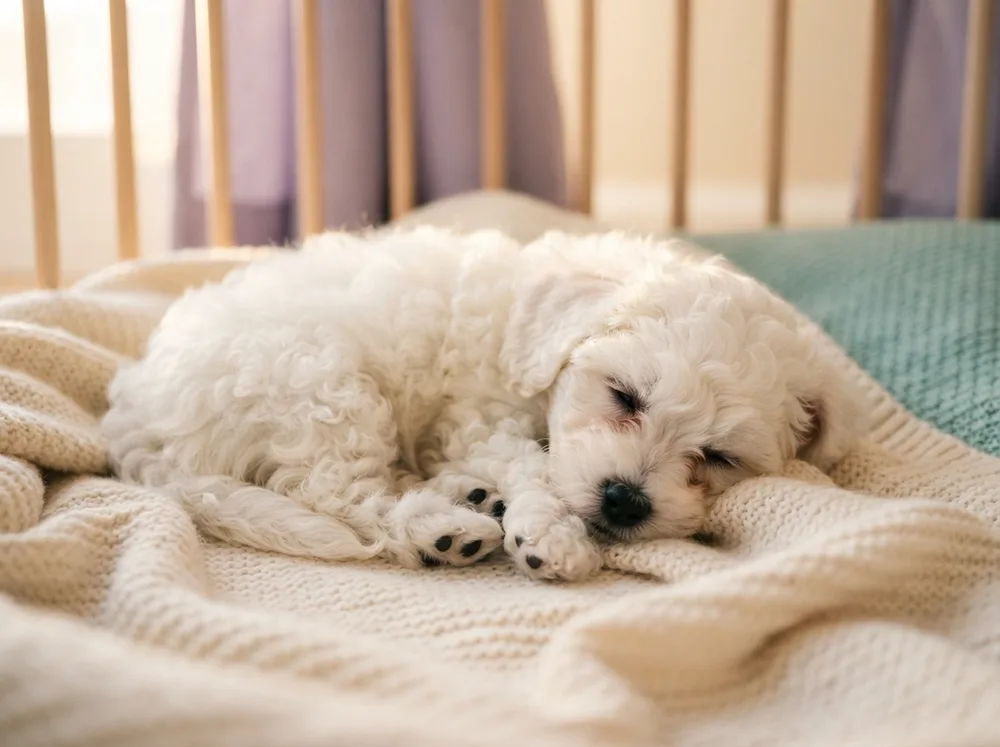
The first seven days shape the years that follow, so the goal is calm, not perfection. Here is the gentle, HDB-flat plan we hand every family who takes a Bichon home from us: a quiet playpen base, a predictable routine, and patience with the wobbles that always come.
Nelson and Kim, Curious Tails · AVS licence AS24J00046
What should I do in my Bichon puppy’s first week home?
Keep it calm. A Bichon puppy’s first week home sets the tone for years, so give it a quiet playpen base, a gentle routine, and start potty training and short alone-time from day one. Expect small settling wobbles, a little soft stool or crying at night, and meet them with patience rather than panic.
The first seven days, made calm
Before the carrier opens: setting up week one
The calm first week is mostly won before your Bichon ever arrives, in the quiet half hour you spend setting the flat up. The single most useful thing you can build is a base camp: one defined corner of the living room that becomes the puppy’s whole world for the first days, ringed by a playpen. Inside it goes a soft bed at one end, water, and a pee tray at the far end, the exact layout that teaches a puppy to step away from where it sleeps to relieve itself. A Bichon given the run of a whole HDB flat on day one is not free, it is overwhelmed, and an overwhelmed puppy settles slower and toilets everywhere.
This is the part we take off your plate. Every Curious Tails Bichon goes home around week 9 with free delivery and a playpen set up in your home, plus a 30-item starter kit, so the base camp is standing before the puppy walks into it rather than being assembled around a frightened dog at nine at night. If you are preparing your own space instead, the checklist beside this paragraph is the whole kit. Get these few things in place, puppy-proof the trailing cables and slipper-sized hazards, keep the same food the puppy already eats to spare its stomach, and you are ready for the carrier to open.
Your week-one base camp
- A playpen around one quiet corner, not the run of the flat
- Soft bed and water at one end, pee tray at the far end
- A crate or covered den inside the pen for naps and night
- The same puppy food it already eats, to avoid a tummy upset
- Cables, shoes and small swallowable objects cleared away
- From us: free delivery, playpen setup and a 30-item starter kit
Day one: a calm arrival, not a welcome party
It is tempting to gather the family and the neighbours to meet the new arrival, and it is one of the kindest mistakes you can make. Your puppy has just left its mother, its littermates and the only home it has known, all in one car ride. What a new puppy needs on day one is quiet, not a crowd. Bring it straight to the pee tray when you walk in, let it explore the base camp at its own pace, and keep voices low and hands gentle. The excited introductions can wait a few days, and the puppy will be far more fun to introduce once it is not trembling behind the water bowl.
Then comes the first night, the part new owners dread and ask us about most. Expect some crying. A puppy alone in the dark in a strange place will protest, and on the first night or two that is normal settling in, not a training failure and not a sign you chose the wrong dog. Put the crate or covered den where the puppy can sense you: beside your bed is perfectly fine for the first nights, so it is not utterly alone. A warm safe den, a soft toy, one last toilet trip before lights out, and a calm hand settle most Bichons within a night or two. What you are teaching, quietly, is that night-time is safe and boring.
Your puppy has just lost its mother, its littermates and its whole world in a single car ride. On day one it needs a quiet corner and a calm hand, not a crowd of visitors.
The gentle routine that settles a Bichon
Puppies settle fastest when the day is predictable, so the heart of week one is a simple repeating rhythm. A Bichon coming home around week 9 is usually on a feeding schedule of three to four small meals a day, given at the same times and in the same spot, which also makes toilet timing predictable, because what goes in on a schedule comes out on a schedule. Between meals the day is a loop of the same four things: potty, a little play, a little handling, then sleep, and a great deal of sleep, because a puppy this age needs close to eighteen hours of it and a tired puppy is a fractious one.
Potty training starts on day one, not in week three. Take the puppy to the pee tray the moment it wakes, within a few minutes of every meal, and after each burst of play, and reward it warmly the instant it goes in the right place. Our Bichon potty training guide lays out the full HDB-flat method, tray placement and schedule and all, but the first week is simply about starting the habit gently and never punishing an accident. Keep the playpen zoned as described above, and let the flat open up one room at a time, only as the puppy earns it.
| Part of the day | What it looks like |
|---|---|
| On waking | Straight to the pee tray, then a small meal and fresh water. Every nap ends with a toilet trip. |
| After meals | A few minutes of gentle play, then back to the tray. A full tummy soon presses on a small bladder. |
| Through the day | Short bursts of play and handling wrapped around long naps. Let a sleeping puppy sleep. |
| Early evening | The liveliest window: a little training, calm socialisation at home, a first taste of alone-time. |
| Bedtime | A last toilet trip, lights low, the den beside you. Expect one or two overnight wakes at first. |
Alone-time, starting from the very first week
Here is the section most first-week guides skip, and the one that matters most for this particular breed. The Bichon Frise is a velcro dog, bred over centuries to be glued to its people, which is the whole charm of it and also its one real risk: separation anxiety is the behaviour problem this cheerful breed struggles with most. The trap is quiet and easy to fall into. A brand-new puppy is so small and so easy to carry everywhere and cuddle constantly that it never learns being alone is safe, and then the first solo workday, weeks later, lands as a shock it has no skills for.
So you build alone-time as a skill from week one, in tiny, boring doses. While you are at home, let the puppy settle in its pen with a stuffed food toy and step out of sight for a few seconds, then a minute, then five, always returning calmly before it works itself into a panic. Keep goodbyes and hellos low-key so your comings and goings feel like nothing worth worrying about. Our separation anxiety plan gives the full stage-by-stage schedule, and the free first training lesson every Curious Tails puppy comes with is timed for week one precisely so these habits start while they are easy. Do not throw a new puppy into a nine-hour day alone and hope it copes; this breed does not do sink-or-swim.
Week 1
When alone-time practice should begin
Seconds
The length of the very first departures
~18 hrs
Sleep a week-9 puppy needs a day
Low-key
Every goodbye and hello, on purpose
Normal settling wobbles, and when to call the vet
A puppy’s body and its nerves are both adjusting in the first week, so a few wobbles are not merely normal, they are expected. Soft stool is common in the first days, usually from the stress of the move and the general excitement, and it firms up as the routine steadies and you keep the food consistent. A shy appetite on day one is normal too: a nervous puppy often eats little at first and comes right within a day or two once it feels safe. And the crying at night we have already met is part of the same picture. None of these, on their own and improving day by day, is any cause for alarm.
What you are watching for is the difference between settling and being unwell, and with a small toy-breed puppy it genuinely pays to know the line, because little dogs can go downhill faster than big ones. The panel below sorts the ordinary from the worrying. When something crosses into the right-hand column, do not wait it out overnight, call your vet. And for the small panics that are not emergencies, the first soft stool, the first refused meal, the first thunderstorm, you also have our care advice line: every family we place keeps our number for exactly these moments, alongside the 5-day bring-back promise if the match itself turns out to be wrong for your home.
Normal settling vs a reason to call the vet
- Normal: soft stool for a day or two that is steadily improving as the routine settles
- Normal: a shy appetite on the first day that picks up within a day or two
- Normal: crying the first night or two that eases as the den starts to feel safe
- Call the vet: watery diarrhoea or vomiting that repeats, or any blood in it
- Call the vet: refusing all food and water, or a limp, cold or very floppy puppy
- Call the vet: a small puppy that turns weak or wobbly, which can signal low blood sugar
Gentle socialisation and the first grooming handling
Week one is early, but it sits right inside the window when new sights and sounds register as normal rather than frightening, so a little gentle socialisation now pays off for the whole life ahead. Keep it low-key and positive: let the puppy notice the vacuum cleaner, the doorbell, the hairdryer and different floor surfaces at its own pace, each one paired with calm praise and a treat so it decides the world is interesting, not scary. One important Singapore caveat: your puppy comes home around week 9 with its early vaccinations done but the week 12 booster still to come, so keep it off communal grass and away from unknown dogs until your vet gives the all-clear. For now, socialise the world you can safely bring to it, indoors and in your arms.
The other habit to start early is handling, because the Bichon is a coated breed that will be brushed and groomed every few weeks for the rest of its life. Make that future easy by touching the puppy all over now, gently and briefly, a few seconds at a time: hold each paw, stroke the ears, look in the mouth, run a soft brush over the coat, and pay every small cooperation with a treat. A puppy that learns in its first week that being handled means good things becomes the dog that stands calmly on the grooming table at six months, instead of the one who dreads it. The checklist beside this paragraph is exactly where to begin.
Gentle handling to start in week one
- Hold each paw for a second, then treat
- Stroke the ears and gently look in the mouth, then treat
- Run a soft brush over the coat for a few strokes
- Introduce home sounds: vacuum, doorbell, hairdryer, from a distance
- Meet new floor surfaces and the lift calmly, carried in your arms
- Keep off communal grass until the week 12 booster is done
Your Bichon’s first seven days at a glance
If you remember nothing else, remember that calm and consistency win the first week, and that everything hard about it is temporary. Below is the whole seven days in a single glance: not a rigid script to obey, but the shape of a week that sets a Bichon up to thrive. Print it, stick it on the fridge, and let every adult in the flat work from the same page, because a puppy given one clear, gentle routine by everyone settles far faster than one given six different kind ones that quietly contradict each other.
And if a wobble throws you off the plan, that is fine, the plan bends. The goal of week one is not a perfectly behaved dog, it is a puppy that is beginning to trust its new home, its new people and its new routine. Get that much, and every bit of training that follows has firm ground to stand on. Message us on WhatsApp at any point in the week: we have walked many Balestier families through exactly these seven days, and we would far rather answer a small question early than watch it grow into a large one.
| Days | What to focus on |
|---|---|
| Day 1 | A calm arrival, the pee tray, the base camp, and a gentle first night beside you. No visitors yet. |
| Days 2 to 3 | Lock in the feeding and toilet rhythm. Let the puppy sleep. Keep the world small and quiet. |
| Days 4 to 5 | Start seconds of alone-time and gentle handling. Introduce home sounds from a distance. |
| Days 6 to 7 | Widen the routine a little, invite calm visitors, and book the week 12 vaccination booster. |
Keep exploring
Frequently asked questions
Where should my Bichon puppy sleep on the first night?
In its crate or covered den, placed where it can sense you: right beside your bed is ideal for the first nights. A Bichon is a companion breed, so being able to hear and smell you keeps the panic down while it learns that night-time is safe. Add a soft toy, do a final toilet trip before lights out, and keep any night-time settling calm and low-key. In a week or two you can move the den to its permanent spot.
Is it normal for a new Bichon puppy to have soft stool or not eat much at first?
Yes, both are common in the first days and usually settle on their own. Soft stool typically comes from the stress of the move and the excitement, and firms up as the routine steadies and you keep the food consistent. A shy appetite on day one is normal too, as a nervous puppy often eats little until it feels safe. What is not normal is repeated vomiting or watery diarrhoea, blood, or refusing all food and water: those mean call your vet, not wait it out.
Should I let my Bichon puppy cry at night, or comfort it?
A night or two of crying at night is normal settling for any new puppy and it passes. The kind middle path is to keep the den close, beside your bed, so the puppy is reassured by your presence without being picked up every time it whimpers, which can accidentally teach it that noise summons you. Take it out if it genuinely needs the toilet, but keep everything calm, quiet and boring. Most Bichons settle within a couple of nights this way.
When should I start potty training and alone-time in the first week?
Both on day one, gently. Take the puppy to the pee tray the moment it wakes, after every meal and after play, and reward the instant it goes in the right place. Start alone-time the same week in tiny doses: step out of sight for seconds while it settles in its pen, then slowly build up. Starting both early, while habits are still forming, is far easier than fixing them later, and it heads off the separation anxiety this velcro breed is prone to.
How old is a Bichon puppy when it comes home, and what comes with it?
Our Bichons go home around week 9, once the early vaccinations, deworming, a vet health check and a microchip are done, with the week 12 booster to follow. Each one comes with free delivery and a playpen set up in your home, a 30-item starter kit, a free first training lesson with an AVS-certified trainer timed for week one, a care advice line for the small worries, and a 5-day bring-back promise. The idea is that your first week starts calm and fully equipped.
Can I take my new Bichon puppy out to meet other dogs in week one?
Not onto communal grass or up to unknown dogs yet. Your puppy comes home around week 9 with its first vaccinations done but the week 12 booster still to come, so its immunity is not complete and public ground carries risk. You can still socialise safely: introduce home sounds and surfaces, carry it to see the lift and the void deck in your arms, and invite a few calm, healthy, vaccinated dogs you trust to visit. Once your vet gives the all-clear, the wider world opens up.
Meet your Bichon
Come say hello at Balestier
2 Balestier Road #01-701, Singapore 320002 · Weekdays 12pm–6pm · Weekends 10am–6pm. Or message us first: tell us about your home and routine, and we'll tell you honestly if a Bichon fits.
Getting ready for week one?
Every Curious Tails Bichon goes home around week 9 with free delivery, a playpen set up in your home, a 30-item starter kit and a free first training lesson, so your first seven days start calm. Tell us your flat and your routine on WhatsApp and we will help you plan them.
Meet our puppies