The colour truth, and your scam armour
Bichon Frise Colours: White, Full Stop
White, full stop. That is the honest answer, and this guide earns it: the four white-based shades the breed standard actually allows, the cream and apricot puppy shading that fades, and why every brown, black, teacup or mini ‘Bichon’ you have been offered is a mislabelled cross or a runt at a premium.
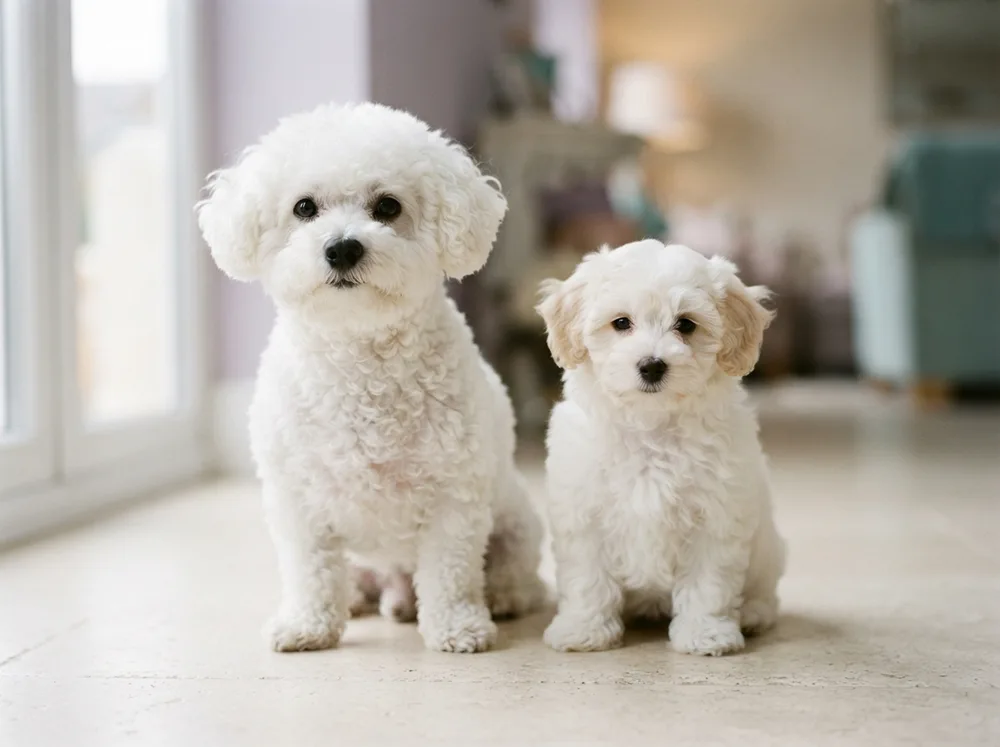
What colours do Bichon Frises come in?
A Bichon Frise is white, full stop. The breed standard allows faint cream, apricot or buff shading on a puppy coat, usually around the ears and back, and it fades as the adult coat grows in. Any brown, black or grey ‘Bichon’, or a teacup or mini one, is a mislabelled cross or a runt sold at a premium.
White, full stop · scam-armour inside
So what colour is a Bichon Frise? White, full stop
Let’s give you the whole answer in one breath: a Bichon Frise is white, full stop. Every serious breed standard says the same thing in almost the same words. The kennel-club register lists the Bichon under four coat descriptions, and every one of them starts with white: plain white, white and apricot, white and cream, and white and buff. Read those again and notice what they are not. There is no brown on the list, no black, no grey, no “chocolate” and no “rare” anything. When you type bichon frise colours (or colors) into Google and a tidy carousel shows you White, White and Apricot, White and Cream and White and Buff, that carousel is not offering four breeds to choose between. It is describing one white dog with, at most, a whisper of warmth in the coat.
Why is the standard so firm about it? Because the Bichon was bred over centuries specifically for that bright, powder-puff white coat, the halo of curls that makes the black eyes and black nose pop. A solid colour is not a fancy upgrade of that dog; it is a sign that something other than a purebred Bichon is in the mix. So this page is two things at once: an honest guide to what colour a Bichon actually is, and a set of scam armour for every “rare coloured”, teacup or mini listing you are about to meet. We have placed 30+ Bichons, all of them white, and we would far rather arm you than sell to you.
White
the whole answer
4
kennel shades, all white-based
5–8kg
one size, no teacup
30+
Bichons we have placed
The shading that is normal, and why it fades
Here is the part that trips up honest buyers, because a little colour on a Bichon really is normal. A puppy coat often carries soft cream or apricot shading, and sometimes a warmer buff, usually around the ears, across the back and at the base of the tail. Good breeders and kennel clubs expect it. The UKC breed standard puts it plainly: white is the acceptable colour, but shadings of buff, cream or apricot around the ears or on the body are acceptable too. That is exactly why the register carries white and apricot, white and cream and white and buff as legitimate descriptions rather than as faults.
The key word is shading, not colour. On a correct Bichon the tint is faint, it sits in patches rather than covering the dog, and, crucially, it fades. As the adult coat grows in over the first year, most of that cream and apricot lightens away until you are left with the bright white the breed is famous for. So a creamy puppy is not a red flag; it is often just a young Bichon whose coat has not finished arriving. What should make you pause is a dog that is solidly and evenly coloured all over, because that is no longer shading. That is a different dog wearing a Bichon’s name, which is exactly where the next section comes in.
What is normal on a Bichon puppy
- A white coat is the breed standard, always
- Faint cream, apricot or buff shading is fine
- Shading sits around the ears, back and tail base
- It fades as the adult coat grows in
- Black nose, lips, eye rims and dark round eyes
- Solid, all-over colour is not shading
A brown, black or grey “Bichon”: the honest word
Now the searches that bring a lot of people to this page: brown bichon frise, black bichon frise, grey or silver Bichon. In Singapore those exact terms are searched every month, and the honest answer is the kind a shop only gives you if it has nothing to hide. A solid brown, black or grey dog sold as a “Bichon Frise” is, almost always, a mislabelled cross. The bright white curly coat is one of the breed’s defining features, so when the colour goes solid, the parentage has changed.
Usually the other half of that cross is easy to guess. A poochon, a Bichon crossed with a Toy Poodle, can arrive apricot, brown or even black, because the Poodle brings those colours in. A shichon, a Bichon crossed with a Shih Tzu, can come in gold, brown and grey. Both can be wonderful dogs, and both are perfectly legal to keep, so this is not a lecture against crosses. It is a warning about the label. If a listing shows you a chocolate-brown puppy and calls it a purebred Bichon, you are being sold one dog under another dog’s name, often at a rare-colour markup. If a coloured coat is genuinely what you love, meet the crosses honestly first; our guide to Bichon mixes walks through the poochon, maltichon and shichon and where each colour actually comes from.
A solid brown, black or grey “Bichon” is a mislabelled cross, usually a poochon or shichon. The dog can be lovely; it is the label and the markup that are dishonest.
What a colour or size claim actually means
Because the wording on listings is designed to sound special, here is a plain decoder. Screenshot it, keep it on your phone, and hold any Bichon advert up against it before a deposit changes hands. The left column is the claim a seller makes; the right column is what it usually means once you translate the marketing back into dog.
| The claim on the listing | What it usually means |
|---|---|
| “Rare brown” or “chocolate” Bichon | A mislabelled cross, usually a poochon. A purebred Bichon is not brown. |
| “Black” or “grey” Bichon | A cross or an off-standard dog. Solid black and grey are not breed standard colours. |
| “Rare colour”, priced higher | A rare colour premium on a fault or a cross. Scarcity is being sold as a feature. |
| “Teacup”, “micro” or “super micro” Bichon | A runt or a cross. There is no teacup size, and it usually means more health problems, not fewer. |
| “Mini” or “miniature” Bichon | Marketing for a normal small Bichon, or code for a runt. The breed has one size. |
| White with faint cream or apricot puppy shading | Normal. It is breed standard and it fades to white as the adult coat comes in. |
The teacup, mini and micro myth
The size scam is the twin of the colour scam, and in Singapore it is louder. Search teacup bichon frise, mini bichon frise or “micro” and you will find local shops merchandising size tiers with a straight face, some importing “super micro” puppies and pricing them like collectors’ items. So let us be blunt: there is no teacup, mini, miniature or micro Bichon Frise. The breed comes in one size. A healthy adult Bichon weighs roughly 5 to 8kg and stands about knee height on a child, and no legitimate standard recognises anything smaller as a separate variety.
So where do the tiny ones come from? Two places, neither of them good news. Some are runts, the smallest puppy of a litter, sold at a premium precisely because they are undersized. Others are crosses with genuinely small breeds, dressed up in Bichon branding. Either way, deliberately breeding for extreme smallness tends to bring more health problems, not fewer: fragile bones, dental crowding, low blood sugar and liver trouble are all over-represented in “teacup” dogs. Paying more for a smaller Bichon usually means paying more for a sicker one. The same red-flag thinking that protects you on colour protects you here, and we lay the whole list out on our available puppies page.
A colour or size premium is a red flag, not a feature
If a seller charges more for a “rare colour”, “teacup”, “mini” or “micro” Bichon, treat that premium as a warning light. A purebred Bichon Frise is white and roughly 5 to 8kg. Anything sold as rarer or tinier is usually a runt or a mislabelled cross, and it often comes with extra vet bills. Ask for the parents, the AVS licence number and a visit before any deposit.
Keeping a white coat clean in Singapore
A white dog in a warm, humid city sounds like a laundry nightmare, and it is the first worry many buyers raise. The honest news is that a Bichon’s coat stays bright with routine, not miracles. The curls are low-shedding, which keeps loose hair off your sofa, but low-shedding coats mat if they are not brushed, and mats are where a white coat turns grey and grubby. A few minutes of line-brushing every day or two, a bath every few weeks and a professional groom every four to six weeks keeps the powder-puff looking the part. Our Bichon grooming guide covers the full routine and the Singapore salon prices.
The one cosmetic quirk to plan for is tear stains, the reddish-brown tracks that can appear under a Bichon’s eyes and show up clearly against white fur. They are mostly about moisture and the shape of the tear ducts rather than anything you did wrong, and a daily face-wipe habit keeps them faint; our note on Bichon tear stains has the gentle, vet-sensible version. None of this makes a white coat high-maintenance, exactly. It makes it honest work, the small daily tax you pay for one of the most cheerful-looking dogs on the planet.
White-coat upkeep, the short version
- Line-brush every one to two days
- Bath every few weeks, dry down to the skin
- Professional groom every 4 to 6 weeks
- A daily face-wipe keeps tear stains faint
- Low-shedding, but never brush-free
- Mats, not colour, are what dull a white coat
So, do Bichons smell?
It is one of the most-asked questions about the breed, so here is the straight version of do Bichons smell. A healthy, groomed Bichon Frise has very little natural doggy odour. This is a clean-smelling breed by reputation, one reason it suits close-quarters flat life, and the same low-shedding curly coat that keeps hair off your furniture also means less of that hair sitting around collecting smells. What a Bichon is not, and here we stay honest, is odour-proof or truly hypoallergenic; no dog is either of those things.
When a Bichon does start to smell, the coat itself is rarely the real culprit. Four things usually are. Damp ears trapped under all that fur can grow a yeasty smell, so ears need checking and drying. A coat left wet after a bath or a rainy-season walk can go musty, so dry it down to the skin. Skin folds and allergies can flare in the humidity and turn sour. And teeth, in a small breed prone to dental crowding, are the quiet offender behind a lot of “smelly dog” complaints. Fix the cause, not the symptom, and the smell goes with it. Our full guide, do Bichons smell?, walks through each cause and the simple fix, so a clean white Bichon stays as pleasant to sit beside as it looks.
Buying a genuinely white Bichon in Singapore
Put the colour truth and the size truth together and you have a simple buying rule. A real Bichon Frise is white, is roughly 5 to 8kg, carries two clear black eyes and a black nose, and shows at most a fading whisper of cream or apricot as a puppy. Anything sold as a brown, black, grey, teacup, mini or micro Bichon deserves a raised eyebrow and a few hard questions before your heart, or your deposit, gets involved.
That is exactly how we work at Curious Tails. Every Bichon we place is a purebred, powder-puff white dog, priced in one honest all-in band with no colour or size surcharge, and backed by our AVS licence AS24J00046. Because the breed is HDB-approved, item 4 on the official list, a white Bichon also fits Singapore flat life without a special appeal. Come and meet the real thing at 2 Balestier Road #01-701, or message us and tell us what you have been offered elsewhere. If a listing looks like a mislabelled cross or a runt at a rare-colour price, we will tell you honestly, even when the honest answer sends you to a different dog.
White
the only coat we stock
$3,500–$6,000
all-in, no colour surcharge
5–8kg
one true size
HDB ✓
item 4, verified
Keep exploring
Frequently asked questions
What colours do Bichon Frises come in?
One, really: white. The breed standard describes the Bichon Frise under four white-based coats, white, white and apricot, white and cream, and white and buff, and all four are still a white dog. Puppies often show faint cream or apricot shading around the ears and back, and that shading fades to bright white as the adult coat grows in. There is no brown, black, grey or “rare” Bichon colour.
Is there such a thing as a brown, black or grey Bichon Frise?
No, not as a purebred. A solid brown, black or grey dog sold as a “Bichon Frise” is almost always a mislabelled cross, usually a poochon (Bichon crossed with a Toy Poodle) or a shichon (Bichon crossed with a Shih Tzu), which inherit those colours from the other parent. The cross can be a lovely dog and is legal to keep; the dishonesty is in the “purebred Bichon” label and the rare-colour markup.
Is a white and apricot or white and cream Bichon still purebred?
Yes. White and apricot, white and cream and white and buff are all recognised, breed-standard descriptions of a purebred Bichon Frise. They simply note the faint cream, apricot or buff shading a puppy coat can carry, mostly around the ears and back. That shading is normal, it is not a “rare colour”, and it usually fades toward pure white as the dog matures.
Are teacup, mini or micro Bichon Frises real?
No. There is no teacup, mini, miniature or micro Bichon Frise; the breed has one size, roughly 5 to 8kg as an adult. A dog sold under those labels is either a runt, the undersized smallest of a litter, or a cross with a smaller breed, and it is priced at a premium as if scarcity were a feature. Breeding for extreme smallness tends to bring more health problems, not fewer.
Why do some sellers charge a premium for a rare-colour or teacup Bichon?
Because scarcity sells. A “rare” colour or a “teacup” size sounds exclusive, so a premium can be attached to it. In reality a purebred Bichon is white and about 5 to 8kg, so both claims usually describe a mislabelled cross or a runt, often one carrying extra health costs. Treat any colour or size surcharge as a warning light and ask to see the parents, the AVS licence number and the puppy in person first.
Do Bichon Frises smell?
A healthy, groomed Bichon has very little doggy odour and is considered a clean-smelling breed, which suits flat life, though no dog is odour-proof or truly hypoallergenic. When a Bichon does smell, the usual causes are damp ears under the coat, a coat left wet after a bath or walk, skin issues flaring in the humidity, or dental problems. Fixing the cause clears the smell; our dedicated guide covers each one.
Are all your Bichon Frise puppies white?
Yes, every one. We keep purebred Bichon Frises in the powder-puff white coat only, with the faint cream or apricot puppy shading photographed honestly rather than hidden or sold as special. We never list a brown, black, grey, teacup, mini or micro “Bichon”, and if a coloured cross is genuinely what suits your home, we will point you to an honest specialist. Message us at +65 8220 6408 to see who is available now.
Meet your Bichon
Come say hello at Balestier
2 Balestier Road #01-701, Singapore 320002 · Weekdays 12pm–6pm · Weekends 10am–6pm. Or message us first: tell us about your home and routine, and we'll tell you honestly if a Bichon fits.
Want to see the real thing, in real white?
Every Bichon we place is purebred, powder-puff white and HDB-approved, with no colour or size surcharge. Tell us what you have been offered elsewhere and we will give you the honest read.
See available puppies