The day-to-day, not the rulebook
Living with a Bichon in an HDB Flat
The rules say a Bichon can live in your flat. This is the part no rulebook covers: what an ordinary day actually looks like, from the morning void-deck walk to keeping the peace in a shared corridor.
Nelson and Kim, Curious Tails · AVS licence AS24J00046
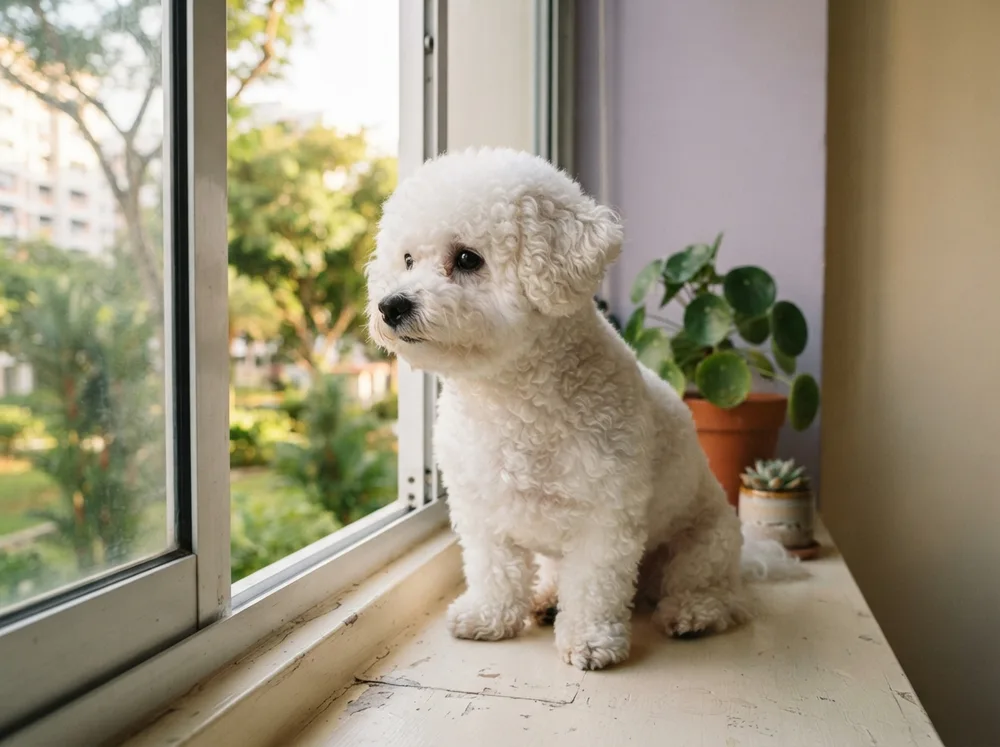
Is the Bichon Frise a good dog for HDB flat living?
The Bichon Frise is one of the best HDB dogs because its size, its low-shedding coat and its easy temperament all fit flat life. Here is the daily reality: two short void deck and park connector walks, calm lift and corridor manners, managing hair in shared air, and simply being a good neighbour in a block full of them.
Void decks, lifts and a happy flat dog
Why the Bichon is one of the best HDB dogs
The lists that rank for best HDB dogs all name the same breeds, and the Bichon Frise is on every roll of HDB-approved dogs for good reason. Three things line up. Size: a grown Bichon is a 5 to 8kg approved small breed, so a flat reads to it as plenty of room, not a cage. Coat: it is genuinely low-shedding, which matters enormously in the shared air of a home where the sofa, the bedroom and the laundry rack breathe the same sixty square metres. Temperament: it is cheerful, people-focused and quick to settle, happy indoors between short walks.
It shares the flat-dog podium with the Toy Poodle, the Maltese and the Shih Tzu, but on the three things that decide flat life the Bichon is hard to beat. This post is the lived-in companion to our Bichon and HDB rules guide, which handles the legal side; here we cover the part no rulebook does. The low-shedding point deserves one honest caveat, since we make it everywhere: no dog is hypoallergenic, and ours are not sold as one. What the coat gives you is less hair and dander adrift in a small home, and our shedding and allergy guide tells that story straight.
Why an HDB flat suits the Bichon
- 5 to 8kg: a true approved small breed
- Low-shedding coat for shared HDB air
- Happy indoors between two short walks
- People-focused and quick to settle
- Small enough to lift-share politely
- One dog per flat, and one is plenty
Daily exercise: no garden needed
The biggest myth about flat dogs is that they need a garden. A Bichon does not. What it needs is a predictable rhythm of small outings and a little indoor play, and an HDB estate is quietly perfect for it. Two short walks a day, roughly twenty minutes each, cover the exercise and most of the toileting. The void deck is your all-weather friend, sheltered from the sun and the afternoon storm, and the estate’s park connector network turns an evening stroll into a proper wander past other dogs and the smells that tire a dog out faster than distance does.
Between walks, a flat holds more play than you think. A short corridor becomes a fetch lane, a rolled towel becomes a tug toy, and a food puzzle or a scatter of kibble across a mat gives the busy little brain the work it actually craves. That mental tiring matters more than raw mileage for this breed. A Bichon that has walked, sniffed and problem-solved a little each day is a calm flatmate; one left to stew with nothing to do finds its own entertainment, usually the noisy kind. Here is a day that works.
| Time of day | What it looks like |
|---|---|
| Morning | A twenty-minute walk before the heat: out to the void deck and a loop of the block for toilet and sniffing. |
| Midday | A meal, then quiet time in the playpen with a food puzzle while the flat is busy or empty. |
| Late afternoon | Indoor play: a few minutes of training and a corridor game of fetch to burn the pre-dinner zoomies. |
| Evening | The longer walk along the park connector, cooler air, other dogs, and a proper wind-down before bed. |
Lift and corridor manners
An HDB block is shared space, and the few metres between your front door and the ground floor are where a dog either makes friends or makes enemies. Keep your Bichon on a short lead the moment you leave the flat, not a loose retractable that lets it drift into a stranger’s ankles. At the lift, wait to the side, let people out first, and read the room: some neighbours adore a small fluffy dog, others are wary of any dog at all, and a child or an elderly resident may want the next lift to themselves. A quiet “we’ll take the next one” costs you nothing and buys years of goodwill.
The corridor is the other pinch point, because sound carries between units, straight onto your neighbours’. The Bichon is not a yappy breed, but it is an alert one, and it will announce the lift chime and next door’s cat if you let the habit set. Manage it early: reward quiet, block the door gap it barks through, and never leave a lonely dog to rehearse barking all day at an empty corridor. This loops back to the breed’s one real caveat, separation anxiety: a Bichon left alone all day is the one most likely to bark, so build alone-time slowly and read our temperament guide first. The barking guide has the full corridor-friendly routine.
Good lift and corridor habits
- Short lead from the moment you step out, never a loose retractable
- Let residents exit the lift first, and stand to one side
- Offer the next lift to anyone who looks unsure
- Reward quiet in the corridor; manage the alert bark early
- Never leave the dog left alone all day to bark at the walkway
Hair and smell in a small shared space
In sixty square metres, cleanliness is not a chore you can put off, and this is where the Bichon quietly earns its keep. Because it is low-shedding, the dead hair catches in the curly coat instead of drifting onto the sofa, into the aircon and across your work clothes, so a small flat stays far cleaner than it would with a dropping breed. The catch, and we always say it, is that the trapped hair has to be brushed out, most days at home and by a groomer every four to six weeks, or it felts into mats. Low shedding is a trade, not a free pass, but in a shared space it pays you back every day.
Smell is the other small-flat worry, and the honest answer is that a well-kept Bichon does not stink. The classic doggy odour comes from skin oils, dirty ears, unbrushed teeth and a damp coat, not from the dog simply existing, so the routine that manages those four keeps a flat fresh: groom on schedule, dry the coat properly after a rainy walk, clean the ears, brush the teeth. Skip them and any dog in any home starts to smell. Keep them and a guest will not know a dog lives with you until the white cloud trots over to say hello.
In a small flat you are not just choosing a dog, you are choosing what shares your air. A low-shedding coat, brushed and groomed on schedule, is what keeps sixty square metres feeling like a home and not a kennel.
One dog per flat, and being a good neighbour
The rules are covered properly on the HDB rules page, but two of them are really about daily living, so they belong here too. The first is simple arithmetic: it is one dog per flat, counted per household, and for a velcro breed that thrives on company, one is genuinely plenty. The second is the Code of Responsible Behaviour you agree to as an HDB dog owner, which is less a legal document than a description of a considerate person: keep the dog from roaming, manage the noise, and clean up every time, in the lift, at the void deck, on the grass verge.
None of that is a burden for a Bichon household, because a thoughtful owner and a well-kept small dog meet the Code of Responsible Behaviour almost by accident. The stakes matter all the same: keeping an unapproved or extra dog breaches the HDB Animals Rules and can draw a fine of up to $4,000, which is why the one-dog, approved-breed path is the calm one. Be the owner whose dog the corridor is glad to see, and you will find a whole estate of dog people quietly on your side. Being a good neighbour is not extra work; it is most of what makes a flat dog a joy rather than a friction.
The good-neighbour checklist
- One dog per flat, counted per household
- An AVS licence before the dog moves in
- Clean up every time: lift, void deck, grass
- Manage barking so the corridor stays peaceful
- Keep the dog leashed and close in shared areas
- The Code of Responsible Behaviour, met by simply being considerate
Where a flat dog toilets
Toileting is the question every flat owner asks, and an HDB home actually gives you two workable systems. The first is fully indoors: a pee tray or pad on the service balcony or in a quiet corner, which is a genuine lifesaver on storm days, across long working hours, and in the weeks before a puppy’s vaccinations are complete. The second is outdoors: a walk down to the same patch of grass at the void deck each time, which many owners prefer once the dog is grown and the routine is set. Plenty of Bichons happily do both, an indoor tray as backup and outdoor trips as the main event.
The one thing that slows a puppy down is indecision, letting it go anywhere with no clear rule, which keeps it confused for months. Pick your system early, put the tray in one fixed spot, reward every correct performance instantly, and be patient, because a toy breed has a small bladder and the Bichon carries a mild stubborn streak. Most are reliably clean by five to six months with that consistency. The full method, tuned for a Singapore flat with no back door, is in our Bichon potty training guide.
Two toilet systems that work in a flat
- Indoor pee tray on the service balcony: ideal for storms, long hours and pre-vaccination weeks
- Outdoor trips to a fixed void-deck grass patch once the dog is grown
- Many Bichons use both: the tray as backup, walks as the main event
- Pick one clear rule early and reward the instant it goes right
Heat, humidity and a fluffy white coat
The last piece of flat life is the one owners of fluffy breeds feel most: Singapore is hot and humid all year, and an HDB corridor or lift lobby is not air-conditioned. A Bichon’s soft coat is insulation, and a white dog on black tarmac at noon heats up fast. The fix is timing, not shaving. Walk in the cool windows, early morning and after sundown, and keep midday outings short and shaded. Feel the pavement with your hand first: if it is too hot for your palm, it is too hot for paws. Watch for heavy panting, drooling or a dog that lags, and head back to the cool if you see it.
Indoors, a Bichon does not need the aircon running all day, but it does need to escape the heat: give it a cool tiled spot, shade and fresh water, and never shut it in a closed room with no airflow. The humidity has a second effect people forget: a Bichon that comes in damp from a rainy-season walk and stays damp can develop trouble in the coat folds, so towel it dry every time. Manage the heat with common sense and the tropics are no barrier at all, which is why the breed has thrived in Singapore flats for years. The flat is never the problem; only the flat that sits empty all day is, so plan those hours before the dog comes home.
Before 8am
Best morning walk window
After 7pm
The cooler evening walk
Palm test
Too hot for your hand, too hot for paws
Towel dry
After every rainy-season walk
Keep exploring
Frequently asked questions
Is a Bichon Frise a good dog for HDB flat living?
Yes, genuinely one of the best. Three things make it fit: it is a 5 to 8kg approved small breed that treats a flat as ample space, it is low-shedding so a small shared home stays clean, and it has a cheerful, adaptable temperament that is happy indoors between short walks. The Bichon Frise is item 4 on HDB’s approved list, so it is legal as well as suited. The only real caveat is that it is a velcro breed that needs company, so a flat empty all day needs an alone-time plan.
How do you exercise a Bichon in an HDB flat with no garden?
You do not need a garden. Two short walks a day of about twenty minutes each cover most of it: a morning loop of the void deck and block, and a longer evening wander along the park connector where the sniffing and dog-watching tire the brain. Between walks, a corridor fetch lane, a tug toy and a food puzzle give the mental workout this breed actually craves. A Bichon exercised this way is a calm flatmate, not a bored, barking one.
Can a Bichon Frise be left alone all day in an HDB flat?
Not comfortably without a plan, and this is the honest catch. The Bichon is a velcro breed prone to separation anxiety, so a flat that empties out for eight or nine hours with no build-up can trigger barking, howling and stress, which in a shared corridor becomes a neighbour problem too. It is very manageable: build alone-time slowly from week one, use a playpen and food puzzles, and arrange a midday break on the longest days. Read our temperament guide and separation anxiety plan before the dog comes home.
What are the lift and corridor manners for a dog in an HDB block?
Keep the dog on a short lead from the moment you leave the flat, never a loose retractable. At the lift, stand to one side, let residents exit first, and offer to take the next lift if anyone looks nervous, especially a child or elderly neighbour. In the corridor, manage the alert bark early by rewarding quiet, since sound carries between units. Clean up every time. These small habits are most of what keeps an estate happy to have a dog in the block.
Do Bichons shed and smell too much for a small flat?
The opposite, if kept well. The Bichon is low-shedding: the dead hair stays in the curly coat rather than drifting onto your sofa and into the aircon, so a small flat stays cleaner than it would with most breeds. The trade is brushing most days and a groom every four to six weeks. Smell is not inherent either; doggy odour comes from oily skin, dirty ears, unbrushed teeth and a damp coat, so the normal care routine keeps a well-kept Bichon and its flat fresh.
How do fluffy white dogs cope with Singapore heat in a non-aircon corridor?
With timing and sense, easily. Walk in the cool windows, before about 8am and after 7pm, keep midday trips short and shaded, and carry water. Use the palm test on the pavement: too hot for your hand means too hot for paws. Indoors, a cool tiled spot, shade, airflow and fresh water matter more than running the aircon all day. Towel the coat dry after any rainy-season walk, since a damp coat in the humidity can cause skin trouble. Managed this way, the tropics are no barrier at all.
Meet your Bichon
Come say hello at Balestier
2 Balestier Road #01-701, Singapore 320002 · Weekdays 12pm–6pm · Weekends 10am–6pm. Or message us first: tell us about your home and routine, and we'll tell you honestly if a Bichon fits.
Picture your flat with one in it
Every Bichon in our shop is HDB-approved, licensed and raised for flat life. Come and meet one at 2 Balestier Road #01-701, or message us first about your block, your hours and your household, and we will tell you honestly how a Bichon would fit.
See available puppies